

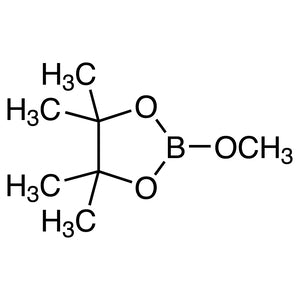
2-Methoxy-4,4,5,5-tetramethyl-1,3,2-dioxaborolane is an organoboron compound widely utilized in organic chemistry synthesis, particularly in reactions involving boron. This reagent plays a crucial role in various synthetic pathways, offering stability and reactivity that make it indispensable in modern laboratory settings. Its unique molecular structure allows it to participate in a range of transformations, making it a versatile tool for chemists working on complex molecule synthesis.
The compound is known for its chemical stability under controlled conditions, which simplifies storage and handling. Its non-corrosive nature and compatibility with a variety of reaction conditions further enhance its appeal. The ability to maintain consistent performance across different experimental setups ensures reliable results, making it a preferred choice for both academic and industrial research. Additionally, its compatibility with common solvents and reagents reduces the need for extensive purification steps, improving overall efficiency in the lab.
In Indonesian laboratories, this compound is frequently used in organic chemistry research, especially in projects focused on the synthesis of heterocyclic compounds and complex molecular structures. It is also a key component in pharmaceutical and industrial chemical research, supporting the development of new drugs and materials. Its reliability and effectiveness make it a staple in laboratories aiming for high-quality chemical synthesis and innovation.
- Organic synthesis reactions, particularly those involving boron-based coupling reactions due to its stability and reactivity.
- Suzuki and Sonogashira cross-coupling reactions, where it serves as a reliable boron source for forming carbon-carbon bonds.
- Heterocyclic compound synthesis, as its molecular structure supports the formation of complex ring systems with high efficiency.
- Pharmaceutical research, where it contributes to the development of new drug molecules through efficient synthetic pathways.
- Industrial chemical production, as it enables the creation of complex organic compounds used in various applications.
| Brand | TCI |
|---|---|
| CAS number | 1195-66-0 |
| Molecular formula | — |
| Purity | — |
| Category | Chemistry > Organometallic Reagents > Organoboron [Organometallic Reagents] |
| Pack sizes | Available in various quantities as per supplier specifications |
| Physical form | Liquid or solid, depending on supplier packaging |
| Storage | Store in a cool, dry place away from moisture and direct sunlight |
This compound should be stored in a cool, dry environment to maintain its chemical stability. It is recommended to use airtight containers to prevent exposure to moisture and air, which may affect its performance. While it is non-corrosive, it should be handled with care to avoid any potential contamination. Proper labeling of containers is essential for safe handling and easy identification. In laboratory settings, it is advisable to work in a well-ventilated area to minimize any inhalation risks. Always follow standard safety protocols when working with organoboron compounds to ensure a safe and efficient experimental process.
—
Produk Terkait
-
4,4,5,5-Tetramethyl-1,3,2-dioxaborolane TCI T2572
Regular price From Rp 1.565.550,00Regular price -
2-(Dimethylphenylsilyl)-4,4,5,5-tetramethyl-1,3,2-dioxaborolane TCI D4357
Regular price From Rp 1.908.900,00Regular price -
4,4,5,5-Tetramethyl-2-(spiro[fluorene-9,9'-xanthen]-4-yl)-1,3,2-dioxaborolane TCI T4407
Regular price From Rp 955.500,00Regular price -
4,4,5,5-Tetramethyl-2-(spiro[fluorene-9,9'-xanthen]-2-yl)-1,3,2-dioxaborolane TCI T4387
Regular price Rp 3.870.300,00Regular price -
4,4,5,5-Tetramethyl-2-(4-vinylphenyl)-1,3,2-dioxaborolane TCI T4061
Regular price From Rp 4.056.150,00Regular price -
2-([1,1':4',1''-Terphenyl]-4-yl)-4,4,5,5-tetramethyl-1,3,2-dioxaborolane TCI T3875
Regular price Rp 3.340.050,00Regular price -
4,4,5,5-Tetramethyl-2-(4-phenoxyphenyl)-1,3,2-dioxaborolane TCI T3831
Regular price From Rp 743.400,00Regular price -
4,4,5,5-Tetramethyl-2-(4-nitrophenyl)-1,3,2-dioxaborolane TCI T3710
Regular price From Rp 1.035.300,00Regular price

![1609484-75-4 4,4,5,5-Tetramethyl-2-(spiro[fluorene-9,9'-xanthen]-4-yl)-1,3,2-dioxaborolane - AMI Scientific](http://amiscientific.com/cdn/shop/files/TCI2510T4407.jpg?v=1768206674&width=533)
![1160862-12-3 4,4,5,5-Tetramethyl-2-(spiro[fluorene-9,9'-xanthen]-2-yl)-1,3,2-dioxaborolane - AMI Scientific](http://amiscientific.com/cdn/shop/files/TCI2510T4387.jpg?v=1768206674&width=533)

![1080632-76-3 2-([1,1':4',1''-Terphenyl]-4-yl)-4,4,5,5-tetramethyl-1,3,2-dioxaborolane - AMI Scientific](http://amiscientific.com/cdn/shop/files/TCI2510T3875.jpg?v=1769143785&width=533)

