


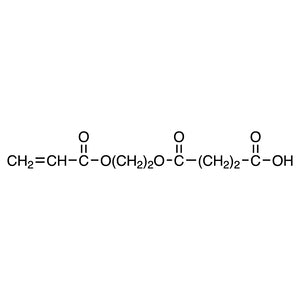
TCI M1824 Mono(2-acryloyloxyethyl) Succinate is a difunctional acrylate monomer that carries a polymerizable acrylate group at one end and a free carboxylic acid group at the other, linked through a succinate and ethylene glycol bridge. The product is stabilized with MEHQ to prevent premature polymerization during storage and shipping. In materials and polymer laboratories, a monomer of this kind serves as a functional comonomer that inserts acid groups into the polymer chain, so that the surface properties, polarity, and adhesion of the finished product can be tuned in a deliberate, directed way.
The characteristic that makes it a preferred choice is the presence of a free carboxylic acid group that does not take part in the reaction while radical polymerization proceeds. That acid group improves adhesion to polar surfaces such as metal, glass, and mineral substrates, improves compatibility with water-based systems, and provides an attachment point for further reactions, for example salt formation, amidation, or ionic crosslinking. The acrylate group, meanwhile, delivers a rapid polymerization rate under radical initiation as well as under ultraviolet irradiation. Its physical form, generally a viscous liquid, allows it to be blended into formulations without an additional dissolution step.
In Indonesian laboratories, this monomer is typically used in university and institutional research groups working on coatings, adhesives, dental and biomedical materials, and functional polymer synthesis. It is normally handled in small quantities on a bench scale, weighed into formulation batches alongside other acrylate monomers and a radical or photoinitiator system. Because it is supplied in research pack sizes, it suits method development and trial formulation work rather than production-scale use.
TCI brochures (PDF)
- Biomaterials Research Reagents 2025-02-19 · p. 9
- Monomers 2025-05-28 · p. 4
Related TCI products
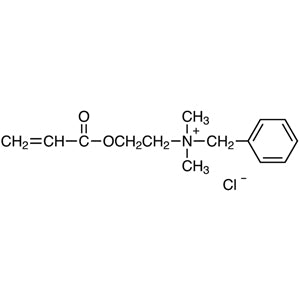
- TCI A3310 46830-22-2 N-(2-Acryloyloxyethyl)-N-benzyl-N,N-dimethylammonium Chloride (ca. 75% in water) (stabilized with MEHQ)
- TCI B2936 13048-33-4 1,6-Bis(acryloyloxy)hexane (stabilized with MEHQ)
- TCI B2935 1070-70-8 1,4-Bis(acryloyloxy)butane (stabilized with MEHQ)
- TCI M3411 126449-41-0 2-Methacryloyloxyethyl Thioctate (stabilized with MEHQ)
- TCI A3367 88992-91-0 3-[[2-(Acryloyloxy)ethyl]dimethylammonio]propane-1-sulfonate
- TCI A1988 1709-71-3 1-(Acryloyloxy)-3-(methacryloyloxy)-2-propanol (mixture of isomers) (stabilized with MEHQ)
- Functional comonomer in radical copolymerization, where its free carboxylic acid group is carried into the polymer backbone to raise chain polarity and introduce acid functionality for later modification.
- UV-curable coating formulation, because the acrylate group polymerizes rapidly under ultraviolet irradiation while the pendant acid group improves wetting and anchoring on metal and glass substrates.
- Adhesive and primer research, where the free carboxylic acid provides strong interaction with polar mineral and metallic surfaces and therefore improves bond strength of the cured acrylate network.
- Water-compatible and waterborne polymer systems, since the acid group can be neutralized to a salt form and so improves dispersion and compatibility of the resin in aqueous media.
- Preparation of ionically crosslinked or post-functionalized polymers, using the unreacted carboxylic acid as an attachment point for amidation, esterification, or ionic crosslinking after the acrylate chain has formed.
| Brand | TCI |
|---|---|
| CAS number | 50940-49-3 |
| Molecular formula | — |
| Purity | — |
| Category | Materials Science > Polymer/Macromolecule Reagents > Monomers |
| Pack sizes | available in laboratory research pack sizes; please confirm the currently listed size when ordering |
| Physical form | generally supplied as a viscous liquid |
| Storage | supplied stabilized with MEHQ to prevent premature polymerization during storage and shipping |
Store the container in a cool, dark place, kept closed and protected from direct sunlight and from sources of heat, since acrylate monomers can polymerize prematurely when warmed or exposed to light. Keep the material in its original tightly sealed container, or in a chemically compatible closed container, and do not remove or deplete the MEHQ stabilizer, as the inhibitor requires the presence of air to remain effective. Handle in a well-ventilated area or fume hood, wearing gloves, safety glasses, and a laboratory coat, because acrylate monomers are skin and eye irritants and may cause sensitization on repeated contact. Avoid contact with radical sources, strong oxidizing agents, and peroxides. Withdraw only the quantity required for the experiment and avoid returning unused material to the original container.
—
Product Categories
Produk Terkait
-
N-(2-Acryloyloxyethyl)-N-benzyl-N,N-dimethylammoniumChloride(ca.75%inwater)(stabilizedwithMEHQ) TCI A3310
Regular price From Rp 1.008.000,00Regular priceRp 720.300,00Sale price From Rp 1.008.000,00 -
1,6-Bis(acryloyloxy)hexane(stabilizedwithMEHQ) TCI B2936
Regular price From Rp 557.550,00Regular priceRp 405.300,00Sale price From Rp 557.550,00 -
1,4-Bis(acryloyloxy)butane(stabilizedwithMEHQ) TCI B2935
Regular price Rp 637.350,00Regular priceRp 445.200,00Sale price Rp 637.350,00 -
2-MethacryloyloxyethylThioctate(stabilizedwithMEHQ) TCI M3411
Regular price From Rp 4.373.250,00Regular priceRp 3.073.350,00Sale price From Rp 4.373.250,00 -
3-[[2-(Acryloyloxy)ethyl]dimethylammonio]propane-1-sulfonate TCI A3367
Regular price From Rp 4.161.150,00Regular priceRp 2.925.300,00Sale price From Rp 4.161.150,00 -
1-(Acryloyloxy)-3-(methacryloyloxy)-2-propanol(mixtureofisomers)(stabilizedwithMEHQ) TCI A1988
Regular price From Rp 662.550,00Regular priceRp 478.800,00Sale price From Rp 662.550,00 -
3-[Bis[2-(methacryloyloxy)ethyl](methyl)ammonio]propane-1-sulfonate TCI B6130
Regular price Rp 3.207.750,00Regular priceRp 2.258.550,00Sale price Rp 3.207.750,00 -
4-[[2-(Methacryloyloxy)ethyl]dimethylammonio]butane-1-sulfonate TCI M3295
Regular price Rp 4.108.650,00Regular priceRp 2.888.550,00Sale price Rp 4.108.650,00



![TCI A3367 88992-91-0 3-[[2-(Acryloyloxy)ethyl]dimethylammonio]propane-1-sulfonate](http://amiscientific.com/cdn/shop/files/TCI2510A3367_f4ac3e6b-7e68-4afc-b41a-bbc8b7cb0886.jpg?v=1792658229&width=533)
![88992-91-0 3-[[2-(Acryloyloxy)ethyl]dimethylammonio]propane-1-sulfonate - AMI Scientific](http://amiscientific.com/cdn/shop/files/TCI2510A3367.jpg?v=1767084168&width=533)


ammonio]propane-1-sulfonate](http://amiscientific.com/cdn/shop/files/TCI2510B6130_94a86ef2-53c9-4f4c-bee1-d50331fdcf81.jpg?v=1792631222&width=533)
ammonio]propane-1-sulfonate (CAS 1314713-40-0) - TCI B6130 - AMI Scientific](http://amiscientific.com/cdn/shop/files/TCI2510B6130.jpg?v=1767093213&width=533)
![TCI M3295 6613-65-6 4-[[2-(Methacryloyloxy)ethyl]dimethylammonio]butane-1-sulfonate](http://amiscientific.com/cdn/shop/files/TCI2510M3295_2e75e9e2-c6f5-4001-96a3-d04e19b37a7a.jpg?v=1792649629&width=533)
![6613-65-6 4-[[2-(Methacryloyloxy)ethyl]dimethylammonio]butane-1-sulfonate - AMI Scientific](http://amiscientific.com/cdn/shop/files/TCI2510M3295.jpg?v=1767128044&width=533)