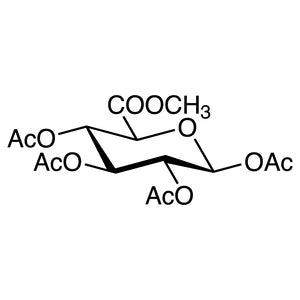
Methyl 1,2,3,4-Tetra-O-acetyl-beta-D-glucuronate (TCI M1868, CAS 7355-18-2) is a fully protected sugar derivative of D-glucuronic acid, in which all four hydroxyl groups have been acetylated and the carboxyl group has been converted into a methyl ester. This protected form is a standard building block in glycoscience, particularly for preparing glycosyl donors used to construct glycosidic bonds in a controlled manner. Without comprehensive protection, a sugar bearing many free hydroxyl groups would react indiscriminately and produce complex mixtures, so peracetylated compounds of this type serve as the near-universal starting point for modern carbohydrate synthesis in the laboratory.
The characteristics that make this compound a preferred choice are its defined beta configuration at the anomeric position and its uniform protection pattern. The acetyl group at the two-position acts as a neighbouring participating group that helps direct the stereochemistry of glycosidic bond formation, so that the resulting product adopts a predictable configuration. The acetyl groups are also readily removed by mild basic methanolysis in the final stage of a synthesis, while the methyl ester on the carboxyl group can be hydrolysed to regenerate the free glucuronic acid function. This combination of directed stereochemistry and cleanly reversible protection gives synthetic chemists a dependable, well-behaved intermediate.
In Indonesian laboratories, this material is typically used in university and institutional research groups working on carbohydrate chemistry, glycoconjugate preparation, and the synthesis of glucuronide reference compounds. It is generally handled in small-scale multi-step synthetic work rather than in routine analysis, and is usually purchased as a specialised research chemical to support thesis projects, published method development, and collaborative work with pharmaceutical and natural-product research programmes that require controlled glycosylation chemistry.
- Glycosyl donor preparation: the fully acetylated anomeric centre can be activated and converted into reactive donors, giving a reliable entry point into controlled glycosidic bond formation.
- Stereoselective glycosylation: the participating acetyl group at position two directs the outcome of coupling reactions, so that the resulting glycoside has a predictable anomeric configuration.
- Glucuronide synthesis: the methyl ester protecting the carboxyl group can be hydrolysed after coupling, allowing the free glucuronic acid function to be restored in the target molecule.
- Glycoconjugate and oligosaccharide assembly: uniform protection prevents indiscriminate side reactions among the multiple hydroxyl groups, which keeps multi-step carbohydrate assembly clean and tractable.
- Carbohydrate methodology research: the defined beta configuration and well-characterised deprotection behaviour make it a suitable substrate for developing and benchmarking new glycosylation methods.
| Brand | TCI (Tokyo Chemical Industry) |
|---|---|
| CAS number | 7355-18-2 |
| Molecular formula | — |
| Purity | — |
| Category | Chemistry > Chemical Biology > Glycoscience |
| Pack sizes | available in standard research-scale packaging; please confirm the currently offered size when ordering |
| Physical form | — |
| Storage | keep in a cool, dry place in a tightly closed container as indicated on the manufacturer's label |
- Catalogue number: M1868
Store the material in its original tightly closed container, in a cool and dry location away from moisture, direct sunlight, and sources of heat or ignition. Acetylated sugar esters are best kept in well-sealed glass containers to limit exposure to atmospheric humidity, which can slowly compromise ester groups. Handle the compound in a fume hood using gloves, safety goggles, and a laboratory coat, and avoid generating or inhaling dust when weighing. Transfer with clean, dry spatulas to prevent contamination, close the container promptly after use, and follow the manufacturer's safety data sheet together with your institution's chemical waste procedures for disposal.
—
Produk Terkait
-
TCI B5774 5,10-Bis(4,4,5,5-tetramethyl-1,3,2-dioxaborolan-2-yl)naphtho[1,2-c:5,6-c']bis([1,2,5]oxadiazole)
Regular price Rp 10.255.350,00Regular price -
Dihydroiodide TCI B6569
Regular price From Rp 1.936.200,00Regular price -
Trifluoromethanesulfonate TCI B7003
Regular price From Rp 1.936.200,00Regular price
![5,10-Bis(4,4,5,5-tetramethyl-1,3,2-dioxaborolan-2-yl)naphtho[1,2-c:5,6-c']bis([1,2,5]oxadiazole) - TCI B5774 - AMI Scientific](http://amiscientific.com/cdn/shop/files/TCI2510B5774.jpg?v=1769180228&width=533)