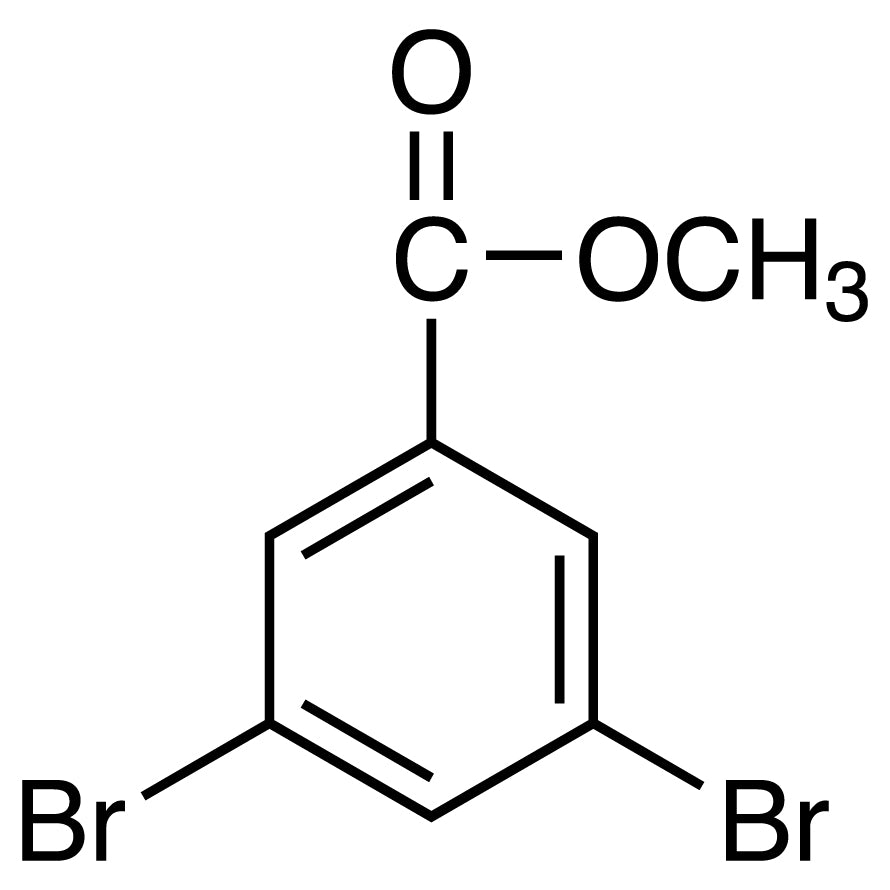
TCI M1929 Methyl 3,5-Dibromobenzoate is the methyl ester of benzoic acid whose aromatic ring carries two bromine atoms at the three and five positions, placed symmetrically with respect to the ester group. The material is classified as a dendrimer building block, meaning a monomer designed to construct branched architectures through repeated generations of coupling. The pattern of a single functional group facing two identical reactive groups makes this compound a classic example of an AB₂-type monomer, the arrangement that underpins the preparation of dendrimers, dendrons, and hyperbranched polymers in polymer chemistry and materials science laboratories.
The characteristics that make this reagent highly sought after are its symmetry and the directionality of its reactions. The two bromine atoms at the meta positions are chemically equivalent, so both can react simultaneously under palladium-catalysed cross-coupling conditions such as the Suzuki, Sonogashira, Buchwald–Hartwig, or Heck reactions, producing branching that is uniform and easy to predict. Meanwhile, the methyl ester group acts as a focal point that can be hydrolysed to a carboxylic acid, reduced to a benzylic alcohol, or converted into an amide when a dendron needs to be attached to a core. This clear division of roles between the branching arms and the focal point is what gives synthetic chemists precise control over each generation of growth.
In Indonesian laboratories, this compound is typically used in university polymer chemistry and materials science research groups, as well as in institutional laboratories working on functional macromolecules. It is generally handled by researchers preparing dendrons and hyperbranched polymers on a laboratory scale, where the AB₂ monomer is coupled step by step under inert conditions. The material is also suited to teaching and training settings that demonstrate convergent and divergent dendrimer synthesis strategies to graduate students.
- Dendrimer and dendron synthesis: the AB₂ arrangement of one ester focal point and two equivalent bromines gives the uniform, predictable branching that generational growth strategies require.
- Hyperbranched polymer preparation: simultaneous reaction of both meta bromine atoms under cross-coupling conditions builds highly branched macromolecular architectures from a single, well-defined monomer unit.
- Palladium-catalysed Suzuki coupling: the two chemically equivalent aryl bromides serve as reliable electrophilic partners for boronic acids, extending the aromatic framework in a symmetric fashion.
- Sonogashira and Heck couplings: the dibrominated aromatic core allows alkyne or alkene arms to be installed at both branching positions, giving conjugated branched materials for functional studies.
- Buchwald–Hartwig amination studies: both bromine sites accept nitrogen nucleophiles, while the methyl ester remains available afterwards for hydrolysis, reduction, or amidation to a dendrimer core.
| Brand | TCI (Tokyo Chemical Industry) |
|---|---|
| CAS number | 51329-15-8 |
| Molecular formula | — |
| Purity | — |
| Category | Materials Science > Polymer/Macromolecule Reagents > Dendrimer Building Blocks |
| Pack sizes | available in standard laboratory research pack sizes as supplied by the manufacturer |
| Physical form | — |
| Storage | store in a cool, dry place in a tightly closed container as indicated on the manufacturer's label |
- Product code: M1929
Store the container tightly closed in a cool, dry, and well-ventilated area, away from heat sources, direct sunlight, and incompatible chemicals, following the conditions stated on the manufacturer's label and safety data sheet. Keep the material in its original supplier container or in a clean, chemically compatible amber glass bottle with a secure closure to limit moisture uptake and contamination. Handle the compound inside a fume hood while wearing safety goggles, a laboratory coat, and suitable chemical-resistant gloves. Avoid inhalation of dust and direct contact with skin and eyes, close the container immediately after weighing, and dispose of residues and contaminated materials through the institution's chemical waste procedures.
—
Produk Terkait
-
TCI B5774 5,10-Bis(4,4,5,5-tetramethyl-1,3,2-dioxaborolan-2-yl)naphtho[1,2-c:5,6-c']bis([1,2,5]oxadiazole)
Regular price Rp 10.255.350,00Regular price -
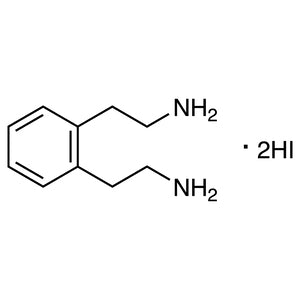
Dihydroiodide TCI B6569
Regular price From Rp 1.936.200,00Regular price -
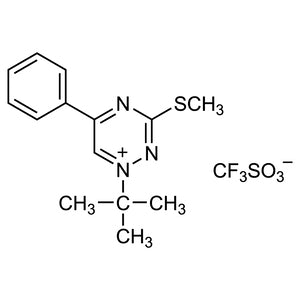
Trifluoromethanesulfonate TCI B7003
Regular price From Rp 1.936.200,00Regular price
![5,10-Bis(4,4,5,5-tetramethyl-1,3,2-dioxaborolan-2-yl)naphtho[1,2-c:5,6-c']bis([1,2,5]oxadiazole) - TCI B5774 - AMI Scientific](http://amiscientific.com/cdn/shop/files/TCI2510B5774.jpg?v=1769180228&width=533)