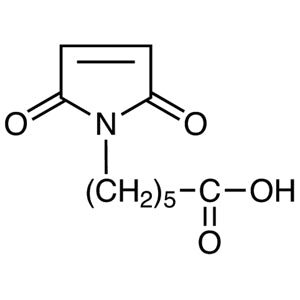
6-Maleimidohexanoic Acid is a heterobifunctional linking reagent that combines a thiol-reactive maleimide ring with a free carboxylic acid group, joined by a six-carbon hexanoate chain. In the chemical biology laboratory, this compound serves as a covalent bridge between thiol-bearing and amine-bearing biomolecules: the maleimide captures free cysteine residues, while the carboxylate is activated into an active ester to bond with lysine or other primary amines. The reagent is also a classic intermediate on the route to preparing NHS esters of long-spacer crosslinkers, making it a foundational building block in bioconjugate chemistry.
The advantage that leads researchers to select this linker lies in the hexanoate spacer length, which is greater than that of short-chain analogues. This additional distance reduces steric hindrance between the two macromolecules being joined, so that antibody binding sites or enzyme active sites remain free to function after conjugation. The selectivity of the maleimide toward thiols at near-neutral pH is preserved, while the carboxylate reaction can be carried out as a separate step. This combination gives full control over the conjugation sequence, the linker-to-protein ratio, and the homogeneity of the final product.
In Indonesian laboratories, this reagent is typically found in university chemical biology groups, biotechnology research institutes, and analytical service units developing immunoassays and protein conjugates. It is used in workflows where antibodies, enzymes, or carrier proteins must be joined to peptides, haptens, or reporter molecules under controlled conditions. Researchers value it in method development work where spacer length must be varied systematically to optimise conjugate performance.
- Antibody–enzyme conjugate preparation: the extended hexanoate spacer keeps the antibody paratope and the enzyme active site sufficiently separated that both retain function after covalent coupling.
- Hapten–carrier protein conjugation for immunogen production: the carboxylate can be activated to bind carrier lysines while the maleimide captures thiolated haptens in a controlled, sequential manner.
- Synthesis of long-spacer NHS ester crosslinkers: this reagent serves as the classic intermediate whose free carboxylic acid is converted into an activated ester for amine-directed coupling chemistry.
- Site-selective cysteine modification of proteins: maleimide selectivity toward free thiols near neutral pH allows targeting of specific cysteine residues without competing amine side reactions.
- Peptide–protein bioconjugate assembly: the two-step orthogonal reactivity gives full control over conjugation order and linker-to-protein ratio, improving the homogeneity of the final construct.
| Brand | TCI |
|---|---|
| CAS number | 55750-53-3 |
| Molecular formula | — |
| Purity | — |
| Category | Chemistry > Chemical Biology > Linkers and Crosslinkers |
| Pack sizes | available in standard TCI research-scale packaging; please confirm the size options when ordering. |
| Physical form | — |
| Storage | keep in a cool, dry place in a tightly closed container as indicated on the manufacturer's label. |
- Product code: M2338
Store the container tightly closed in a cool, dry place away from direct sunlight, moisture, and sources of heat, following the storage conditions stated on the manufacturer's label. Maleimide reagents are sensitive to hydrolysis, so containers should be kept sealed and allowed to reach room temperature before opening to prevent moisture condensation. Use tightly closed glass or compatible chemically resistant containers for any aliquots, and label them clearly with the substance name and date. Handle in a fume hood using gloves, safety glasses, and a laboratory coat, avoid contact with skin and eyes, and prepare working solutions in anhydrous solvent shortly before use. Consult the manufacturer's safety data sheet before handling and dispose of residues through approved chemical waste channels.
—
Produk Terkait
-
TCI B5774 5,10-Bis(4,4,5,5-tetramethyl-1,3,2-dioxaborolan-2-yl)naphtho[1,2-c:5,6-c']bis([1,2,5]oxadiazole)
Regular price Rp 10.255.350,00Regular price -
Dihydroiodide TCI B6569
Regular price From Rp 1.936.200,00Regular price -
Trifluoromethanesulfonate TCI B7003
Regular price From Rp 1.936.200,00Regular price
![5,10-Bis(4,4,5,5-tetramethyl-1,3,2-dioxaborolan-2-yl)naphtho[1,2-c:5,6-c']bis([1,2,5]oxadiazole) - TCI B5774 - AMI Scientific](http://amiscientific.com/cdn/shop/files/TCI2510B5774.jpg?v=1769180228&width=533)