TCI M3036 1-Methyl-3-propylimidazolium Tetrafluoroborate is an imidazolium salt paired with a tetrafluoroborate anion, classified within the catalogue as a carbon-donor ligand source for catalysis. The 1-methyl-3-propylimidazolium cation is a classical precursor to N-heterocyclic carbenes (NHCs), the strongly sigma-donating ligands widely used to stabilise transition metal centres. Beyond its role in catalysis, this compound also behaves as an ionic liquid, which means it can serve as a reaction medium or as an electrolyte across a broad range of laboratory experiments.
The properties that make this compound a preferred choice lie in the combination of its cation and anion. The tetrafluoroborate anion is weakly coordinating, so it does not compete with the substrate for binding at the metal centre — an important advantage in metal-catalysed reactions. Compared with halide salts, tetrafluoroborate also offers a wider electrochemical window and a different viscosity profile, which is why it is frequently favoured in electrochemical studies. The C-2 position of the imidazolium ring can be deprotonated with a strong base to generate the free carbene or an NHC-metal complex in situ, giving researchers a direct synthetic route to catalytically active species.
In Indonesian laboratories, this material is typically found in university and institutional research groups working on homogeneous catalysis, organometallic synthesis, and electrochemistry. It is used at research and method-development scale rather than in routine analysis, supporting work where an NHC precursor or an ionic liquid medium is needed. Its dual character as both a ligand precursor and a solvent-type medium makes it useful in laboratories that need flexible reagents for exploratory synthetic and electrochemical work.
TCI brochures (PDF)
- Ionic Liquids for Battery Research 2026-04-13 · p. 1
- Ionic Liquids 2026-06-08 · p. 9
- Ligands 2025-12-01 · p. 8
- Suzuki-Miyaura Cross Coupling Reaction 2025-12-01 · p. 26
- Boron Compounds 2025-10-07 · p. 25
Related TCI products
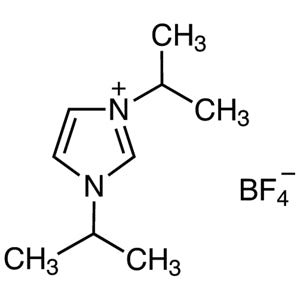
- TCI D3623 286014-34-4 1,3-Diisopropylimidazolium Tetrafluoroborate
- TCI D3622 137581-18-1 1,3-Diisopropylimidazolinium Tetrafluoroborate
- TCI D5655 1671098-46-6 1-(2,6-Diethylphenyl)-2,2,4-trimethyl-4-phenyl-3,4-dihydro-2H-pyrrol-1-ium Tetrafluoroborate
- TCI D4624 862095-91-8 6,7-Dihydro-2-pentafluorophenyl-5H-pyrrolo[2,1-c][1,2,4]triazolium Tetrafluoroborate
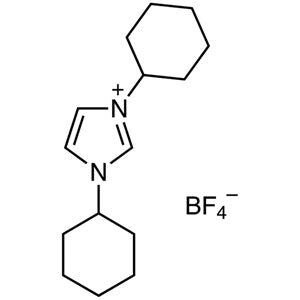
- TCI D3850 286014-38-8 1,3-Dicyclohexylimidazolium Tetrafluoroborate
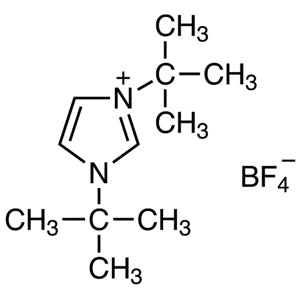
- TCI D3711 263163-17-3 1,3-Di-tert-butylimidazolium Tetrafluoroborate
- N-Heterocyclic carbene precursor: deprotonation at the C-2 position with a strong base releases a free carbene that binds transition metals as a strong sigma donor for catalyst construction.
- Homogeneous metal catalysis: the weakly coordinating tetrafluoroborate anion avoids competing with substrates at the metal centre, helping catalysed reactions proceed without anion interference at the active site.
- Ionic liquid reaction medium: the salt behaves as an ionic liquid, allowing it to replace conventional molecular solvents as the reaction medium in synthetic laboratory experiments.
- Electrolyte for electrochemical studies: the wider electrochemical window offered by tetrafluoroborate compared with halide salts makes this compound suitable as an electrolyte in electrochemical measurements.
- In situ NHC-metal complex generation: researchers can form NHC-metal complexes directly in the reaction vessel, shortening the synthetic route to catalytically active organometallic species.
| Brand | TCI (Tokyo Chemical Industry) |
|---|---|
| CAS number | 244193-48-4 |
| Molecular formula | — |
| Purity | — |
| Category | Chemistry > Catalysis and Inorganic Chemistry > Carbon-Donor Ligands [Catalysis] |
| Pack sizes | available in standard TCI research pack sizes; please confirm the currently listed pack size when ordering |
| Physical form | — |
| Storage | store in a tightly closed container, protected from moisture, as specified on the manufacturer's label |
- Catalogue Number: M3036
Store this compound in its original tightly closed container in a cool, dry, and well-ventilated area, away from moisture, since imidazolium salts of this type are commonly hygroscopic and absorbed water can affect their behaviour as a reaction medium or electrolyte. Keep the container closed when not in use and handle the material in a fume hood wherever practical. Standard laboratory personal protective equipment should be worn, including safety glasses, chemical-resistant gloves, and a laboratory coat. Avoid contact with skin and eyes and avoid inhaling any dust generated during transfer. Always consult the manufacturer's Safety Data Sheet before handling, and follow institutional procedures for chemical waste disposal.
—
Product Categories
- Catalysis and Inorganic ChemistryCarbon-Donor Ligands [Catalysis]Imidazolinium Salts, Cyclic Alkyl Amino Carbene (CAAC) Pecursors [Carbon-Donor Ligands]
- Catalysis and Inorganic ChemistryCross-coupling Reaction using Transition Metal Catalysts [C-C Bond Formation]N-Heterocyclic Carbene (NHC) Ligands [Cross-coupling Reaction using Transition Metal Catalysts]
- Specialty SynthesisIonic Liquids [Specialty Synthesis]Imidazolium Salts [Ionic Liquids]
- Synthetic ReagentsC-C Bond Formation [Synthetic Reagents]Cross-coupling Reaction using Transition Metal Catalysts [C-C Bond Formation]
Produk Terkait
-
1,3-DiisopropylimidazoliumTetrafluoroborate TCI D3623
Regular price Rp 1.801.800,00Regular priceRp 1.275.750,00Sale price Rp 1.801.800,00 -
1,3-DiisopropylimidazoliniumTetrafluoroborate TCI D3622
Regular price Rp 3.365.250,00Regular priceRp 2.368.800,00Sale price Rp 3.365.250,00 -
1-(2,6-Diethylphenyl)-2,2,4-trimethyl-4-phenyl-3,4-dihydro-2H-pyrrol-1-iumTetrafluoroborate TCI D5655
Regular price From Rp 5.617.500,00Regular priceRp 3.943.800,00Sale price From Rp 5.617.500,00 -
6,7-Dihydro-2-pentafluorophenyl-5H-pyrrolo[2,1-c][1,2,4]triazoliumTetrafluoroborate TCI D4624
Regular price Rp 7.261.800,00Regular priceRp 5.093.550,00Sale price Rp 7.261.800,00 -
1,3-DicyclohexylimidazoliumTetrafluoroborate TCI D3850
Regular price From Rp 1.538.250,00Regular priceRp 1.090.950,00Sale price From Rp 1.538.250,00 -
1,3-Di-tert-butylimidazoliumTetrafluoroborate TCI D3711
Regular price From Rp 1.326.150,00Regular priceRp 942.900,00Sale price From Rp 1.326.150,00 -
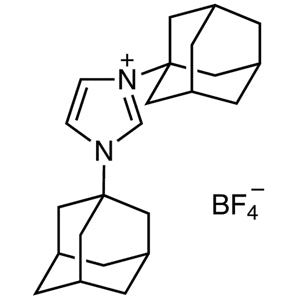
1,3-Di(1-adamantyl)imidazoliumTetrafluoroborate TCI D3621
Regular price Rp 3.735.900,00Regular priceRp 2.628.150,00Sale price Rp 3.735.900,00 -
1,3-Di(1-adamantyl)imidazoliniumTetrafluoroborate TCI D3620
Regular price Rp 3.207.750,00Regular priceRp 2.258.550,00Sale price Rp 3.207.750,00



![TCI D4624 862095-91-8 6,7-Dihydro-2-pentafluorophenyl-5H-pyrrolo[2,1-c][1,2,4]triazolium Tetrafluoroborate](http://amiscientific.com/cdn/shop/files/TCI2510D4624_a6c7122b-cbb9-4921-af4b-d2300ece664b.jpg?v=1792639462&width=533)
![6,7-Dihydro-2-pentafluorophenyl-5H-pyrrolo[2,1-c][1,2,4]triazolium Tetrafluoroborate (CAS 862095-91-8) - TCI D4624 - AMI Scientific](http://amiscientific.com/cdn/shop/files/TCI2510D4624.jpg?v=1767107769&width=533)