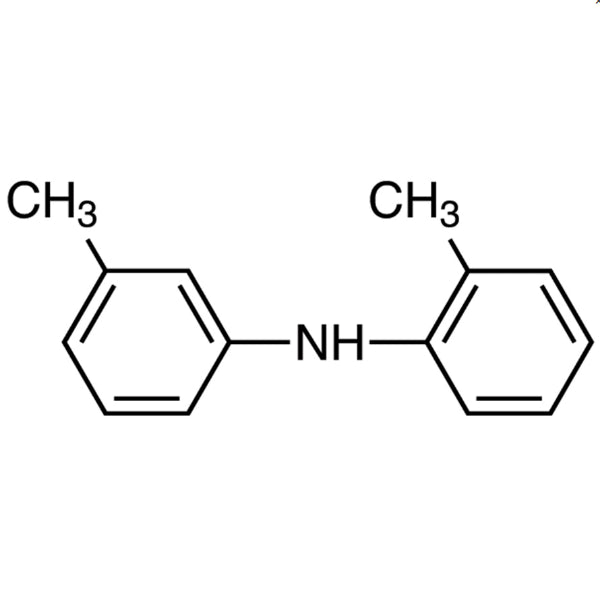
TCI M3064 is 2-Methyl-N-(m-tolyl)aniline, CAS number 34801-11-1, an unsymmetrical diarylamine built from two methyl-substituted aromatic rings joined through a single nitrogen atom. The product is classified as a small molecule semiconductor building block, and that is precisely where its main role lies. The diarylamine unit is a classic electron-donating group sitting at the heart of many hole-transport materials, which makes a compound of this type a starting material in the synthesis of organic electronic materials in materials research laboratories.
The property that makes this compound a preferred choice is the nitrogen atom that still carries one free hydrogen. That hydrogen is what allows the molecule to be joined to another aromatic core through Buchwald–Hartwig amination or Ullmann coupling, producing the triarylamines that form the common framework of hole-transport materials. The methyl substituents — ortho on one ring and meta on the other — are not decoration: they tune the twist angle between the rings, raise solubility in organic solvents, and make unwanted molecular stacking in thin films more difficult. All three effects bear directly on how the final material performs.
In Indonesian laboratories, a material of this kind is typically found in university and institutional materials research groups working on organic electronics, where it serves as an intermediate in multi-step synthesis rather than as a finished device material. It is normally handled in a fume hood on a small preparative scale, with the coupling step run under inert atmosphere, and the product carried forward to purification and characterisation before being incorporated into thin-film work.
- Synthesis of hole-transport materials — the free N–H allows the diarylamine to be coupled onto an aromatic core, giving the triarylamine framework that underpins most organic hole-transport layers.
- Buchwald–Hartwig amination — this secondary diarylamine is a standard amine partner for palladium-catalysed C–N bond formation with aryl halides, forming triarylamine products in a single step.
- Ullmann-type coupling chemistry — the reactive N–H site also permits copper-mediated C–N coupling, offering an alternative route to the same triarylamine targets without palladium catalysis.
- Organic electronic materials research — as an electron-donating building block, it is used to introduce donor character when constructing donor–acceptor small molecule semiconductors in materials laboratories.
- Thin-film material development — the ortho and meta methyl groups control inter-ring twist and discourage unwanted stacking, making it useful when designing derivatives intended for solution-processed films.
| Brand | TCI |
|---|---|
| CAS number | 34801-11-1 |
| Molecular formula | — |
| Purity | — |
| Category | Materials Science > Material Building Blocks > Small Molecule Semiconductor Building Blocks |
| Pack sizes | available in standard TCI research-scale packaging; please confirm the pack size when ordering |
| Physical form | — |
| Storage | keep in the tightly closed original container, protected from light and air |
- Chemical name: 2-Methyl-N-(m-tolyl)aniline
Store the material in its tightly closed original container in a cool, dry, well-ventilated place away from direct sunlight, heat sources, and strong oxidising agents. Amber glass or the supplier's original packaging is suitable, as aromatic amines are generally sensitive to light and to prolonged contact with air. Handle the compound in a fume hood and wear nitrile gloves, safety goggles, and a laboratory coat, avoiding skin contact, inhalation of dust or vapour, and contact with the eyes. Weigh and transfer the material with clean, dry spatulas, close the container immediately after use, and consult the manufacturer's safety data sheet before first handling and before waste disposal.
—
Produk Terkait
-
TCI B5774 5,10-Bis(4,4,5,5-tetramethyl-1,3,2-dioxaborolan-2-yl)naphtho[1,2-c:5,6-c']bis([1,2,5]oxadiazole)
Regular price Rp 10.255.350,00Regular price -
Dihydroiodide TCI B6569
Regular price From Rp 1.936.200,00Regular price -
Trifluoromethanesulfonate TCI B7003
Regular price From Rp 1.936.200,00Regular price
![5,10-Bis(4,4,5,5-tetramethyl-1,3,2-dioxaborolan-2-yl)naphtho[1,2-c:5,6-c']bis([1,2,5]oxadiazole) - TCI B5774 - AMI Scientific](http://amiscientific.com/cdn/shop/files/TCI2510B5774.jpg?v=1769180228&width=533)