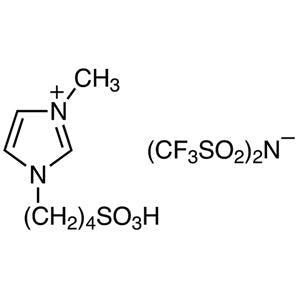
TCI M3119 1-Methyl-3-(4-sulfobutyl)imidazolium Bis(trifluoromethanesulfonyl)imide is a functional ionic liquid of the imidazolium family that carries a sulfonic acid group on the butyl chain of its cation. Compounds of this type are known as Brønsted acidic ionic liquids, and they are able to play a dual role in a reaction system, acting at the same time as the solvent and as the acid catalyst. In the laboratory, this material is used as a replacement for liquid mineral acids such as sulfuric acid in a wide range of acid-catalysed reactions, so that handling becomes safer, corrosion of equipment is reduced, and separation of the catalyst from the reaction product becomes far simpler.
The principal property that makes this ionic liquid a preferred choice is that the acidity is attached directly to the structure of the cation. Because the acidic function is part of the molecule itself, the catalyst is not carried over into the product during work-up, and it can be recovered and used again in the next reaction cycle. The NTf2 anion contributes hydrophobic character and good thermal stability, while at the same time strengthening the effective acidity of the system, since that anion is a very weak conjugate base. The combination of the sulfonate group and the NTf2 anion yields a strong acid catalyst that is practically non-volatile.
In Indonesian laboratories, this reagent fits the working pattern of university research groups and industrial R&D units that are developing greener catalytic routes and reducing their dependence on corrosive liquid mineral acids. The 1 g and 5 g pack sizes suit bench-scale catalysis experiments and screening work, where a small quantity is sufficient for repeated trial runs, catalyst recycling studies, and method development before any decision is made to scale a process up.
TCI brochures (PDF)
- Ionic Liquids 2026-06-08 · p. 9
Related TCI products
- TCI V0145 1013027-27-4 1-Vinylimidazole Bis(trifluoromethanesulfonyl)imide
- TCI B5421 1312310-16-9 3,3'-(Butane-1,4-diyl)bis(1-vinyl-3-imidazolium) Bis(trifluoromethanesulfonyl)imide
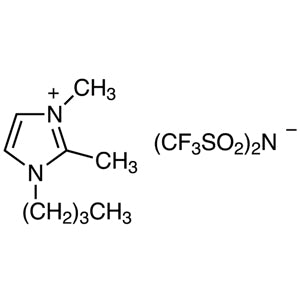
- TCI B3159 350493-08-2 1-Butyl-2,3-dimethylimidazolium Bis(trifluoromethanesulfonyl)imide
- TCI B2477 174899-83-3 1-Butyl-3-methylimidazolium Bis(trifluoromethanesulfonyl)imide
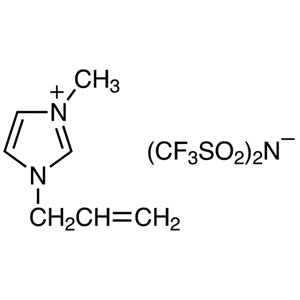
- TCI A3210 655249-87-9 1-Allyl-3-methylimidazolium Bis(trifluoromethanesulfonyl)imide
- TCI M3210 353239-08-4 1-Methylimidazole Bis(trifluoromethanesulfonyl)imide
- Acid-catalysed organic synthesis: the sulfonic acid group supplies strong Brønsted acidity directly in the reaction medium, so the ionic liquid functions as both solvent and catalyst without a separate mineral acid.
- Replacement of sulfuric acid in bench reactions: researchers adopt it where handling of corrosive liquid mineral acid is undesirable, since the non-volatile ionic liquid is safer to handle and less aggressive toward equipment.
- Catalyst recycling and reuse studies: because the acidity is bound to the cation, the catalyst stays out of the product stream during separation and can be collected and returned to a following reaction cycle.
- Green chemistry and solvent replacement research: the practically non-volatile nature of the material makes it attractive for work aimed at reducing solvent emissions and simplifying downstream purification of reaction mixtures.
- Biphasic reaction and extraction work: the hydrophobic character contributed by the NTf2 anion supports systems where the ionic liquid phase must remain separate from an aqueous phase during reaction and work-up.
| Brand | TCI |
|---|---|
| CAS number | 909390-59-6 |
| Molecular formula | — |
| Purity | — |
| Category | Chemistry > Specialty Synthesis > Ionic Liquids [Specialty Synthesis] |
| Pack sizes | 1 g and 5 g |
| Physical form | ionic liquid |
| Storage | keep in the closed original container, protected from moisture |
Store the material in its original tightly closed container in a cool, dry place away from direct sunlight and sources of heat. Because ionic liquids of this type are hygroscopic in handling, keep exposure to open air as short as possible and close the container promptly after each use; transfer under dry conditions where the work allows. Use glass or other chemically compatible containers and keep the product away from strong bases and from materials that are sensitive to acid. Handle in a fume hood using safety glasses, gloves, and a laboratory coat, and follow the supplier safety data sheet for the material before use.
—
Produk Terkait
-
1-VinylimidazoleBis(trifluoromethanesulfonyl)imide TCI V0145
Regular price Rp 2.809.800,00Regular priceRp 1.980.300,00Sale price Rp 2.809.800,00 -
3,3'-(Butane-1,4-diyl)bis(1-vinyl-3-imidazolium)Bis(trifluoromethanesulfonyl)imide TCI B5421
Regular price Rp 2.439.150,00Regular priceRp 1.720.950,00Sale price Rp 2.439.150,00 -
1-Butyl-2,3-dimethylimidazoliumBis(trifluoromethanesulfonyl)imide TCI B3159
Regular price From Rp 1.431.150,00Regular priceRp 1.016.400,00Sale price From Rp 1.431.150,00 -
1-Butyl-3-methylimidazoliumBis(trifluoromethanesulfonyl)imide TCI B2477
Regular price From Rp 1.351.350,00Regular priceRp 960.750,00Sale price From Rp 1.351.350,00 -
1-Allyl-3-methylimidazoliumBis(trifluoromethanesulfonyl)imide TCI A3210
Regular price From Rp 2.093.700,00Regular priceRp 1.479.450,00Sale price From Rp 2.093.700,00 -
1-MethylimidazoleBis(trifluoromethanesulfonyl)imide TCI M3210
Regular price From Rp 1.934.100,00Regular priceRp 1.368.150,00Sale price From Rp 1.934.100,00 -
1-Methyl-3-(4-sulfobutyl)imidazoliumHydrogenSulfate TCI M3120
Regular price From Rp 3.048.150,00Regular priceRp 2.147.250,00Sale price From Rp 3.048.150,00 -
1-Methyl-3-propylimidazoliumBis(trifluoromethanesulfonyl)imide TCI M3059
Regular price From Rp 1.538.250,00Regular priceRp 1.090.950,00Sale price From Rp 1.538.250,00