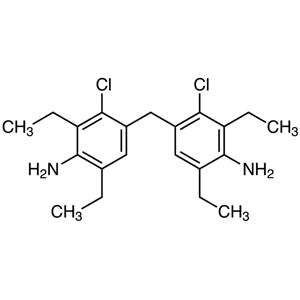
4,4'-Methylenebis(3-chloro-2,6-diethylaniline), listed under CAS number 106246-33-7 and frequently abbreviated MCDEA in the technical literature, is a non-heterocyclic building block supplied by TCI. Structurally it is an aromatic diamine built from two aniline rings joined by a methylene bridge. Each ring carries ethyl groups at the positions ortho to the amino function together with a chlorine atom, which makes the molecule both sterically hindered and electronically modified. In the laboratory it is known primarily as a curing agent or chain extender for thermoset resin systems, particularly epoxies and polyurethanes, and as a diamine monomer in high-performance polymer research.
The property that leads researchers to select this material is the deliberately moderated reactivity of its aromatic amino groups. The flanking ethyl substituents shield the amine sterically, while the electron-withdrawing chlorine atom reduces its nucleophilic character. Together these effects give a longer working time, or pot life, than unhindered aromatic diamines provide. That extra margin lets a researcher mix, pour, and degas a resin system before cure advances significantly, which matters for castings, laminates, and any formulation where trapped air would compromise the result. The rigid double aromatic backbone also contributes stiffness to the polymer network that forms.
In Indonesian laboratories this compound is typically handled in polymer chemistry and materials research groups at universities, government research institutes, and industrial R&D units working on coatings, adhesives, and composite matrices. The 25 g pack size suits bench-scale formulation studies, cure kinetics experiments, and comparative screening of hardeners, where only small quantities are consumed per trial. Researchers running method development or thesis-scale work generally find this quantity appropriate for repeated small batches rather than production use.
TCI brochures (PDF)
- Monomers 2025-05-28 · p. 32
Related TCI products
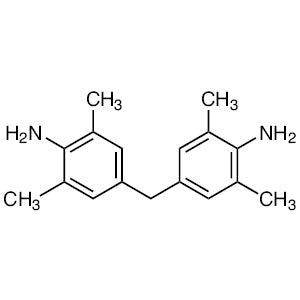
- TCI M3403 4073-98-7 4,4'-Methylenebis(2,6-dimethylaniline)
- TCI B6650 5285-60-9 4,4'-Methylenebis[N-(sec-butyl)aniline]
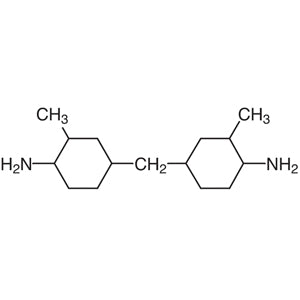
- TCI M1422 6864-37-5 4,4'-Methylenebis(2-methylcyclohexylamine) (mixture of isomers)
- TCI M1897 13680-35-8 4,4'-Methylenebis(2,6-diethylaniline)
- TCI C0154 19372-80-6 2-Chloro-N,N-diethylaniline
- TCI D0475 91-66-7 N,N-Diethylaniline
- Epoxy resin curing studies, where the hindered aromatic amine allows controlled network formation and gives researchers a workable pot life for mixing and degassing before gelation begins.
- Polyurethane chain extension research, in which the diamine functionality links prepolymer segments and the rigid aromatic backbone contributes hard-segment stiffness to the resulting elastomer network.
- High-performance polymer synthesis, using the compound as a diamine monomer whose substituted aromatic rings build thermal and mechanical rigidity into the polymer chain being investigated.
- Cure kinetics and pot life investigations, where the moderated amine reactivity produces a slower, more measurable reaction profile than unhindered aromatic diamines can offer for comparison.
- Composite matrix formulation work, where the extended working time permits thorough fiber wetting and void removal before the thermoset matrix advances toward its final crosslinked state.
| Brand | TCI |
|---|---|
| CAS number | 106246-33-7 |
| Molecular formula | — |
| Purity | — |
| Category | Chemistry > Building Blocks > Non-Heterocyclic Building Blocks |
| Pack sizes | 25 g |
| Physical form | — |
| Storage | store in a cool, dry place in the tightly closed original container |
- Chemical class: aromatic diamine, methylene-bridged, non-heterocyclic building block
Keep the container tightly closed and store it in a cool, dry, well-ventilated area away from direct sunlight, heat sources, and incompatible materials such as strong oxidizing agents and acids. The original supplier container is the most suitable storage vessel; if the material must be transferred, use a clean, dry, chemically compatible container that is clearly labelled with the substance name and CAS number. Handle the compound inside a fume hood and wear appropriate personal protective equipment, including safety glasses, chemical-resistant gloves, and a laboratory coat, since aromatic amines require care in avoiding skin contact and inhalation of dust. Always consult the manufacturer's safety data sheet before use, and follow institutional procedures for chemical waste disposal.
—
Produk Terkait
-
4,4'-Methylenebis(2,6-dimethylaniline) TCI M3403
Regular price From Rp 2.411.850,00Regular priceRp 1.702.050,00Sale price From Rp 2.411.850,00 -
4,4'-Methylenebis[N-(sec-butyl)aniline] TCI B6650
Regular price From Rp 1.060.500,00Regular priceRp 757.050,00Sale price From Rp 1.060.500,00 -
4,4'-Methylenebis(2-methylcyclohexylamine)(mixtureofisomers) TCI M1422
Regular price From Rp 557.550,00Regular priceRp 405.300,00Sale price From Rp 557.550,00 -
4,4'-Methylenebis(2,6-diethylaniline) TCI M1897
Regular price From Rp 928.200,00Regular priceRp 664.650,00Sale price From Rp 928.200,00 -
2-Chloro-N,N-diethylaniline TCI C0154
Regular price Rp 3.232.950,00Regular priceRp 2.260.650,00Sale price Rp 3.232.950,00 -
N,N-Diethylaniline TCI D0475
Regular price From Rp 477.750,00Regular priceRp 333.900,00Sale price From Rp 477.750,00 -
4,4'-Methylenebis(2-ethylaniline) TCI M3167
Regular price From Rp 1.378.650,00Regular priceRp 979.650,00Sale price From Rp 1.378.650,00 -
4,4'-Methylenebis(2-ethyl-6-methylaniline) TCI M1238
Regular price Rp 928.200,00Regular priceRp 664.650,00Sale price Rp 928.200,00

![4,4'-Methylenebis[N-(sec-butyl)aniline] (CAS 5285-60-9) - TCI B6650 - AMI Scientific](http://amiscientific.com/cdn/shop/files/TCI2510B6650.jpg?v=1768816090&width=533)