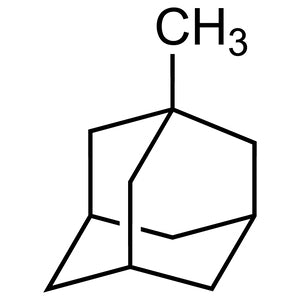
1-Methyladamantane from TCI is a cage-structured hydrocarbon built on an adamantane framework with a single methyl group attached at a bridgehead carbon. Adamantane itself is the smallest repeating unit of the diamond lattice, which is why compounds of this class are also known as diamondoids. In the laboratory, this compound serves as a non-heterocyclic building block that supplies a bulky, rigid hydrophobic fragment, as a reference compound for diamondoid analysis in petroleum geochemistry, and as a model substance in studies of high-boiling hydrocarbons that demand high thermal stability throughout testing.
The properties that make it a preferred choice are the rigidity and stability of its cage skeleton. The three-dimensional adamantane structure is free of ring strain, so the compound is highly resistant to heat and does not decompose readily under conditions that destroy open-chain hydrocarbons. Its large steric volume makes it an ideal lipophilic substituent in medicinal chemistry, because adding an adamantyl group frequently improves a molecule's ability to cross cell membranes while slowing metabolic breakdown. The methyl group at the bridgehead position also provides a defined attachment point for further functionalization.
In Indonesian laboratories, this material is typically handled in synthetic organic chemistry groups preparing adamantane-derived intermediates, in petroleum and geochemistry laboratories that use diamondoid markers in crude oil characterization, and in university research units running thermal stability work on hydrocarbon systems. It is generally used at bench scale in fume-hood work and in analytical method development, where a well-defined, stable hydrocarbon standard is required for calibration and comparison.
- Non-heterocyclic building block synthesis: the rigid adamantane cage delivers a large, conformationally fixed hydrophobic fragment that anchors three-dimensional shape into target molecules during multi-step organic preparation.
- Diamondoid reference compound in petroleum geochemistry: analysts rely on this defined methyladamantane structure as a comparison substance when identifying and characterising diamondoid markers present in crude oil samples.
- Model compound for high-boiling hydrocarbon studies: its strain-free cage withstands elevated temperatures without decomposing, making it a dependable representative of thermally robust hydrocarbons during extended test runs.
- Lipophilic substituent research in medicinal chemistry: the bulky adamantyl unit is introduced to improve membrane permeation and to slow metabolic breakdown, so this compound supports structure-property investigations.
- Bridgehead functionalization chemistry: the methyl group at the bridgehead position offers a defined site for further derivatization, allowing researchers to elaborate the adamantane core in controlled synthetic sequences.
| Brand | TCI |
|---|---|
| CAS number | 768-91-2 |
| Molecular formula | — |
| Purity | — |
| Category | Chemistry > Building Blocks > Non-Heterocyclic Building Blocks |
| Pack sizes | please refer to the manufacturer's catalogue listing and the accompanying label for available pack sizes and the recommended storage condition for the specific lot supplied. |
| Physical form | — |
| Storage | — |
- Product code: M3940
- Product name: 1-Methyladamantane
Store the container tightly closed in a cool, dry, well-ventilated area away from heat sources, open flames, and strong oxidising agents, following the storage condition printed on the manufacturer's label and safety data sheet. Keep the material in its original supplier container or in a chemically compatible, clearly labelled vessel, and reseal promptly after each use to limit exposure to moisture and air. Handle in a fume hood using safety glasses, gloves, and a laboratory coat, avoid generating dust or vapour, and dispose of residues and contaminated materials through the laboratory's chemical waste procedure.
—
Produk Terkait
-
TCI B5774 5,10-Bis(4,4,5,5-tetramethyl-1,3,2-dioxaborolan-2-yl)naphtho[1,2-c:5,6-c']bis([1,2,5]oxadiazole)
Regular price Rp 10.255.350,00Regular price -
Dihydroiodide TCI B6569
Regular price From Rp 1.936.200,00Regular price -
Trifluoromethanesulfonate TCI B7003
Regular price From Rp 1.936.200,00Regular price
![5,10-Bis(4,4,5,5-tetramethyl-1,3,2-dioxaborolan-2-yl)naphtho[1,2-c:5,6-c']bis([1,2,5]oxadiazole) - TCI B5774 - AMI Scientific](http://amiscientific.com/cdn/shop/files/TCI2510B5774.jpg?v=1769180228&width=533)