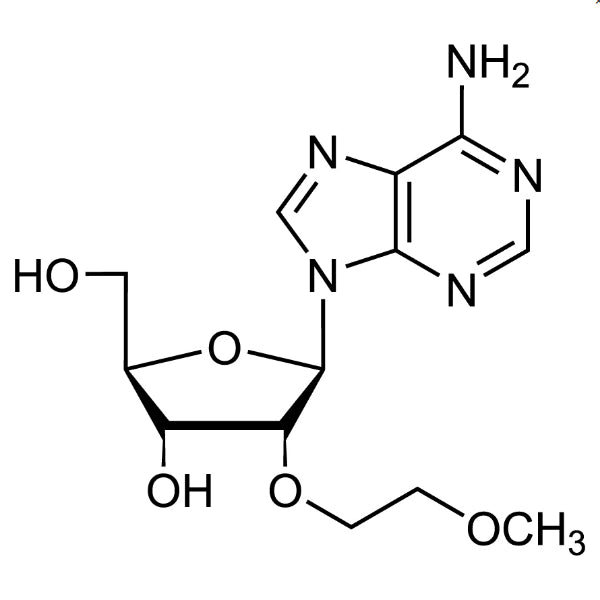
TCI's 2'-O-(2-Methoxyethyl)adenosine is a modified adenosine nucleoside carrying a 2-methoxyethyl group at the two-prime position of the ribose sugar. This modification, commonly abbreviated as MOE among oligonucleotide researchers, ranks among the most important chemical changes in the development of nucleic acid-based therapeutics. In the laboratory, the compound serves as a starting material for the preparation of phosphoramidite monomers and as a reference material in the analysis of modified oligonucleotides. Its availability allows researchers to design oligonucleotide strands that are considerably more robust than natural strands without altering their ability to recognise complementary base sequences.
The advantage that makes this nucleoside a preferred choice lies in the influence of the methoxyethyl group on strand behaviour. The substituent at the two-prime position drives the sugar ring toward a conformation favourable to duplex formation, so affinity for the target RNA strand increases and the melting temperature of the duplex rises. At the same time, the group obstructs nuclease enzymes from reaching the neighbouring phosphodiester linkages, so the oligonucleotide survives far longer in biological fluids. The methoxyethyl chain thus delivers two benefits at once — stronger binding and greater resistance to degradation — while leaving base-pairing specificity intact.
In Indonesian laboratories, this nucleoside is typically used by university and institutional research groups working on antisense oligonucleotides, RNA chemistry, and nucleic acid analysis. It is handled in small quantities on the analytical and preparative scale, most often within organic synthesis or biochemistry laboratories equipped for moisture-sensitive work. Research teams also use it as a comparative standard when characterising modified oligonucleotide products by chromatographic and spectroscopic methods.
Related TCI products
- TCI M3954 223777-15-9 2'-O-(2-Methoxyethyl)uridine
- TCI A0152 58-61-7 Adenosine
- TCI M3539 163759-49-7 2'-O-(2-Methoxyethyl)-5-methyluridine
- TCI A0157 34369-07-8 Adenosine 5'-Triphosphate Disodium Salt Hydrate
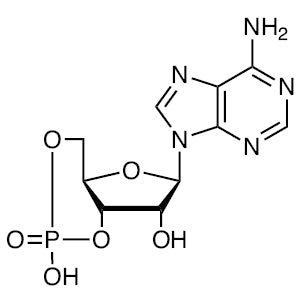
- TCI A2381 60-92-4 Adenosine 3',5'-Cyclic Monophosphate
- TCI A2117 4578-31-8 Adenosine 5'-Monophosphate Disodium Salt
- Phosphoramidite monomer synthesis: the nucleoside provides the protected building block needed to introduce MOE residues into oligonucleotide chains during solid-phase assembly.
- Antisense oligonucleotide research: the two-prime modification raises target RNA affinity and nuclease resistance, making it central to studies on antisense strand design and stability.
- Reference material for oligonucleotide analysis: it serves as a comparison standard when identifying and characterising modified nucleoside components in synthesised oligonucleotide samples.
- Duplex stability studies: researchers use it to examine how the methoxyethyl substituent shifts sugar conformation and raises the melting temperature of oligonucleotide duplexes.
- Nuclease stability evaluation: because the group blocks enzyme access to nearby phosphodiester bonds, it supports experiments measuring oligonucleotide survival in biological fluids.
| Brand | TCI |
|---|---|
| CAS number | 168427-74-5 |
| Molecular formula | — |
| Purity | — |
| Category | Life Science > Biochemicals and Reagents > Nucleosides, Nucleotides, Oligonucleotides |
| Pack sizes | available in the research-scale pack sizes listed by TCI for this catalogue number |
| Physical form | — |
| Storage | store according to the manufacturer's stated conditions for this nucleoside |
- Catalogue number: M3942
Store the container tightly closed in a cool, dry place, following the storage conditions stated by the manufacturer on the product label and safety data sheet. Keep the material in its original container or in a tightly sealed amber glass vial, protected from moisture and direct light, since modified nucleosides are generally sensitive to humidity. Handle the compound in a well-ventilated area or fume hood, wearing gloves, safety glasses, and a laboratory coat. Use clean, dry spatulas when weighing, and allow cold containers to reach room temperature before opening to prevent condensation. Dispose of residues in accordance with institutional chemical waste procedures.
—
Produk Terkait
-
2'-O-(2-Methoxyethyl)uridine TCI M3954
Regular price Rp 3.153.150,00Regular priceRp 2.220.750,00Sale price Rp 3.153.150,00 -
Adenosine TCI A0152
Regular price From Rp 769.650,00Regular priceRp 553.350,00Sale price From Rp 769.650,00 -
2'-O-(2-Methoxyethyl)-5-methyluridine TCI M3539
Regular price From Rp 2.121.000,00Regular priceRp 1.498.350,00Sale price From Rp 2.121.000,00 -
Adenosine5'-TriphosphateDisodiumSaltHydrate TCI A0157
Regular price From Rp 610.050,00Regular priceRp 442.050,00Sale price From Rp 610.050,00 -
Adenosine3',5'-CyclicMonophosphate TCI A2381
Regular price From Rp 2.757.300,00Regular priceRp 1.943.550,00Sale price From Rp 2.757.300,00 -
Adenosine5'-MonophosphateDisodiumSalt TCI A2117
Regular price Rp 1.988.700,00Regular priceRp 1.405.950,00Sale price Rp 1.988.700,00 -
Adenosine3',5'-CyclicMonophosphateSodiumSalt TCI A2112
Regular price Rp 1.643.250,00Regular priceRp 1.164.450,00Sale price Rp 1.643.250,00 -
Adenosine5'-DiphosphateDisodiumSalt TCI A0626
Regular price From Rp 822.150,00Regular priceRp 590.100,00Sale price From Rp 822.150,00