


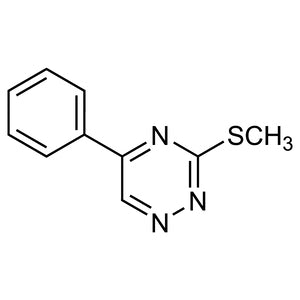
3-(Methylthio)-5-phenyl-1,2,4-triazine, CAS number 28735-27-5, is a nitrogen-rich heterocyclic compound built on a 1,2,4-triazine ring that carries a methylthio group at position 3 and a phenyl group at position 5. In the laboratory it serves an important role in conjugation chemistry and click chemistry, the field that relies on fast, selective, high-yielding reactions to join two molecules together. The 1,2,4-triazine ring is well known as an electron-poor diene capable of reacting through inverse electron demand Diels-Alder cycloaddition with electron-rich dienophiles or strained alkenes, which makes this compound a useful building block for bioorthogonal ligation studies.
The property that drives its selection is the electron-poor character of the triazine ring, which is reinforced by the substituents surrounding it. The methylthio group plays a dual role: it tunes the electronic reactivity of the ring while also acting as a good leaving group in nucleophilic aromatic substitution reactions, allowing researchers to replace it with amines, thiols, or alkoxides to construct libraries of derivatives. The methylthio group can also be oxidised to the corresponding sulfoxide or sulfone, which are considerably more reactive. The phenyl group, meanwhile, adds conjugative stability while contributing lipophilic character that is useful in downstream applications.
In Indonesian laboratories this compound is typically handled in university research groups, medicinal chemistry programmes, and institutional research centres working on bioconjugation and heterocyclic synthesis. It is normally used at small scale on the bench, weighed out in a fume hood and carried forward directly into a coupling or substitution step. Because it functions as an intermediate rather than an end product, it is usually ordered in modest quantities alongside the dienophile or nucleophile partner required for the planned reaction sequence.
Related TCI products
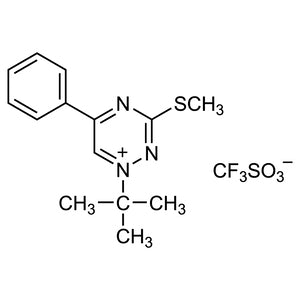
- TCI B7003 1-(tert-Butyl)-3-(methylthio)-5-phenyl-1,2,4-triazin-1-ium Trifluoromethanesulfonate
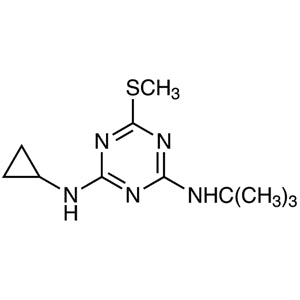
- TCI I0842 28159-98-0 2-(tert-Butylamino)-4-(cyclopropylamino)-6-(methylthio)-1,3,5-triazine
- TCI B4406 63810-78-6 5-Bromo-4-chloro-2-(methylthio)pyrimidine
- TCI B3829 50593-92-5 5-Bromo-2-(methylthio)pyrimidine-4-carboxylic Acid
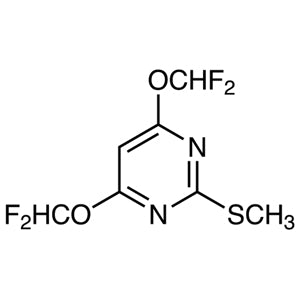
- TCI B2755 100478-25-9 4,6-Bis(difluoromethoxy)-2-(methylthio)pyrimidine
- TCI B1778 49638-64-4 4,5-Bis(methylthio)-1,3-dithiole-2-thione
- Inverse electron demand Diels-Alder studies: the electron-poor 1,2,4-triazine ring reacts readily with electron-rich dienophiles or strained alkenes, giving fast and selective cycloaddition without additional catalysts.
- Bioconjugation and click chemistry ligation: the compound supports rapid, selective, high-yielding joining of two molecular partners, which is the defining requirement of conjugation chemistry workflows.
- Derivative library synthesis: the methylthio group behaves as a good leaving group in nucleophilic aromatic substitution, letting chemists install amines, thiols, or alkoxides to generate structurally varied analogues.
- Sulfoxide and sulfone preparation: oxidation of the methylthio substituent produces markedly more reactive sulfoxide or sulfone derivatives, giving access to activated intermediates for subsequent displacement chemistry.
- Heterocyclic building block research: the phenyl substituent supplies conjugative stability and lipophilic character, making the compound a practical scaffold for constructing more elaborate nitrogen heterocyclic systems.
| Brand | TCI |
|---|---|
| CAS number | 28735-27-5 |
| Molecular formula | — |
| Purity | — |
| Category | Chemistry > Chemical Biology > Conjugation Chemistry / Click Chemistry |
| Pack sizes | available in standard research laboratory pack sizes; please confirm the size required when ordering. |
| Physical form | — |
| Storage | store in a cool, dry place in a tightly closed container, away from light and moisture. |
- Product code: M4025
Store the material in its original tightly closed container in a cool, dry, well-ventilated area, protected from light, moisture, and sources of ignition. Amber glass bottles or the supplier's original packaging are suitable containers; keep the cap firmly sealed to limit exposure to air and humidity. Handle all weighing and transfer operations inside a fume hood, and wear a laboratory coat, chemical-resistant gloves, and safety goggles. Avoid inhalation of dust and direct skin or eye contact. Keep the compound separate from strong oxidising agents, and consult the manufacturer's safety data sheet before use. Dispose of residues and contaminated materials in accordance with applicable chemical waste procedures.
—
Product Categories
- Biochemicals and ReagentsBioconjugationCopper-free Click Reaction Reagents
- Pharmaceutical Development and Drug Discovery ResearchBioconjugationCopper-free Click Reaction Reagents
- Pharmaceutical Development and Drug Discovery ResearchConjugation Chemistry/Click ChemistryCopper-free Click Reaction Reagents
Produk Terkait
-
Trifluoromethanesulfonate TCI B7003
Regular price From Rp 1.988.700,00Regular priceRp 1.405.950,00Sale price From Rp 1.988.700,00 -
2-(tert-Butylamino)-4-(cyclopropylamino)-6-(methylthio)-1,3,5-triazine TCI I0842
Regular price From Rp 1.696.800,00Regular priceRp 1.202.250,00Sale price From Rp 1.696.800,00 -
5-Bromo-4-chloro-2-(methylthio)pyrimidine TCI B4406
Regular price From Rp 1.008.000,00Regular priceRp 720.300,00Sale price From Rp 1.008.000,00 -
5-Bromo-2-(methylthio)pyrimidine-4-carboxylicAcid TCI B3829
Regular price From Rp 769.650,00Regular priceRp 553.350,00Sale price From Rp 769.650,00 -
4,6-Bis(difluoromethoxy)-2-(methylthio)pyrimidine TCI B2755
Regular price From Rp 717.150,00Regular priceRp 516.600,00Sale price From Rp 717.150,00 -
4,5-Bis(methylthio)-1,3-dithiole-2-thione TCI B1778
Regular price Rp 3.658.200,00Regular priceRp 2.573.550,00Sale price Rp 3.658.200,00 -
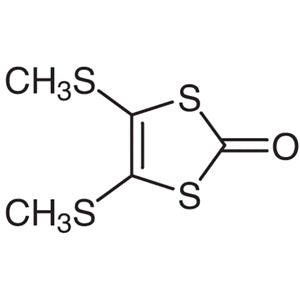
4,5-Bis(methylthio)-1,3-dithiol-2-one TCI B1777
Regular price Rp 3.207.750,00Regular priceRp 2.258.550,00Sale price Rp 3.207.750,00 -
N-[Bis(methylthio)methylene]-p-toluenesulfonamide TCI B1389
Regular price Rp 2.121.000,00Regular priceRp 1.498.350,00Sale price Rp 2.121.000,00






![TCI B1389 2651-15-2 N-[Bis(methylthio)methylene]-p-toluenesulfonamide](http://amiscientific.com/cdn/shop/files/TCI2510B1389_b6140954-a3f9-4418-a961-b51ef0b2b170.jpg?v=1792659772&width=533)
![2651-15-2 N-[Bis(methylthio)methylene]-p-toluenesulfonamide - AMI Scientific](http://amiscientific.com/cdn/shop/files/TCI2510B1389.jpg?v=1767087151&width=533)