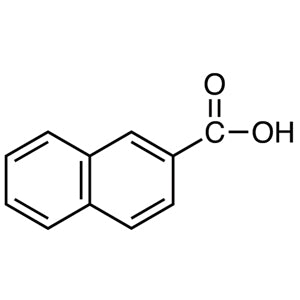
2-Naphthoic acid is the beta isomer of naphthoic acid, in which the carboxyl group is attached to the second position of the naphthalene skeleton. This arrangement produces a molecule that is more linear and less sterically hindered than the alpha isomer, which is why it is frequently the first choice when researchers need a long, directional aromatic connector. In the laboratory it serves as a starting material for the synthesis of ester and amide derivatives, as a carboxylate ligand in coordination chemistry, and as a building unit for conjugated molecules in organic materials research.
Several characteristics explain why this compound is so widely selected. It is a stable solid at room temperature, it is readily purified by recrystallisation, and its acid-base behaviour is predictable, so it can be separated from neutral mixtures by a simple acid-base extraction. The naphthalene core contributes strong ultraviolet absorption and luminescent behaviour that is useful both in photophysical studies and as a means of analytical detection. The linear geometry of its carboxylate group is particularly valued in the design of metal-organic frameworks and coordination polymers, because the regular bond direction makes ordered structure formation easier to achieve.
In Indonesian laboratories, 2-naphthoic acid is typically found in synthetic organic chemistry groups at universities and research institutes, as well as in materials chemistry work where aromatic linkers are required. It is generally handled on the bench scale for derivative preparation, ligand studies, and method development, where its solid form, straightforward purification, and predictable behaviour make it convenient for routine use by both students and experienced researchers.
- Ester and amide derivative synthesis: the carboxyl group reacts predictably through standard activation and coupling routes, giving reliable access to a wide family of naphthalene-based derivatives.
- Carboxylate ligand in coordination chemistry: the compound binds metal centres through its carboxylate group, providing a well-behaved aromatic ligand for the preparation and study of coordination compounds.
- Metal-organic framework and coordination polymer design: its linear carboxylate geometry gives ordered bond directionality, which makes the assembly of regular extended framework structures considerably easier to control.
- Conjugated molecule construction for organic materials research: the extended naphthalene system serves as a rigid aromatic building unit within larger conjugated architectures studied in materials laboratories.
- Photophysical and analytical detection studies: strong ultraviolet absorption and luminescent behaviour from the naphthalene core make the compound useful both as a probe and as a detectable analytical species.
| Brand | TCI |
|---|---|
| CAS number | 93-09-4 |
| Molecular formula | — |
| Purity | — |
| Category | Chemistry > Building Blocks > Non-Heterocyclic Building Blocks |
| Pack sizes | available in standard TCI catalogue pack sizes; please confirm the option required when ordering |
| Physical form | solid at room temperature |
| Storage | keep in a tightly closed container in a cool, dry, well-ventilated place |
- Product code: N0025
Store 2-naphthoic acid in a tightly closed original container in a cool, dry and well-ventilated area, away from moisture, direct sunlight and incompatible materials such as strong bases and strong oxidising agents. Amber glass or the supplier's original packaging is suitable for keeping the solid dry and protected from light. Handle the material inside a fume hood and wear a laboratory coat, safety goggles and chemical-resistant gloves, since the fine solid may irritate the eyes, skin and respiratory tract. Avoid generating dust when weighing, use a clean and dry spatula to prevent contamination of the stock, and close the container immediately after use. Wash hands thoroughly after handling, and consult the manufacturer's safety data sheet before first use and before disposal of any residue.
—
Produk Terkait
-
TCI B5774 5,10-Bis(4,4,5,5-tetramethyl-1,3,2-dioxaborolan-2-yl)naphtho[1,2-c:5,6-c']bis([1,2,5]oxadiazole)
Regular price Rp 10.255.350,00Regular price -
Dihydroiodide TCI B6569
Regular price From Rp 1.936.200,00Regular price -
Trifluoromethanesulfonate TCI B7003
Regular price From Rp 1.936.200,00Regular price
![5,10-Bis(4,4,5,5-tetramethyl-1,3,2-dioxaborolan-2-yl)naphtho[1,2-c:5,6-c']bis([1,2,5]oxadiazole) - TCI B5774 - AMI Scientific](http://amiscientific.com/cdn/shop/files/TCI2510B5774.jpg?v=1769180228&width=533)