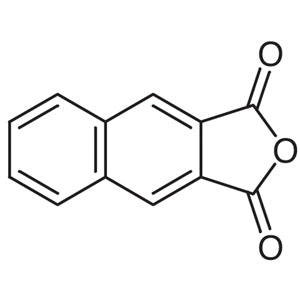
2,3-Naphthalenedicarboxylic Anhydride is a chemical compound widely used as a foundational building block in various chemical reactions. It is commonly found in chemical laboratories, particularly in the synthesis of aromatic and heterocyclic compounds. As an anhydride, this compound is capable of reacting with alcohols and amines to form esters and amides, making it a versatile reagent in organic chemistry. Its role in the laboratory is critical for the development of complex molecular structures, especially in synthetic pathways involving aromatic systems.
The compound’s molecular structure is stable, yet it exhibits high reactivity due to its aromatic nature. This reactivity allows it to participate in a wide range of chemical transformations, making it a preferred choice for researchers seeking reliable and efficient synthetic routes. Its ability to form esters and amides under controlled conditions ensures its utility in both academic and industrial settings. The compound’s availability and consistent performance further enhance its appeal in laboratory environments.
In Indonesian laboratories, 2,3-Naphthalenedicarboxylic Anhydride is frequently used in chemical research, particularly in organic synthesis. It is a key component in the development of new compounds and materials, supporting both educational and research initiatives. Its reliability and effectiveness make it a staple in the laboratories of universities and research institutions across Indonesia.
- Organic synthesis of aromatic and heterocyclic compounds due to its reactivity and ability to form esters and amides.
- Development of new chemical materials in research and industrial settings because of its versatile functional groups.
- Teaching and experimental use in chemistry courses to demonstrate anhydride reactions and molecular building blocks.
- Pharmaceutical research for the synthesis of complex drug molecules requiring aromatic ring modifications.
- Analytical chemistry applications for the characterization of compounds through various spectroscopic techniques.
| Brand | TCI |
|---|---|
| CAS number | 716-39-2 |
| Molecular formula | — |
| Purity | — |
| Category | Chemistry > Building Blocks > Non-Heterocyclic Building Blocks |
| Pack sizes | Available in various quantities as per standard laboratory supply |
| Physical form | Solid |
| Storage | Store in a cool, dry place away from moisture and direct sunlight |
This compound should be stored in a cool, dry environment to maintain its stability and prevent degradation. It is recommended to use airtight containers to protect it from moisture and air exposure. Due to its reactivity, it should be handled in a well-ventilated area, preferably under a fume hood, to minimize inhalation risks. Avoid contact with skin and eyes, and use appropriate personal protective equipment such as gloves and safety goggles. Ensure that storage areas are free from incompatible materials to prevent unwanted reactions. Regular monitoring of storage conditions is advised to ensure the compound remains in optimal condition for laboratory use.
—
Produk Terkait
-
TCI B5774 5,10-Bis(4,4,5,5-tetramethyl-1,3,2-dioxaborolan-2-yl)naphtho[1,2-c:5,6-c']bis([1,2,5]oxadiazole)
Regular price Rp 10.255.350,00Regular price -
Dihydroiodide TCI B6569
Regular price From Rp 1.936.200,00Regular price -
Trifluoromethanesulfonate TCI B7003
Regular price From Rp 1.936.200,00Regular price
![5,10-Bis(4,4,5,5-tetramethyl-1,3,2-dioxaborolan-2-yl)naphtho[1,2-c:5,6-c']bis([1,2,5]oxadiazole) - TCI B5774 - AMI Scientific](http://amiscientific.com/cdn/shop/files/TCI2510B5774.jpg?v=1769180228&width=533)