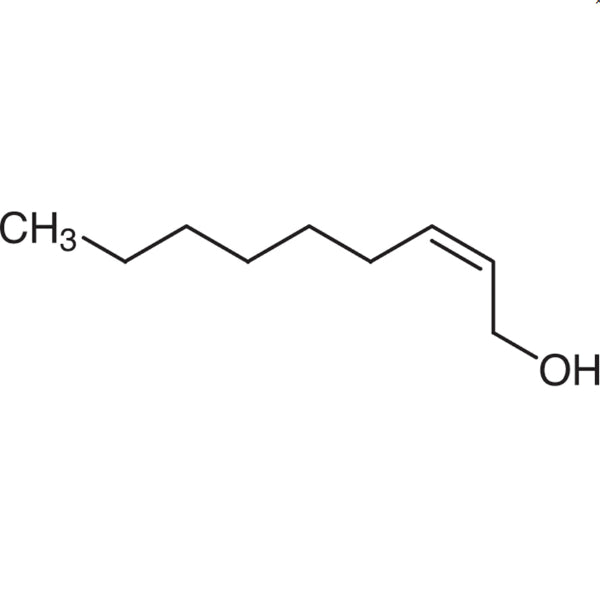
cis-2-Nonen-1-ol is a nine-carbon aliphatic alcohol with a single cis (Z) double bond between the second and third carbon atoms, directly next to a primary hydroxyl group. Because the double bond sits beside the alcohol, the compound is an allylic alcohol. This class of compounds is very useful in organic synthesis because the hydroxyl group and the double bond affect each other's reactivity. In the laboratory, this TCI product serves as a non-heterocyclic building block, a reference standard in aroma analysis, and a model substrate for studying stereoselective reactions. It gives researchers a well-defined starting point for synthesis and analytical work.
The main reason chemists choose this material is its defined cis geometry. Many reactions of allylic alcohols depend strongly on the geometry of the double bond. Examples include directed epoxidation, cyclopropanation, and oxidation to α,β-unsaturated aldehydes. Having the specific cis isomer lets researchers obtain products with the stereochemistry they expect. It also avoids the uncertainty that comes from mixed isomers. Nine-carbon unsaturated alcohols are also well known in flavour and fragrance chemistry. This makes the isomer valuable as a reference compound for identifying volatile components in complex samples.
In Indonesia, cis-2-Nonen-1-ol is relevant to organic chemistry laboratories, food technology laboratories, and research groups working on flavour and fragrance analysis. University researchers can use it to teach and study stereoselective transformations of allylic alcohols. Analytical and food science laboratories can use it as a reference standard when profiling the volatile compounds that shape aroma. Synthetic chemistry groups can also use it as a building block to construct larger non-heterocyclic molecules for research projects.
- Stereoselective synthesis studies: the defined cis double bond next to the hydroxyl group makes it a good model substrate for reactions whose outcome depends on alkene geometry.
- Directed epoxidation and cyclopropanation: as an allylic alcohol, its hydroxyl group can guide reagents to the double bond, so researchers can study selectivity with a known cis isomer.
- Oxidation to α,β-unsaturated aldehydes: the primary allylic hydroxyl group can be oxidised to the corresponding unsaturated aldehyde, which is useful for preparing further synthetic intermediates.
- Aroma and flavour analysis: nine-carbon unsaturated alcohols are known in flavour chemistry, so this isomer serves as a reference compound for identifying volatile components in samples.
- Non-heterocyclic building block: its simple chain with two reactive functional groups lets chemists build larger acyclic molecules through well-established alcohol and alkene chemistry.
| Brand | TCI (product code N0586) |
|---|---|
| CAS number | 41453-56-9 |
| Molecular formula | — |
| Purity | — |
| Category | Chemistry > Building Blocks > Non-Heterocyclic Building Blocks |
| Pack sizes | see the product page for the pack sizes currently offered |
| Physical form | liquid |
| Storage | keep tightly closed in a cool, dark, well-ventilated place; follow the supplier's label and Safety Data Sheet |
Store cis-2-Nonen-1-ol in its original, tightly sealed container. Keep it in a cool, dry, dark, and well-ventilated area away from heat sources, open flames, and strong oxidising agents. Close containers promptly after use to limit exposure to air and moisture, which helps preserve the defined cis isomer. Handle the material in a fume hood or a well-ventilated area. Wear suitable gloves, safety glasses, and a laboratory coat, and avoid contact with skin and eyes and breathing in vapours. Always read the manufacturer's Safety Data Sheet before use, and dispose of waste according to local regulations and your institution's laboratory safety procedures.
—
Produk Terkait
-
TCI B5774 5,10-Bis(4,4,5,5-tetramethyl-1,3,2-dioxaborolan-2-yl)naphtho[1,2-c:5,6-c']bis([1,2,5]oxadiazole)
Regular price Rp 10.255.350,00Regular price -
Dihydroiodide TCI B6569
Regular price From Rp 1.936.200,00Regular price -
Trifluoromethanesulfonate TCI B7003
Regular price From Rp 1.936.200,00Regular price
![5,10-Bis(4,4,5,5-tetramethyl-1,3,2-dioxaborolan-2-yl)naphtho[1,2-c:5,6-c']bis([1,2,5]oxadiazole) - TCI B5774 - AMI Scientific](http://amiscientific.com/cdn/shop/files/TCI2510B5774.jpg?v=1769180228&width=533)