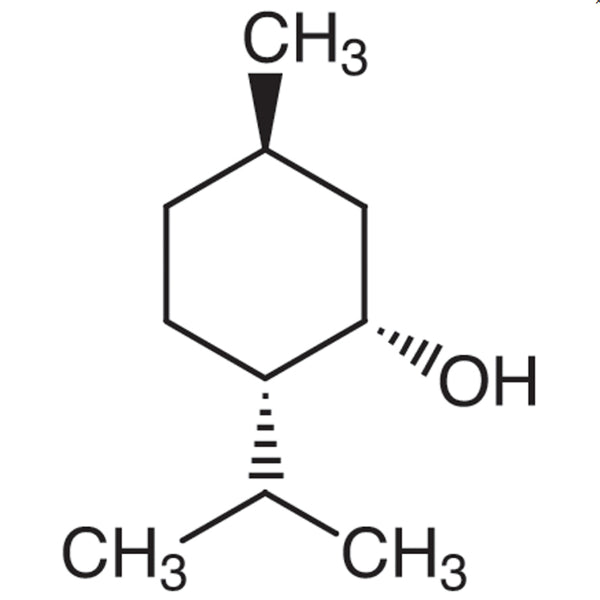
TCI N0626 (+)-Neomenthol is a stereoisomer of menthol. It is a cyclic monoterpene alcohol with three chiral centres on its cyclohexane ring. Neomenthol differs from menthol in the spatial arrangement of its hydroxyl group. The (+) designation refers to the specific enantiomer that rotates plane-polarised light to the right. In the laboratory, this compound serves as a chiral building block in asymmetric synthesis and as a chiral auxiliary. It is also used as a reference standard in the analysis of menthol stereoisomers, where its well-defined identity helps researchers tell closely related isomers apart.
Researchers choose (+)-Neomenthol for its well-defined chirality and its rigid, naturally derived carbon framework. In asymmetric synthesis, the menthyl framework is often used to direct the stereochemistry of a reaction. A common approach is to form esters or other derivatives, which can then be separated and cleaved to release the desired product. Because its hydroxyl group is arranged differently from menthol's, neomenthol shows different reactivity and selectivity. This makes it a useful option for researchers who want to compare how stereochemistry affects reaction outcomes, and a valuable complement to the more commonly used menthol-based auxiliaries.
(+)-Neomenthol is also an important standard in the chromatographic analysis of essential oils. Indonesia is rich in plants that produce essential oils, so laboratories in universities, research institutes and the flavour, fragrance and natural product industries often need reliable stereoisomer references. Analysts use such references to check the composition and authenticity of essential oil samples. Synthetic chemistry groups use them to build chiral molecules and to study how stereochemistry changes reaction behaviour in their own research programmes.
- Chiral building block in asymmetric synthesis: the compound's defined chirality and rigid cyclohexane framework provide a dependable stereochemical starting point for building more complex chiral target molecules.
- Chiral auxiliary for stereocontrol: the menthyl framework can be attached as an ester or other derivative to direct a reaction's stereochemistry, then separated and cleaved once the transformation is complete.
- Comparative stereochemistry studies: because its hydroxyl group is arranged differently from menthol's, it lets researchers compare how stereochemistry changes reactivity and selectivity under the same reaction conditions.
- Reference standard for menthol stereoisomer analysis: its well-defined stereochemical identity makes it suitable for identifying and distinguishing menthol isomers in analytical methods that separate closely related compounds.
- Chromatographic analysis of essential oils: it serves as a reference compound when checking the composition of essential oil samples, which is especially relevant given the wide range of essential-oil-producing plants in Indonesia.
| Brand | TCI (product code N0626) |
|---|---|
| CAS number | 2216-52-6 |
| Molecular formula | — |
| Purity | — |
| Category | Chemistry > Asymmetric Synthesis > Chiral Building Blocks |
| Pack sizes | available in the pack sizes listed on the product page; please confirm with our team when ordering |
| Physical form | refer to the manufacturer's Certificate of Analysis and Safety Data Sheet |
| Storage | keep in a tightly closed original container in a cool, dry, well-ventilated place, as directed by the manufacturer's documentation |
Store (+)-Neomenthol in its original, tightly closed container in a cool, dry and well-ventilated area, away from direct sunlight, heat sources and incompatible materials such as strong oxidising agents. Use chemically compatible glass or manufacturer-supplied packaging, and label containers clearly to avoid confusion with other menthol stereoisomers. Handle the compound in a fume hood or well-ventilated area. Wear suitable personal protective equipment, including safety glasses, laboratory gloves and a lab coat. Avoid contact with skin and eyes, and do not inhale vapours. Always read the manufacturer's Safety Data Sheet before use, and dispose of residues according to local regulations and institutional laboratory safety procedures.
—
Produk Terkait
-
TCI B5774 5,10-Bis(4,4,5,5-tetramethyl-1,3,2-dioxaborolan-2-yl)naphtho[1,2-c:5,6-c']bis([1,2,5]oxadiazole)
Regular price Rp 10.255.350,00Regular price -
Dihydroiodide TCI B6569
Regular price From Rp 1.936.200,00Regular price -
Trifluoromethanesulfonate TCI B7003
Regular price From Rp 1.936.200,00Regular price
![5,10-Bis(4,4,5,5-tetramethyl-1,3,2-dioxaborolan-2-yl)naphtho[1,2-c:5,6-c']bis([1,2,5]oxadiazole) - TCI B5774 - AMI Scientific](http://amiscientific.com/cdn/shop/files/TCI2510B5774.jpg?v=1769180228&width=533)