![TCI N0634 125700-73-4 2-(5-Norbornene-2,3-dicarboximido)-1,1,3,3-tetramethyluronium Tetrafluoroborate [Coupling Reagent for Peptide]](http://amiscientific.com/cdn/shop/files/TCI2510N0634_dce91219-e06a-4a6b-b391-6a2bd8668daf.jpg?v=1792650634&width=1946)
![125700-73-4 2-(5-Norbornene-2,3-dicarboximido)-1,1,3,3-tetramethyluronium Tetrafluoroborate [Coupling Reagent for Peptide] - AMI Scientific](http://amiscientific.com/cdn/shop/files/TCI2510N0634.jpg?v=1769181097&width=1946)
![TCI N0634 125700-73-4 2-(5-Norbornene-2,3-dicarboximido)-1,1,3,3-tetramethyluronium Tetrafluoroborate [Coupling Reagent for Peptide]](http://amiscientific.com/cdn/shop/files/TCI2510N0634_dce91219-e06a-4a6b-b391-6a2bd8668daf.jpg?v=1792650634&width=1445)
![125700-73-4 2-(5-Norbornene-2,3-dicarboximido)-1,1,3,3-tetramethyluronium Tetrafluoroborate [Coupling Reagent for Peptide] - AMI Scientific](http://amiscientific.com/cdn/shop/files/TCI2510N0634.jpg?v=1769181097&width=1445)
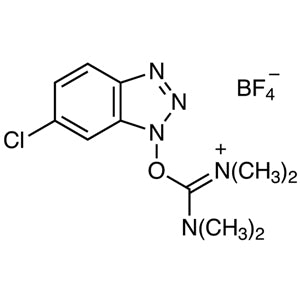
2-(5-Norbornene-2,3-dicarboximido)-1,1,3,3-tetramethyluronium Tetrafluoroborate from TCI, commonly abbreviated as TNTU, is a uronium salt coupling reagent for peptide chemistry. It activates the carboxyl group of amino acids and other carboxylic acids so that they react readily with amines to form amide bonds. The amide bond is the backbone of every peptide and of many pharmaceutical molecules. In the laboratory, TNTU is one of the main tools chemists use to join building blocks reliably when making peptides and amide-containing compounds.
TNTU belongs to the same family of uronium reagents as TBTU and HBTU. Unlike those reagents, it uses an N-hydroxy-5-norbornene-2,3-dicarboximide (HONB) framework as its activating group instead of a benzotriazole derivative. Chemists choose it because it converts carboxylic acids directly into HONB active esters. These esters have long been known in peptide synthesis as intermediates that are reactive but still reasonably controlled. Under suitable conditions, this helps suppress racemization of chiral amino acids. TNTU is a solid tetrafluoroborate salt, so it is easy to weigh and fits standard protocols that use a tertiary amine base.
In Indonesia, TNTU is relevant to university research groups, pharmaceutical and biotechnology development laboratories, and institutions working on synthetic peptides or small-molecule drug candidates. The reagent works in both solution-phase and solid-phase peptide synthesis, as well as in general amide formation in organic chemistry. This makes it a practical choice for laboratories that need one coupling reagent for several synthetic tasks. It suits teaching, method development and routine preparative work alike, whenever a reliable amide bond is needed.
TCI brochures (PDF)
- Condensing Agents 2025-11-18 · p. 7
- Boron Compounds 2025-10-07 · p. 25
- Amino Acids and Peptide Synthesis Reagents 2025-08-14 · p. 40
Related TCI products
- TCI B1774 128625-52-5 1H-Benzotriazol-1-yloxytripyrrolidinophosphonium Hexafluorophosphate [Coupling Reagent for Peptide]
- TCI B1658 125700-67-6 TBTU [Coupling Reagent for Peptide]
- TCI B1657 94790-37-1 HBTU [Coupling Reagent for Peptide]
- TCI B1651 56602-33-6 1H-Benzotriazol-1-yloxytris(dimethylamino)phosphonium Hexafluorophosphate [Coupling Reagent for Peptide]
- TCI O0390 125700-71-2 O-[2-Oxo-1(2H)-pyridyl]-N,N,N',N'-tetramethyluronium Tetrafluoroborate
- TCI E0916 136849-72-4 O-[(Ethoxycarbonyl)cyanomethylenamino]-N,N,N',N'-tetramethyluronium Tetrafluoroborate
- Solid-phase peptide synthesis: TNTU activates protected amino acids as HONB active esters, which lets resin-bound peptide chains grow step by step through controlled amide bond formation.
- Solution-phase peptide synthesis: Its solid, easily weighed salt form and compatibility with tertiary amine bases make it convenient for coupling peptide fragments and amino acids in solution.
- Racemization-sensitive couplings: The controlled reactivity of HONB active esters helps suppress racemization of chiral amino acids under appropriate conditions, which protects the stereochemical integrity of the product.
- General amide formation in organic synthesis: Beyond peptides, TNTU converts many carboxylic acids into active esters that react readily with amines, which is useful for building amide-containing target molecules.
- Pharmaceutical and medicinal chemistry research: The amide bond is common in drug molecules, so TNTU helps research laboratories prepare candidate compounds and intermediates that need dependable amide coupling steps.
| Brand | TCI (product code N0634) |
|---|---|
| CAS number | 125700-73-4 |
| Molecular formula | — |
| Purity | — |
| Category | Chemistry > Chemical Biology > Peptide Chemistry |
| Pack sizes | available in the standard TCI pack sizes listed on the product page |
| Physical form | solid (tetrafluoroborate salt) |
| Storage | keep tightly closed in a cool, dry place and follow the TCI label and Safety Data Sheet |
Store TNTU in its original, tightly sealed container in a cool, dry and well-ventilated area, away from moisture, heat and incompatible substances. Coupling reagents of this type can lose activity if exposed to humidity. Reseal the container promptly after each use, and consider a desiccator for opened packs. Handle the reagent in a fume hood and wear appropriate personal protective equipment, including gloves, safety glasses and a lab coat. Avoid breathing dust and avoid contact with skin and eyes. Always check the TCI label and Safety Data Sheet for specific storage conditions, hazard information and disposal requirements.
—
Product Categories
Produk Terkait
-
1H-Benzotriazol-1-yloxytripyrrolidinophosphoniumHexafluorophosphate[CouplingReagentforPeptide] TCI B1774
Regular price From Rp 1.033.200,00Regular priceRp 738.150,00Sale price From Rp 1.033.200,00 -
TBTU[CouplingReagentforPeptide] TCI B1658
Regular price From Rp 1.563.450,00Regular priceRp 1.108.800,00Sale price From Rp 1.563.450,00 -
HBTU[CouplingReagentforPeptide] TCI B1657
Regular price From Rp 637.350,00Regular priceRp 460.950,00Sale price From Rp 637.350,00 -
1H-Benzotriazol-1-yloxytris(dimethylamino)phosphoniumHexafluorophosphate[CouplingReagentforPeptide] TCI B1651
Regular price From Rp 848.400,00Regular priceRp 609.000,00Sale price From Rp 848.400,00 -
O-[2-Oxo-1(2H)-pyridyl]-N,N,N',N'-tetramethyluroniumTetrafluoroborate TCI O0390
Regular price From Rp 742.350,00Regular priceRp 534.450,00Sale price From Rp 742.350,00 -
O-[(Ethoxycarbonyl)cyanomethylenamino]-N,N,N',N'-tetramethyluroniumTetrafluoroborate TCI E0916
Regular price From Rp 689.850,00Regular priceRp 497.700,00Sale price From Rp 689.850,00 -
O-(6-Chlorobenzotriazol-1-yl)-N,N,N',N'-tetramethyluroniumTetrafluoroborate TCI C1926
Regular price From Rp 530.250,00Regular priceRp 386.400,00Sale price From Rp 530.250,00 -
O-(6-Chlorobenzotriazol-1-yl)-N,N,N',N'-tetramethyluroniumHexafluorophosphate TCI C1988
Regular price Rp 557.550,00Regular priceRp 405.300,00Sale price Rp 557.550,00
![TCI B1774 128625-52-5 1H-Benzotriazol-1-yloxytripyrrolidinophosphonium Hexafluorophosphate [Coupling Reagent for Peptide]](http://amiscientific.com/cdn/shop/files/TCI2510B1774_efb7c161-8bce-4342-9b12-b8ffdbdd4456.jpg?v=1792660126&width=533)
![128625-52-5 1H-Benzotriazol-1-yloxytripyrrolidinophosphonium Hexafluorophosphate [Coupling Reagent for Peptide] - AMI Scientific](http://amiscientific.com/cdn/shop/files/TCI2510B1774.jpg?v=1768204096&width=533)
![TCI B1658 125700-67-6 TBTU [Coupling Reagent for Peptide]](http://amiscientific.com/cdn/shop/files/TCI2510B1658_d81473d6-09b8-400d-bcee-b1ac7277e7f6.jpg?v=1792660053&width=533)
![125700-67-6 TBTU [Coupling Reagent for Peptide] - AMI Scientific](http://amiscientific.com/cdn/shop/files/TCI2510B1658.jpg?v=1768204085&width=533)
![94790-37-1 HBTU [Coupling Reagent for Peptide] - AMI Scientific](http://amiscientific.com/cdn/shop/files/TCI2510B1657.jpg?v=1768359309&width=533)
![TCI B1651 56602-33-6 1H-Benzotriazol-1-yloxytris(dimethylamino)phosphonium Hexafluorophosphate [Coupling Reagent for Peptide]](http://amiscientific.com/cdn/shop/files/TCI2510B1651_d5da0b4a-830e-4eea-8f93-9dd7d1d4e45c.jpg?v=1792660049&width=533)
![56602-33-6 1H-Benzotriazol-1-yloxytris(dimethylamino)phosphonium Hexafluorophosphate [Coupling Reagent for Peptide] - AMI Scientific](http://amiscientific.com/cdn/shop/files/TCI2510B1651.jpg?v=1768204084&width=533)
![TCI O0390 125700-71-2 O-[2-Oxo-1(2H)-pyridyl]-N,N,N',N'-tetramethyluronium Tetrafluoroborate](http://amiscientific.com/cdn/shop/files/TCI2510O0390_05003839-8caf-40d4-a05a-689c7072d563.jpg?v=1792651408&width=533)
![125700-71-2 O-[2-Oxo-1(2H)-pyridyl]-N,N,N',N'-tetramethyluronium Tetrafluoroborate - AMI Scientific](http://amiscientific.com/cdn/shop/files/TCI2510O0390.jpg?v=1768205996&width=533)
![TCI E0916 136849-72-4 O-[(Ethoxycarbonyl)cyanomethylenamino]-N,N,N',N'-tetramethyluronium Tetrafluoroborate](http://amiscientific.com/cdn/shop/files/TCI2510E0916_5eef4b93-6f8a-4179-b158-8b4468d5f9de.jpg?v=1792641354&width=533)
![O-[(Ethoxycarbonyl)cyanomethylenamino]-N,N,N',N'-tetramethyluronium Tetrafluoroborate (CAS 136849-72-4) - TCI E0916 - AMI Scientific](http://amiscientific.com/cdn/shop/files/TCI2510E0916.jpg?v=1768205247&width=533)