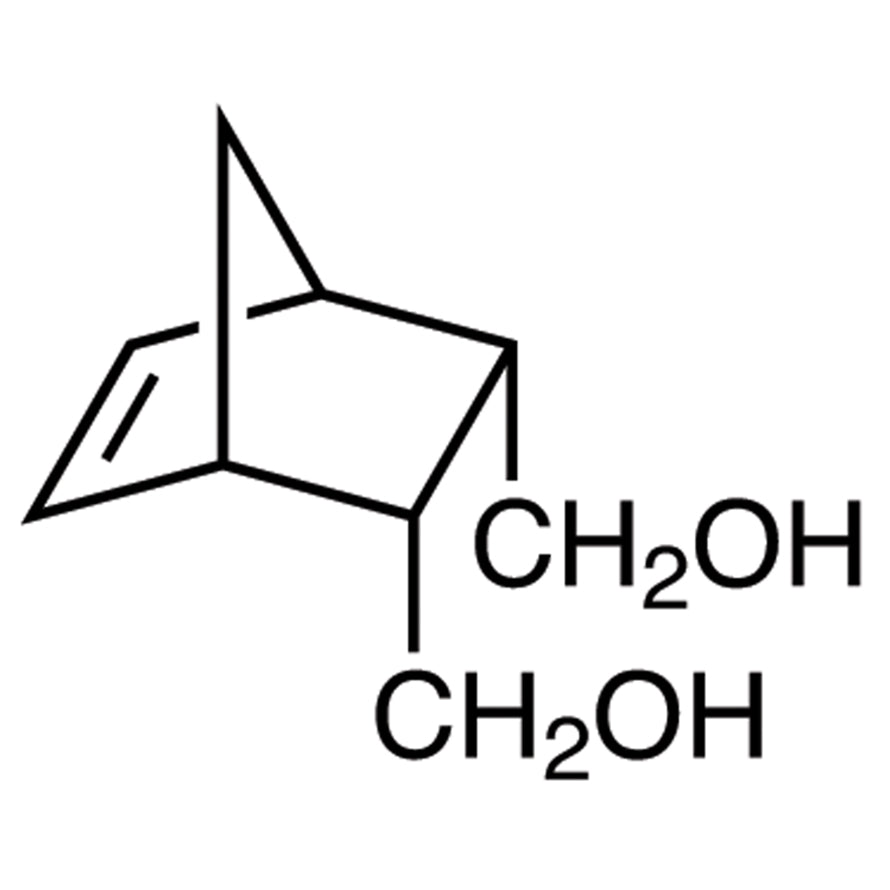
5-Norbornene-2-endo,3-endo-dimethanol from TCI is a bicyclic diol built on a norbornene skeleton. Both of its hydroxymethyl groups sit in the endo configuration, which means they point toward the same side as the C=C double bond. The product is a single isomer rather than a mixed endo/exo version, so researchers can work with a defined stereochemistry. In the laboratory it serves as a monomer in polymer chemistry. It can polymerize through ring-opening metathesis polymerization (ROMP) of its alkene, or through polycondensation of its two primary alcohol groups.
The main advantage of the pure endo,endo isomer is consistency. Because every molecule has the same stereochemistry, polymerization kinetics are more reproducible, and the resulting polymers have a more regular structure than those made from isomer mixtures. In ROMP, endo isomers usually react more slowly than exo isomers. This makes the compound a useful reference in mechanistic studies, and the difference can be used to control monomer sequence in copolymerization. The two endo hydroxyl groups also sit close together in space, which makes it easier to form cyclic derivatives such as cyclic acetals or cyclic carbonates.
In Indonesian laboratories, this monomer suits university polymer chemistry groups, materials science research centres and industrial R&D teams that need a stereochemically defined building block. It fits projects that compare how isomer configuration affects polymerization behaviour, and syntheses where a regular polymer backbone matters. Research groups working on ROMP catalysts, functional polyesters or polycarbonates, or cyclic diol derivatives can use it as a dependable starting material for experiments that need to be repeated and compared.
- Ring-opening metathesis polymerization (ROMP): the strained norbornene double bond takes part in metathesis, and the pure endo,endo configuration gives more reproducible kinetics than endo/exo mixtures.
- Polycondensation: the two primary hydroxymethyl groups can react with suitable co-monomers to build polyesters or related condensation polymers with a more regular structure.
- Mechanistic studies of ROMP: endo isomers typically react more slowly than exo isomers, so this single isomer is an important reference when studying catalyst behaviour and how stereochemistry affects reactivity.
- Sequence control in copolymerization: the slower ROMP reactivity of the endo isomer can be used to influence the order in which monomers are incorporated when it is copolymerized with faster-reacting monomers.
- Synthesis of cyclic derivatives: the two endo hydroxyl groups sit close together in space, which makes it easier to prepare cyclic acetals or cyclic carbonates for further polymer or materials research.
| Brand | TCI |
|---|---|
| CAS number | 699-97-8 |
| Molecular formula | — |
| Purity | — |
| Category | Materials Science > Polymer/Macromolecule Reagents > Monomers |
| Pack sizes | as listed in the current TCI catalogue offering for this product |
| Physical form | — |
| Storage | follow the conditions stated on the TCI product label and Safety Data Sheet |
- Product code: N0768
Keep 5-Norbornene-2-endo,3-endo-dimethanol in its original, tightly closed container in a cool, dry, well-ventilated place, away from heat sources, direct sunlight and incompatible materials such as strong oxidizing agents. Always follow the storage conditions on the TCI label and Safety Data Sheet. Reseal the container right after use so the diol does not absorb moisture or get contaminated. Handle it according to good laboratory practice: wear safety glasses, chemical-resistant gloves and a lab coat, and work in a fume hood or well-ventilated area. Avoid contact with skin and eyes, and avoid breathing any dust or vapour. Label any portions you transfer clearly, and dispose of waste according to local regulations and your institution's rules.
—
Produk Terkait
-
TCI B5774 5,10-Bis(4,4,5,5-tetramethyl-1,3,2-dioxaborolan-2-yl)naphtho[1,2-c:5,6-c']bis([1,2,5]oxadiazole)
Regular price Rp 10.255.350,00Regular price -
Dihydroiodide TCI B6569
Regular price From Rp 1.936.200,00Regular price -
Trifluoromethanesulfonate TCI B7003
Regular price From Rp 1.936.200,00Regular price
![5,10-Bis(4,4,5,5-tetramethyl-1,3,2-dioxaborolan-2-yl)naphtho[1,2-c:5,6-c']bis([1,2,5]oxadiazole) - TCI B5774 - AMI Scientific](http://amiscientific.com/cdn/shop/files/TCI2510B5774.jpg?v=1769180228&width=533)