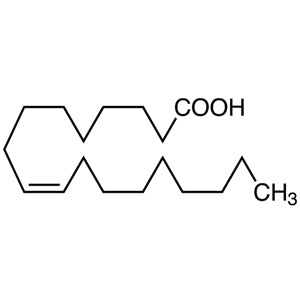
Oleic Acid (TCI O0011, CAS 112-80-1) is a monounsaturated fatty acid with an 18-carbon chain and a cis double bond at the ninth carbon. It is the most abundant fatty acid in nature and a major component of many vegetable oils, including olive oil and palm oil. It has a wide range of uses in the laboratory. It serves as a ligand and surfactant in nanoparticle synthesis, as a formulation ingredient, as a standard in lipid analysis, and as a building block for making oleochemical derivatives. This makes it a common reagent in both research and applied chemistry laboratories.
Researchers choose oleic acid because its structure combines two useful features. Its carboxyl group can bind to metal and metal oxide surfaces. Its long hydrocarbon chain is bent by the cis configuration. The bent chain provides effective steric hindrance, which stops nanoparticles from clumping together and keeps them dispersed in nonpolar solvents. Oleic acid is liquid at room temperature, so it is easy to measure, dispense, and mix. Its double bond can also be modified by epoxidation, hydrogenation, or oxidative cleavage. This lets chemists turn a single starting material into many different derivatives, which is why it is valued as a synthetic building block.
In Indonesia, oleic acid is an important material for nanotechnology laboratories that synthesize magnetic nanoparticles and quantum dots, where it is used to control particle surfaces and keep particles dispersed. It is also important for oleochemical laboratories, which is especially relevant because Indonesia has a large palm oil sector and oleic acid is a major fatty acid in palm-derived materials. Lipid analysis and formulation laboratories also use it as a well-characterized reference fatty acid and as a working ingredient in their studies.
- Nanoparticle synthesis: oleic acid acts as a capping ligand and surfactant, because its carboxyl group binds metal oxide surfaces and its bent chain prevents particles from aggregating.
- Magnetic nanoparticle and quantum dot preparation: its steric stabilization keeps these nanomaterials well dispersed in nonpolar solvents, which supports consistent synthesis and later surface characterization work.
- Lipid analysis standard: as the most abundant natural fatty acid, it is a relevant reference compound for identifying and comparing fatty acid profiles in oils and lipid samples.
- Oleochemical derivative synthesis: its cis double bond can be epoxidized, hydrogenated, or oxidatively cleaved, making it a versatile starting point for a variety of fatty acid derivatives.
- Formulation studies: because it is liquid at room temperature, it is easy to measure and blend, so it is practical as an ingredient in laboratory formulation development and testing.
| Brand | TCI (product code O0011) |
|---|---|
| CAS number | 112-80-1 |
| Molecular formula | — |
| Purity | — |
| Category | Chemistry > Building Blocks > Non-Heterocyclic Building Blocks |
| Pack sizes | available pack sizes are listed on the product page |
| Physical form | liquid at room temperature |
| Storage | store according to the manufacturer's label and Safety Data Sheet |
Keep Oleic Acid in its original, tightly closed container in a cool, dry, well-ventilated area, away from direct sunlight and heat sources. Because the molecule has a carbon-carbon double bond, limit its exposure to air and light to help protect its quality over time. Always check the manufacturer's label and Safety Data Sheet for the recommended storage conditions. Use suitable glass or chemically compatible containers when transferring or dispensing the liquid. Follow standard laboratory safety practice: wear protective gloves, safety glasses, and a lab coat, avoid contact with skin and eyes, and work in a ventilated area. Clean up spills promptly and dispose of waste according to local regulations and institutional procedures.
—
Produk Terkait
-
TCI B5774 5,10-Bis(4,4,5,5-tetramethyl-1,3,2-dioxaborolan-2-yl)naphtho[1,2-c:5,6-c']bis([1,2,5]oxadiazole)
Regular price Rp 10.255.350,00Regular price -
Dihydroiodide TCI B6569
Regular price From Rp 1.936.200,00Regular price -
Trifluoromethanesulfonate TCI B7003
Regular price From Rp 1.936.200,00Regular price
![5,10-Bis(4,4,5,5-tetramethyl-1,3,2-dioxaborolan-2-yl)naphtho[1,2-c:5,6-c']bis([1,2,5]oxadiazole) - TCI B5774 - AMI Scientific](http://amiscientific.com/cdn/shop/files/TCI2510B5774.jpg?v=1769180228&width=533)