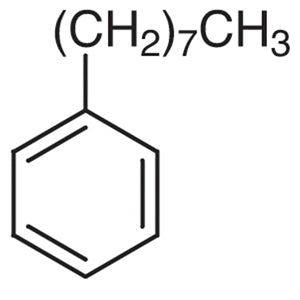
n-Octylbenzene from TCI is an aromatic hydrocarbon made of a benzene ring carrying a straight eight-carbon alkyl chain. It has both an aromatic core and a long aliphatic chain, which makes it a useful non-heterocyclic building block for synthesizing alkylaromatic compounds. In the laboratory, n-octylbenzene serves as a precursor to ring-substituted derivatives, for example through sulfonation, nitration, or halogenation. It is also a practical model compound for studying how alkylbenzenes behave. Alkylbenzenes are an important class of compounds in the detergent and lubricating oil industries.
n-Octylbenzene is valued mainly because it is strongly hydrophobic and chemically stable under ordinary conditions. For this reason, researchers often use it as a standard in reversed-phase chromatography and in partition studies, where predictable, non-polar behavior matters. The benzene ring can still undergo electrophilic aromatic substitution, and the octyl chain affects both the orientation of incoming substituents and the solubility of the products. Sulfonating n-octylbenzene gives an alkylbenzene sulfonic acid, the basic structure behind anionic surfactants. This link makes the compound relevant to both applied and fundamental research.
In Indonesian laboratories, n-octylbenzene suits university organic chemistry groups, industrial research and development teams, and analytical laboratories. Synthetic chemists can use it as a starting material for substituted alkylaromatic intermediates. Analytical chemists can use it as a hydrophobic reference compound when developing and checking chromatographic methods. It also supports research on detergent formulation and environmental studies of alkylbenzene-derived surfactants. Because TCI is a well-known reagent brand, laboratories can use this compound for research, method development, and teaching work that needs consistent material.
- Organic synthesis of ring-substituted derivatives: the benzene ring undergoes sulfonation, nitration, or halogenation, so n-octylbenzene is a convenient precursor for a range of substituted alkylaromatic compounds.
- Surfactant and detergent research: sulfonation gives an alkylbenzene sulfonic acid, the core structure of anionic surfactants, which makes this compound a relevant starting point for formulation studies.
- Reversed-phase chromatography standard: its strong hydrophobicity and chemical stability give predictable retention behavior, so it works well as a reference compound during method development and system checks.
- Partition and hydrophobicity studies: the long octyl chain on an aromatic core gives a clearly non-polar molecule, which suits experiments on how compounds distribute between phases.
- Model compound for alkylbenzene behavior: its simple, well-defined structure lets researchers study how alkyl chains affect reactivity, substitution orientation, and product solubility.
| Brand | TCI (product code O0046) |
|---|---|
| CAS number | 2189-60-8 |
| Molecular formula | — |
| Purity | — |
| Category | Chemistry > Building Blocks > Non-Heterocyclic Building Blocks |
| Pack sizes | see the pack size options listed on this product page |
| Physical form | aromatic hydrocarbon; check the product label or certificate of analysis for details |
| Storage | keep tightly closed in a cool, dry, well-ventilated place |
Store n-octylbenzene in its original, tightly sealed container in a cool, dry, well-ventilated area, away from direct sunlight, heat, and ignition sources. Keep it apart from strong oxidizing agents and from reagents used in reactive substitution chemistry. Use only glass or chemically compatible containers when transferring the material, and label every secondary container clearly. When handling the compound, wear standard personal protective equipment, including safety glasses, chemical-resistant gloves, and a laboratory coat. Work in a fume hood or a well-ventilated area to avoid breathing vapors. Avoid contact with skin and eyes, and wash thoroughly after handling. Always check the supplier's Safety Data Sheet for hazard information, spill response, and correct disposal of hydrophobic organic waste under local regulations.
—
Produk Terkait
-
TCI B5774 5,10-Bis(4,4,5,5-tetramethyl-1,3,2-dioxaborolan-2-yl)naphtho[1,2-c:5,6-c']bis([1,2,5]oxadiazole)
Regular price Rp 10.255.350,00Regular price -
Dihydroiodide TCI B6569
Regular price From Rp 1.936.200,00Regular price -
Trifluoromethanesulfonate TCI B7003
Regular price From Rp 1.936.200,00Regular price
![5,10-Bis(4,4,5,5-tetramethyl-1,3,2-dioxaborolan-2-yl)naphtho[1,2-c:5,6-c']bis([1,2,5]oxadiazole) - TCI B5774 - AMI Scientific](http://amiscientific.com/cdn/shop/files/TCI2510B5774.jpg?v=1769180228&width=533)