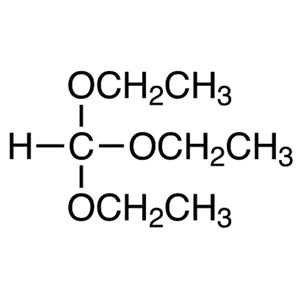
Triethyl Orthoformate from TCI, product code O0066, is the ortho ester of formic acid. Its central carbon atom carries three ethoxy groups and one hydrogen. It is a versatile reagent in organic synthesis and does three main jobs. It is a one-carbon source at the formate oxidation level. It forms diethyl acetals and ketals. It also acts as a water scavenger in moisture-sensitive reactions. For these reasons, Triethyl Orthoformate is kept on hand in almost every synthetic organic chemistry laboratory. It is classed as a non-heterocyclic building block, yet it is widely used to build heterocyclic scaffolds.
Chemists choose this reagent because it reacts readily with nucleophiles under acid catalysis. Its by-products are only ethanol and ethyl formate, and both are easy to separate from the target product, so work-up stays simple. When it meets water, the compound consumes that water. In acetal formation, this shifts the equilibrium toward the product and improves conversion without extra drying steps. As a one-carbon source, it can close rings when heterocycles such as benzimidazoles, imidazoles, triazoles and quinazolinones are made from diamine or amino-amide precursors. Because it is a liquid, it is also easy to measure and dispense accurately.
In Indonesia, Triethyl Orthoformate is widely used in university organic chemistry laboratories, in medicinal chemistry research, and in the development of pharmaceutical and agrochemical active ingredients. Students and researchers use it for thesis work, synthesis practicals and multi-step routes where they need a dependable formylating or protecting reagent. Research groups making heterocyclic compounds for bioactivity screening use it as a standard one-carbon reagent. Industrial R&D teams use it when developing and optimizing synthetic routes, where consistent reagent quality helps results stay reproducible between batches.
- Acetal and ketal protection: it converts aldehydes and ketones into diethyl acetals or ketals under acid catalysis, and its water-consuming action pushes the equilibrium toward the protected product.
- Heterocycle ring closure: it serves as a one-carbon source to cyclize diamine or amino-amide precursors into benzimidazoles, imidazoles, triazoles and quinazolinones, which are common scaffolds in medicinal chemistry.
- Water scavenging in moisture-sensitive reactions: it reacts with traces of water in the reaction mixture, which helps keep conditions dry for transformations that suffer when moisture is present.
- Formate-level one-carbon introduction: it delivers a single carbon at the formate oxidation level to nucleophiles, so chemists can build formyl-derived functional groups and intermediates in a controlled way.
- Teaching and research synthesis: its liquid form is easy to measure, and its easily separated by-products (ethanol and ethyl formate) make it practical for university practicals, thesis projects and route development work.
| Brand | TCI (product code O0066) |
|---|---|
| CAS number | 122-51-0 |
| Molecular formula | — |
| Purity | — |
| Category | Chemistry > Building Blocks > Non-Heterocyclic Building Blocks |
| Pack sizes | available in the pack sizes offered by TCI; please ask AMI Scientific for the options currently available |
| Physical form | liquid |
| Storage | moisture-sensitive; keep the container tightly closed in a cool, dry place |
Triethyl Orthoformate reacts with water, so protect it from moisture at all times. Keep it in its original, tightly sealed container in a cool, dry, well-ventilated area, away from heat, open flames and other ignition sources. Store it away from acids and oxidizing agents. After each use, close the container quickly, and flush it with dry inert gas if possible to protect the remaining reagent. Handle it in a fume hood and wear suitable gloves, safety glasses and a laboratory coat. Avoid breathing vapors and avoid contact with skin and eyes. Always read the supplier's Safety Data Sheet before use. Dispose of waste according to institutional and local regulations.
—
Produk Terkait
-
TCI B5774 5,10-Bis(4,4,5,5-tetramethyl-1,3,2-dioxaborolan-2-yl)naphtho[1,2-c:5,6-c']bis([1,2,5]oxadiazole)
Regular price Rp 10.255.350,00Regular price -
Dihydroiodide TCI B6569
Regular price From Rp 1.936.200,00Regular price -
Trifluoromethanesulfonate TCI B7003
Regular price From Rp 1.936.200,00Regular price
![5,10-Bis(4,4,5,5-tetramethyl-1,3,2-dioxaborolan-2-yl)naphtho[1,2-c:5,6-c']bis([1,2,5]oxadiazole) - TCI B5774 - AMI Scientific](http://amiscientific.com/cdn/shop/files/TCI2510B5774.jpg?v=1769180228&width=533)