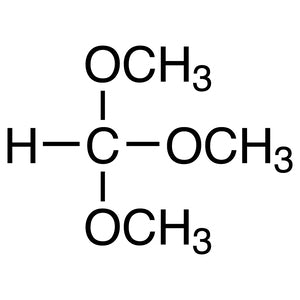
Trimethyl Orthoformate from TCI, product code O0068, is the ortho ester of formic acid. Its central carbon atom carries three methoxy groups and one hydrogen atom. It is the methyl counterpart of triethyl orthoformate and one of the basic reagents in organic synthesis laboratories. Chemists use it to form dimethyl acetals and ketals, as a one-carbon source for closing heterocyclic rings, and to take up water in reactions that must stay anhydrous. Its range of uses makes it a regular item on the reagent shelf in research and teaching laboratories.
Chemists often choose this reagent over its ethyl analogue because it is smaller and because its by-products, methanol and methyl formate, have low boiling points and are easy to remove after the reaction. Dimethyl acetals made with it are generally easier to cleave than diethyl acetals, which suits temporary protection strategies where the carbonyl group must be recovered later. Combined with methanol and an acid catalyst, it converts ketones into dimethyl ketals very effectively. It is also used to prepare methyl esters and enol ethers. Because it is a liquid, it can be measured out conveniently by volume.
In Indonesia, Trimethyl Orthoformate is widely needed by organic chemistry, medicinal chemistry, and process development laboratories at universities and in the pharmaceutical industry. It is often used to synthesise drug intermediates, where protecting carbonyl groups and building heterocyclic frameworks are routine steps. Academic research groups use it for multistep synthesis projects and student research. Industrial process chemists value its easily removed by-products when they scale reactions from the bench toward pilot production.
- Dimethyl acetal and ketal formation: with methanol and an acid catalyst, the reagent converts aldehydes and ketones into dimethyl acetals and ketals efficiently, which helps protect carbonyl groups during multistep synthesis.
- Temporary carbonyl protection: dimethyl acetals from this reagent are generally easier to cleave than diethyl acetals, so they suit strategies where the carbonyl must be recovered under mild conditions.
- Heterocyclic ring closure: the orthoformate carbon acts as a one-carbon source for closing heterocyclic rings, which makes it a useful building block when constructing heterocyclic frameworks for medicinal chemistry.
- Water scavenging in anhydrous reactions: the reagent reacts with water, so it can remove moisture from reactions that must stay dry and help push equilibria toward the desired product.
- Preparation of methyl esters and enol ethers: it is used to make methyl esters and enol ethers, and its volatile by-products, methanol and methyl formate, are easy to remove during workup.
| Brand | TCI (product code O0068) |
|---|---|
| CAS number | 149-73-5 |
| Molecular formula | — |
| Purity | — |
| Category | Chemistry > Building Blocks > Non-Heterocyclic Building Blocks |
| Pack sizes | please see the product listing for available pack sizes |
| Physical form | liquid |
| Storage | keep tightly closed, dry, and away from moisture; follow the TCI label and Safety Data Sheet |
Store Trimethyl Orthoformate in its original tightly sealed container in a cool, dry, well-ventilated area, away from heat and ignition sources. Because the reagent reacts with water, keep the container closed when not in use so moisture does not degrade it. Transfer it with dry glassware and syringes, and consider working under an inert atmosphere for moisture-sensitive reactions. Handle it in a fume hood, and wear safety glasses, chemical-resistant gloves, and a lab coat. Always follow the storage conditions, hazard information, and disposal instructions in the TCI Safety Data Sheet and product label.
—
Produk Terkait
-
TCI B5774 5,10-Bis(4,4,5,5-tetramethyl-1,3,2-dioxaborolan-2-yl)naphtho[1,2-c:5,6-c']bis([1,2,5]oxadiazole)
Regular price Rp 10.255.350,00Regular price -
Dihydroiodide TCI B6569
Regular price From Rp 1.936.200,00Regular price -
Trifluoromethanesulfonate TCI B7003
Regular price From Rp 1.936.200,00Regular price
![5,10-Bis(4,4,5,5-tetramethyl-1,3,2-dioxaborolan-2-yl)naphtho[1,2-c:5,6-c']bis([1,2,5]oxadiazole) - TCI B5774 - AMI Scientific](http://amiscientific.com/cdn/shop/files/TCI2510B5774.jpg?v=1769180228&width=533)