
![TCI O0120 95-92-1 Diethyl Oxalate [for Spectrophotometry]](http://amiscientific.com/cdn/shop/files/TCI2510O0120_73d5749f-7b8a-459b-82e4-ad12bd1ea7cb.jpg?v=1792651190&width=1946)
![95-92-1 Diethyl Oxalate [for Spectrophotometry] - AMI Scientific](http://amiscientific.com/cdn/shop/files/TCI2510O0120.jpg?v=1767131409&width=1946)
![TCI O0120 95-92-1 Diethyl Oxalate [for Spectrophotometry]](http://amiscientific.com/cdn/shop/files/TCI2510O0120_73d5749f-7b8a-459b-82e4-ad12bd1ea7cb.jpg?v=1792651190&width=1445)
![95-92-1 Diethyl Oxalate [for Spectrophotometry] - AMI Scientific](http://amiscientific.com/cdn/shop/files/TCI2510O0120.jpg?v=1767131409&width=1445)
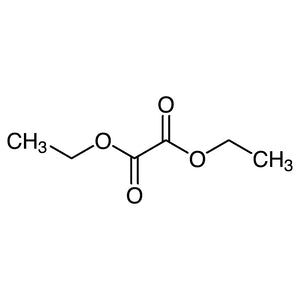
Diethyl Oxalate [for Spectrophotometry] from TCI is the diethyl ester of oxalic acid, supplied in a grade made for spectrophotometric work. It is a liquid ester well known in organic synthesis as a source of the oxalyl group and as an electrophile in Claisen condensation reactions. Because of its spectrophotometric grade, it can serve as a solvent or measurement medium in optical analysis where solvent purity matters. It can also be used as a low-impurity reagent in synthetic work, which makes it useful in both analytical and preparative laboratories.
Chemists choose diethyl oxalate because it has two adjacent ester groups that are highly electrophilic but carry no alpha hydrogens. As a result, it cannot condense with itself. This makes it an ideal partner in crossed Claisen condensations with esters, ketones, or nitriles that do have alpha hydrogens, and these reactions give α-ketoesters and 1,3-dicarbonyl compounds. As a solvent, its moderate polarity offers a different environment from both alkane and alcohol solvents. The spectrophotometric grade helps reduce background absorbance from impurities when the material is used in optical measurements, so readings are more reliable.
In Indonesia, spectrophotometric-grade diethyl oxalate is used in university research laboratories, pharmaceutical and fine-chemical development facilities, and analytical testing laboratories. Synthetic chemists use it to build α-ketoester and 1,3-dicarbonyl intermediates for further work. Analysts value a solvent grade that keeps interference low during optical measurement. Having one material that serves both as a synthetic building block and as a controlled-purity medium helps laboratories reduce the number of separate reagents they need to keep in stock.
Related TCI products
- TCI A0228 123-86-4 Butyl Acetate [for Spectrophotometry]
- TCI O0078 95-92-1 Diethyl Oxalate
- TCI B0806 75-25-2 Bromoform (stabilized with 2-Methyl-2-butene) [for Spectrophotometry]
- TCI O0118 111-65-9 n-Octane [for Spectrophotometry]
- TCI A5005 2050-14-8 2,2'-Dihydroxyazobenzene [Spectrophotometric and fluorimetric reagent for Al, Mg and other metals]
- TCI O0236 30431-54-0 Bis[3,4,6-trichloro-2-(pentyloxycarbonyl)phenyl] Oxalate
- Crossed Claisen condensation: with no alpha hydrogens, diethyl oxalate cannot self-condense, so it reacts cleanly as the electrophilic partner with esters, ketones, and nitriles that have alpha hydrogens.
- Synthesis of α-ketoesters: its two adjacent, highly electrophilic ester groups make it an efficient way to introduce the oxalyl unit and produce α-ketoester intermediates for further synthetic steps.
- Preparation of 1,3-dicarbonyl compounds: condensation with suitable carbonyl partners gives 1,3-dicarbonyl structures that are versatile building blocks for more complex organic molecules in research synthesis.
- Solvent or medium for spectrophotometric measurement: the spectrophotometric grade keeps background absorbance from impurities low, which supports more reliable optical readings when the liquid is used as a measurement medium.
- Moderate-polarity solvent studies: its moderate polarity gives a solvation environment unlike alkane or alcohol solvents, which is useful when researchers compare solvent effects in optical or reaction studies.
| Brand | TCI (product code O0120) |
|---|---|
| CAS number | 95-92-1 |
| Molecular formula | — |
| Purity | — |
| Category | Chemistry > Building Blocks > Non-Heterocyclic Building Blocks |
| Pack sizes | see the product listing for available pack sizes, and follow the storage guidance on the TCI label and Safety Data Sheet |
| Physical form | liquid ester |
| Storage | — |
- Grade: for Spectrophotometry
Keep diethyl oxalate in its original, tightly closed container in a cool, dry, well-ventilated area, away from heat, ignition sources, moisture, and incompatible materials such as strong oxidizers, strong bases, and strong acids. Esters can hydrolyse slowly when exposed to moisture, so close the container promptly after each use to protect the material's spectrophotometric quality. Handle it in a fume hood or a well-ventilated area, and wear chemical-resistant gloves, safety glasses, and a laboratory coat. Avoid breathing vapour and prevent contact with skin and eyes. Use clean, dry glassware and pipettes so the material does not pick up contaminants that could affect optical measurements. Always read the Safety Data Sheet before use, and dispose of waste according to local regulations and your laboratory's procedures.
—
Produk Terkait
-
ButylAcetate[forSpectrophotometry] TCI A0228
Regular price Rp 1.538.250,00Regular priceRp 1.075.200,00Sale price Rp 1.538.250,00 -
DiethylOxalate TCI O0078
Regular price From Rp 505.050,00Regular priceRp 352.800,00Sale price From Rp 505.050,00 -
Bromoform(stabilizedwith2-Methyl-2-butene)[forSpectrophotometry] TCI B0806
Regular price Rp 6.333.600,00Regular priceRp 4.428.900,00Sale price Rp 6.333.600,00 -
n-Octane[forSpectrophotometry] TCI O0118
Regular price Rp 3.419.850,00Regular priceRp 2.390.850,00Sale price Rp 3.419.850,00 -
2,2'-Dihydroxyazobenzene[SpectrophotometricandfluorimetricreagentforAl,Mgandothermetals] TCI A5005
Regular price From Rp 2.625.000,00Regular priceRp 1.835.400,00Sale price From Rp 2.625.000,00 -
Bis[3,4,6-trichloro-2-(pentyloxycarbonyl)phenyl]Oxalate TCI O0236
Regular price From Rp 2.252.250,00Regular priceRp 1.590.750,00Sale price From Rp 2.252.250,00 -
EthylAcetate[forSpectrophotometry] TCI A0030
Regular price Rp 1.167.600,00Regular priceRp 815.850,00Sale price Rp 1.167.600,00 -
1-Butanol[forSpectrophotometry] TCI B0228
Regular price Rp 928.200,00Regular priceRp 648.900,00Sale price Rp 928.200,00
![TCI A0228 123-86-4 Butyl Acetate [for Spectrophotometry]](http://amiscientific.com/cdn/shop/files/TCI2510A0228_3bfa5f96-ffa9-4366-b5b8-e6ddc52b0628.jpg?v=1792665176&width=533)
![123-86-4 Butyl Acetate [for Spectrophotometry] - AMI Scientific](http://amiscientific.com/cdn/shop/files/TCI2510A0228.jpg?v=1767078302&width=533)

![TCI B0806 75-25-2 Bromoform (stabilized with 2-Methyl-2-butene) [for Spectrophotometry]](http://amiscientific.com/cdn/shop/files/TCI2510B0806_5be06482-330a-4fd6-9fb7-fcd1b99be79f.jpg?v=1792659251&width=533)
![75-25-2 Bromoform (stabilized with 2-Methyl-2-butene) [for Spectrophotometry] - AMI Scientific](http://amiscientific.com/cdn/shop/files/TCI2510B0806.jpg?v=1767086115&width=533)
![TCI O0118 111-65-9 n-Octane [for Spectrophotometry]](http://amiscientific.com/cdn/shop/files/TCI2510O0118_45b3d0ff-408b-4f03-8e92-8533537925d1.jpg?v=1792651188&width=533)
![111-65-9 n-Octane [for Spectrophotometry] - AMI Scientific](http://amiscientific.com/cdn/shop/files/TCI2510O0118.jpg?v=1767131405&width=533)
![TCI A5005 2050-14-8 2,2'-Dihydroxyazobenzene [Spectrophotometric and fluorimetric reagent for Al, Mg and other metals]](http://amiscientific.com/cdn/shop/files/TCI2510A5005_880dfec4-754c-4c30-8aed-d958b11d062c.jpg?v=1792658518&width=533)
![2050-14-8 2,2'-Dihydroxyazobenzene [Spectrophotometric and fluorimetric reagent for Al, Mg and other metals] - AMI Scientific](http://amiscientific.com/cdn/shop/files/TCI2510A5005.jpg?v=1767084831&width=533)
![TCI O0236 30431-54-0 Bis[3,4,6-trichloro-2-(pentyloxycarbonyl)phenyl] Oxalate](http://amiscientific.com/cdn/shop/files/TCI2510O0236_9efea9ed-036a-4d64-b583-4a8598807403.jpg?v=1792651309&width=533)
![30431-54-0 Bis[3,4,6-trichloro-2-(pentyloxycarbonyl)phenyl] Oxalate - AMI Scientific](http://amiscientific.com/cdn/shop/files/TCI2510O0236.jpg?v=1767131634&width=533)
![TCI A0030 141-78-6 Ethyl Acetate [for Spectrophotometry]](http://amiscientific.com/cdn/shop/files/TCI2510A0030_4df05fe1-06a3-4da6-ab2c-70dc729f0340.jpg?v=1792665074&width=533)
![141-78-6 Ethyl Acetate [for Spectrophotometry] - AMI Scientific](http://amiscientific.com/cdn/shop/files/TCI2510A0030.jpg?v=1767077891&width=533)
![TCI B0228 71-36-3 1-Butanol [for Spectrophotometry]](http://amiscientific.com/cdn/shop/files/TCI2510B0228_6872f712-c794-4923-9e8b-676fb1457992.jpg?v=1792658830&width=533)
![71-36-3 1-Butanol [for Spectrophotometry] - AMI Scientific](http://amiscientific.com/cdn/shop/files/TCI2510B0228.jpg?v=1767085276&width=533)