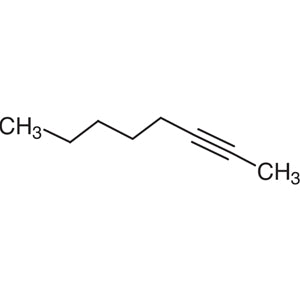
2-Octyne from TCI is an internal alkyne with an eight-carbon chain. Its carbon-carbon triple bond sits between the second and third carbons of the octane backbone. The compound belongs to the non-heterocyclic building blocks category and gives researchers access to triple-bond chemistry, one of the most versatile functional groups in organic synthesis. In the laboratory, 2-Octyne serves as a substrate for partial hydrogenation, hydration, halogen addition, cycloaddition reactions and a range of transition-metal-catalysed transformations used to build new molecular frameworks.
Because the triple bond sits near one end of the chain, 2-Octyne is unsymmetrical. This makes it a useful model compound for studying the regioselectivity of addition reactions, for example hydration, which can give a mixture of ketones. Unlike terminal alkynes, 2-Octyne has no acidic acetylenic hydrogen, so it does not take part in reactions that need that group. Researchers can therefore steer reactions more selectively and avoid unwanted side pathways. Controlled partial hydrogenation can convert it into 2-octene with a defined geometry, which makes the compound useful for stereoselectivity studies and for comparing catalyst performance.
In Indonesian laboratories, 2-Octyne suits university research groups in organic chemistry, catalysis and synthetic methodology, as well as industrial research and development teams exploring new synthetic routes. It is a practical choice for teaching and research projects on alkyne reactivity, selective hydrogenation and regiochemistry. Supplied under the TCI brand, it gives laboratories a well-defined starting material for reproducible experiments, method development and the preparation of more complex non-heterocyclic intermediates.
- Partial hydrogenation studies: the internal triple bond can be selectively reduced to 2-octene with a defined geometry, which makes it ideal for evaluating catalysts and stereoselectivity.
- Regioselectivity research in hydration: its unsymmetrical structure can give a mixture of ketones, so researchers can measure how catalysts and conditions control the direction of addition.
- Halogen addition reactions: the reactive triple bond readily accepts halogens, producing halogenated alkene or alkane intermediates for further synthetic steps and mechanistic teaching experiments.
- Cycloaddition chemistry: as an internal alkyne, 2-Octyne can act as a partner in cycloaddition reactions that build ring systems and new carbon frameworks from a simple linear precursor.
- Transition-metal-catalysed transformations: because it has no acidic acetylenic hydrogen, it lets researchers study metal-catalysed coupling and functionalisation reactions without the competing pathways that terminal alkynes introduce.
| Brand | TCI (product code O0125) |
|---|---|
| CAS number | 2809-67-8 |
| Molecular formula | — |
| Purity | — |
| Category | Chemistry > Building Blocks > Non-Heterocyclic Building Blocks |
| Pack sizes | see the current product listing for available pack sizes |
| Physical form | see the TCI product documentation for physical form and purity details |
| Storage | keep tightly closed in a cool, well-ventilated place away from heat and ignition sources |
Store 2-Octyne in its original tightly sealed container in a cool, dry and well-ventilated area, away from heat, sparks, open flames and strong oxidising agents. As a low-molecular-weight hydrocarbon, it should be treated as a potentially flammable organic chemical. Handle it in a fume hood, and wear suitable personal protective equipment, including chemical-resistant gloves, safety glasses and a laboratory coat. Avoid breathing vapours and avoid contact with skin and eyes. Keep containers closed when not in use to limit evaporation and contamination. Always check the TCI Safety Data Sheet for specific hazard, storage and disposal instructions before use.
—
Produk Terkait
-
TCI B5774 5,10-Bis(4,4,5,5-tetramethyl-1,3,2-dioxaborolan-2-yl)naphtho[1,2-c:5,6-c']bis([1,2,5]oxadiazole)
Regular price Rp 10.255.350,00Regular price -
Dihydroiodide TCI B6569
Regular price From Rp 1.936.200,00Regular price -
Trifluoromethanesulfonate TCI B7003
Regular price From Rp 1.936.200,00Regular price
![5,10-Bis(4,4,5,5-tetramethyl-1,3,2-dioxaborolan-2-yl)naphtho[1,2-c:5,6-c']bis([1,2,5]oxadiazole) - TCI B5774 - AMI Scientific](http://amiscientific.com/cdn/shop/files/TCI2510B5774.jpg?v=1769180228&width=533)