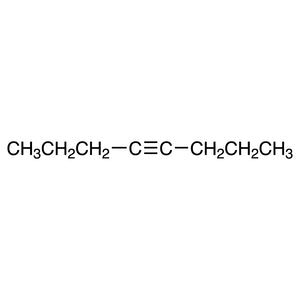
4-Octyne from TCI is an eight-carbon internal alkyne. Its triple bond sits in the middle of the chain, between the fourth and fifth carbon atoms, so the molecule is symmetrical, with a propyl group on each side. It belongs to the non-heterocyclic building blocks category and is widely used as a model substrate when developing new alkyne reactions. Laboratories use 4-Octyne in transition-metal catalysis, annulation reactions and cycloadditions to build substituted aromatic and heterocyclic rings.
The main advantage of 4-Octyne is its symmetry. Both sides of the triple bond are identical, so regioselectivity is not an issue. Researchers can focus on catalyst efficiency, stereoselectivity or reaction mechanism without dealing with mixtures of regioisomers. For this reason, 4-Octyne is often chosen as the "standard alkyne" in scientific publications on C–H activation and annulation chemistry. It has no acetylenic hydrogen, so its reactions tend to run more cleanly. The products are usually simple to characterise by NMR spectroscopy.
In Indonesian laboratories, 4-Octyne is especially useful for research groups working on catalysis and organic synthesis at universities, research institutes and industrial R&D facilities. Graduate students and researchers can use it as a benchmark substrate when testing new catalytic systems, comparing reaction conditions or reproducing methods from the international literature. Because results with 4-Octyne are easy to compare with published data, it helps local teams validate their methods before moving on to more complex, unsymmetrical alkynes.
- Transition-metal catalysis research: the symmetrical internal triple bond gives one predictable product, so chemists can judge catalyst activity and selectivity without regioisomer mixtures getting in the way.
- C–H activation and annulation reactions: 4-Octyne is a common standard alkyne partner in these studies, so new results can be compared directly with published work.
- Cycloaddition chemistry: the internal alkyne takes part in cycloadditions that build substituted aromatic and heterocyclic rings, which makes it a practical way to reach more complex ring systems.
- Reaction mechanism studies: with identical groups on both sides and no acetylenic hydrogen, 4-Octyne cuts down on side reactions and makes mechanistic results clearer and easier to interpret.
- Method development and benchmarking: products made from 4-Octyne are fairly simple to analyse by NMR spectroscopy, which makes it a good first substrate for optimising new synthetic procedures.
| Brand | TCI (product code O0127) |
|---|---|
| CAS number | 1942-45-6 |
| Molecular formula | — |
| Purity | — |
| Category | Chemistry > Building Blocks > Non-Heterocyclic Building Blocks |
| Pack sizes | see the pack size options on this product page |
| Physical form | liquid at room temperature |
| Storage | keep the container tightly closed in a cool, well-ventilated place, following the manufacturer's recommendations |
Store 4-Octyne in its original, tightly sealed container in a cool, dry, well-ventilated area. Keep it away from heat, sparks, open flames and other ignition sources, because low-molecular-weight hydrocarbons are generally flammable. Keep it separate from strong oxidising agents. Handle it in a fume hood and wear suitable personal protective equipment, including safety glasses, chemical-resistant gloves and a lab coat. Avoid breathing vapours and avoid contact with skin and eyes. Always read the TCI Safety Data Sheet before use, and dispose of waste according to local regulations.
—
Produk Terkait
-
TCI B5774 5,10-Bis(4,4,5,5-tetramethyl-1,3,2-dioxaborolan-2-yl)naphtho[1,2-c:5,6-c']bis([1,2,5]oxadiazole)
Regular price Rp 10.255.350,00Regular price -
Dihydroiodide TCI B6569
Regular price From Rp 1.936.200,00Regular price -
Trifluoromethanesulfonate TCI B7003
Regular price From Rp 1.936.200,00Regular price
![5,10-Bis(4,4,5,5-tetramethyl-1,3,2-dioxaborolan-2-yl)naphtho[1,2-c:5,6-c']bis([1,2,5]oxadiazole) - TCI B5774 - AMI Scientific](http://amiscientific.com/cdn/shop/files/TCI2510B5774.jpg?v=1769180228&width=533)