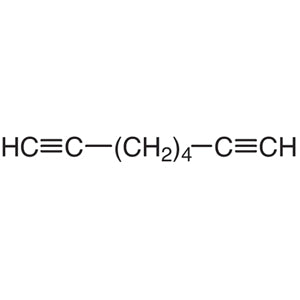
1,7-Octadiyne from TCI is a linear eight-carbon hydrocarbon with a terminal alkyne group at each end of the chain. Because it carries two terminal alkynes, it is a bifunctional molecule that can react at both ends. In organic synthesis and polymer chemistry laboratories, chemists use it as a linker, as a crosslinker, and as a starting material for cyclic structures and extended conjugated chains. This makes 1,7-Octadiyne a useful building block for designing symmetrical molecules and functional materials.
Its main advantage is the well-known, selective reactivity of the terminal alkyne. The C≡C–H group takes part in copper-catalysed azide-alkyne click reactions, Sonogashira coupling with aryl halides, Glaser oxidative coupling, hydrosilylation, and transition-metal-catalysed cyclotrimerisation. The four methylene groups between the two alkynes give the molecule enough length and flexibility to form rings or bridges between molecules without excessive ring strain. Chemists can therefore predict how it will behave in many common synthetic routes. Because the two ends are identical, the resulting products are symmetrical, which makes both reaction design and product characterisation simpler.
In Indonesia, 1,7-Octadiyne is useful to synthetic organic chemistry, polymer chemistry, and materials science laboratories at universities, research institutes, and industrial R&D centres. Research groups use it to build model compounds, to prepare crosslinked polymer networks, and to explore new conjugated materials. It is also well suited to teaching and research work that covers modern coupling and click chemistry, because each terminal alkyne can take part in a range of standard reactions.
TCI brochures (PDF)
- Click Chemistry 2026-09-08 · p. 11
- Copper-catalysed azide-alkyne click chemistry: two terminal alkynes let one molecule join two azide-bearing partners, so it works as a symmetrical triazole-forming linker.
- Sonogashira cross-coupling: each C≡C–H end couples with aryl halides, so researchers can build symmetrical diaryl-diyne structures in a single, predictable synthetic step.
- Glaser oxidative coupling: the terminal alkynes can undergo oxidative homocoupling, which gives access to extended conjugated chains and macrocyclic diyne frameworks for materials research.
- Polymer crosslinking and hydrosilylation: its bifunctional structure lets it bridge polymer chains or react with silanes, which makes it useful for building crosslinked networks and silicon-containing materials.
- Transition-metal-catalysed cyclotrimerisation: the flexible four-methylene spacer lets both alkynes reach a single metal centre, which supports the construction of fused ring systems without excessive strain.
| Brand | TCI (product code O0147) |
|---|---|
| CAS number | 871-84-1 |
| Molecular formula | — |
| Purity | — |
| Category | Chemistry > Building Blocks > Non-Heterocyclic Building Blocks |
| Pack sizes | see the pack options on the product page |
| Physical form | see the TCI product label and Certificate of Analysis |
| Storage | keep tightly closed in a cool, well-ventilated place away from ignition sources |
Keep 1,7-Octadiyne in its original, tightly sealed TCI container in a cool, dry, well-ventilated chemical storage area. Keep it away from heat, sparks, open flames, and strong oxidising agents. Like other low-molecular-weight hydrocarbons, treat it as a potentially flammable organic compound. Terminal alkynes can form unstable metal acetylides, so avoid unintended contact with copper, silver, or mercury salts outside controlled reactions. Handle it in a fume hood while wearing safety glasses, chemical-resistant gloves, and a laboratory coat. Always read the supplier's Safety Data Sheet before use, and dispose of waste according to institutional and local regulations.
—
Product Categories
Produk Terkait
-
2,6-Octadiyne TCI O0194
Regular price Rp 1.724.100,00Regular priceRp 1.205.400,00Sale price Rp 1.724.100,00 -
1,3,5-Triethynylbenzene TCI T2760
Regular price From Rp 3.578.400,00Regular priceRp 2.502.150,00Sale price From Rp 3.578.400,00 -
1-Butyl-4-ethynylbenzene TCI B2301
Regular price From Rp 980.700,00Regular priceRp 685.650,00Sale price From Rp 980.700,00 -
3,3-Dimethyl-1-butyne TCI B1114
Regular price From Rp 3.446.100,00Regular priceRp 2.409.750,00Sale price From Rp 3.446.100,00 -
1-Tetradecyne TCI T0761
Regular price From Rp 1.273.650,00Regular priceRp 890.400,00Sale price From Rp 1.273.650,00 -
Propyne(ca2%inHexane,ca03mol/L) TCI P3067
Regular price From Rp 1.087.800,00Regular priceRp 760.200,00Sale price From Rp 1.087.800,00 -
Propyne(ca2%inDichloromethane,ca07mol/L) TCI P3065
Regular price From Rp 1.087.800,00Regular priceRp 760.200,00Sale price From Rp 1.087.800,00 -
PropargylAcrylate(stabilizedwithBHT) TCI P2878
Regular price From Rp 2.254.350,00Regular priceRp 1.576.050,00Sale price From Rp 2.254.350,00