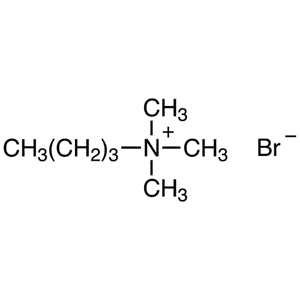
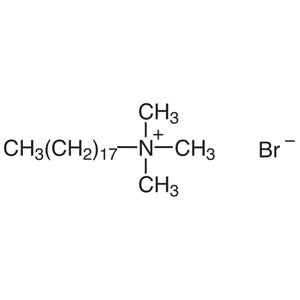
n-Octyltrimethylammonium Bromide is a quaternary ammonium salt in which the nitrogen atom carries three methyl groups and one octyl chain, with a bromide ion as its counterion. In the TCI catalog it is listed under synthetic reagents, in the phase transfer catalyst group. It has a polar cationic head and a short-to-medium hydrocarbon tail, so it behaves as a cationic surfactant. This makes it useful in biphasic reactions, micelle studies and ion-pair-based analytical chemistry, where it helps move chemical species across phase boundaries and organise them in solution.
Researchers choose this material because of the balance its octyl chain provides. The chain makes the molecule lipophilic enough to carry reactive anions from the aqueous phase into the organic phase, which is how a phase transfer catalyst works. The chain is also short enough that the salt stays readily soluble and has a relatively high critical micelle concentration. This helps when a researcher needs a cationic surfactant that does not aggregate too strongly. As a quaternary salt, the compound is stable under neutral conditions. It is also a useful reference member when studying the homologous series of alkyltrimethylammonium bromides.
In Indonesian laboratories, this reagent suits organic chemistry research groups that run alkylation, nucleophilic substitution or oxidation reactions in biphasic systems without relying on aprotic solvents. University research laboratories studying surfactants and colloids can use it to examine how chain length affects micelle formation. Analytical laboratories working with ion-pair techniques may also find it useful. Teaching laboratories can use it to show students how phase transfer catalysis works, with clear links between molecular structure and reactivity.
TCI brochures (PDF)
- Quaternary Ammonium Salts 2025-11-10 · p. 5
- Colloidal Quantum Dot (QD) Research Reagents 2026-05-21 · p. 9
- Polymer Additives 2026-04-16 · p. 11
Related TCI products
- TCI O0178 10108-86-8 n-Octyltrimethylammonium Chloride
- TCI B5798 2650-51-3 Butyltrimethylammonium Bromide
- TCI T2734 1943-11-9 Trimethylnonylammonium Bromide
- TCI T0906 1119-97-7 Tetradecyltrimethylammonium Bromide
- TCI S0364 1120-02-1 Trimethylstearylammonium Bromide
- TCI H0534 2650-53-5 Hexyltrimethylammonium Bromide
- Phase transfer catalysis: its lipophilic octyl chain lets the cation carry reactive anions from the aqueous phase into the organic phase, which speeds up reactions between reagents that would otherwise stay separated.
- Biphasic alkylation and nucleophilic substitution: the salt lets these reactions proceed in water–organic solvent systems, reducing the need for aprotic solvents in routine synthetic work.
- Micelle and surfactant studies: its relatively high critical micelle concentration and moderate aggregation make it a useful cationic surfactant for studying how micelles form in solution.
- Homologous series comparison: as one member of the alkyltrimethylammonium bromide family, it serves as a reference point for studying how alkyl chain length affects solubility and surfactant behaviour.
- Ion-pair analytical chemistry: its cationic head can pair with anionic analytes, which supports analytical methods based on ion-pair formation and separation between phases.
| Brand | TCI (product code O0163) |
|---|---|
| CAS number | 2083-68-3 |
| Molecular formula | — |
| Purity | — |
| Category | Chemistry > Synthetic Reagents > Phase Transfer Catalysts |
| Pack sizes | please check the product listing for available pack sizes |
| Physical form | please check the TCI product documentation |
| Storage | keep tightly closed in a cool, dry place, following the manufacturer's label and Safety Data Sheet |
Store n-Octyltrimethylammonium Bromide in its original, tightly sealed container in a cool, dry, well-ventilated area, away from direct sunlight and moisture. Quaternary ammonium salts can absorb moisture, so reseal the container promptly after each use. Keep it away from strong oxidising agents and incompatible materials. When handling, wear standard laboratory protection, including gloves, safety glasses and a lab coat. Avoid creating dust and avoid contact with skin and eyes. Work in a fume hood or a well-ventilated area. Always read the manufacturer's Safety Data Sheet before use, and dispose of waste according to institutional and local regulations.
—
Product Categories
Produk Terkait
-
n-OctyltrimethylammoniumChloride TCI O0178
Regular price From Rp 1.220.100,00Regular priceRp 868.350,00Sale price From Rp 1.220.100,00 -
ButyltrimethylammoniumBromide TCI B5798
Regular price From Rp 1.351.350,00Regular priceRp 960.750,00Sale price From Rp 1.351.350,00 -
TrimethylnonylammoniumBromide TCI T2734
Regular price Rp 1.801.800,00Regular priceRp 1.275.750,00Sale price Rp 1.801.800,00 -
TetradecyltrimethylammoniumBromide TCI T0906
Regular price From Rp 582.750,00Regular priceRp 423.150,00Sale price From Rp 582.750,00 -
TrimethylstearylammoniumBromide TCI S0364
Regular price Rp 2.013.900,00Regular priceRp 1.423.800,00Sale price Rp 2.013.900,00 -
HexyltrimethylammoniumBromide TCI H0534
Regular price From Rp 2.411.850,00Regular priceRp 1.702.050,00Sale price From Rp 2.411.850,00 -
HexadecyltrimethylammoniumBromide TCI H0081
Regular price From Rp 530.250,00Regular priceRp 386.400,00Sale price From Rp 530.250,00 -
DodecyltrimethylammoniumBromide TCI D1468
Regular price From Rp 928.200,00Regular priceRp 664.650,00Sale price From Rp 928.200,00