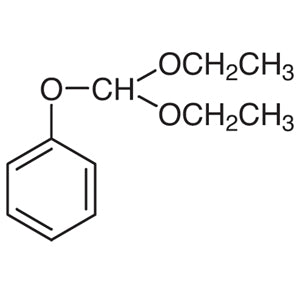
TCI O0187 Diethyl Phenyl Orthoformate (CAS 14444-77-0) is a mixed orthoester derived from formic acid. Its central carbon atom carries one hydrogen atom, two ethoxy groups and one phenoxy group. Organic synthesis laboratories know it as a formylating reagent. A classic use is making aldehydes from Grignard reagents. The compound reacts with an organomagnesium species to give a diethyl acetal, and hydrolysis of that acetal gives the aldehyde. This makes it a practical way to add a single aldehyde carbon to a molecular framework, which is a common step in multistep synthesis.
Chemists choose this reagent mainly because of how its leaving groups differ. The phenoxy group leaves more easily than the ethoxy groups. As a result, carbon nucleophiles such as Grignard reagents attack more selectively at one position, and the product is a protected diethyl acetal instead of a mixture. The acetal is stable under basic conditions and releases the free aldehyde only when it is hydrolyzed with acid. Chemists can therefore carry the masked aldehyde through later steps and unmask it when they need it. Like other orthoesters, the compound is sensitive to water and acid, so it must be handled under dry conditions.
In Indonesian laboratories, Diethyl Phenyl Orthoformate is useful to organic synthesis and medicinal chemistry research groups that need a reliable way to introduce an aldehyde function into their target molecules. University research laboratories, postgraduate thesis projects and industrial R&D teams working on intermediates can use it in Grignard-based formylation sequences. It is supplied as a TCI building block, so researchers can source it under a recognised catalogue number and use it for reproducible synthetic work and method development.
- Aldehyde synthesis from Grignard reagents: the orthoformate reacts with organomagnesium compounds to give diethyl acetals, and acid hydrolysis then turns these into the corresponding aldehydes.
- One-carbon homologation: the reagent adds a single aldehyde carbon to a molecular framework, which is useful when a synthetic route needs a formyl group at a specific position.
- Preparation of protected aldehydes: the diethyl acetal product is stable under basic conditions, so the aldehyde stays masked through later base-mediated steps until acid hydrolysis releases it.
- Selective reactions with carbon nucleophiles: the phenoxy group leaves more easily than the ethoxy groups, so nucleophilic attack happens more selectively at one position and gives cleaner acetal products.
- Medicinal chemistry intermediate work: research groups building drug-like scaffolds can use this formylation route to install aldehyde handles for further functionalisation of their target structures.
| Brand | TCI (product code O0187) |
|---|---|
| CAS number | 14444-77-0 |
| Molecular formula | — |
| Purity | — |
| Category | Chemistry > Building Blocks > Non-Heterocyclic Building Blocks |
| Pack sizes | see the available TCI pack options on the product page |
| Physical form | see the TCI product documentation (not listed here) |
| Storage | moisture- and acid-sensitive; keep tightly sealed under dry conditions |
Diethyl Phenyl Orthoformate is an orthoester and is sensitive to water and acid, so keep it tightly closed in its original container, protected from moisture. Store it in a cool, dry, well-ventilated area away from acids, oxidising agents and sources of humidity. Once the container has been opened, flushing the headspace with dry inert gas before resealing helps preserve quality. Use dry glassware and anhydrous solvents in reactions. Work in a fume hood, wear suitable gloves, safety glasses and a lab coat, and read the TCI Safety Data Sheet for full hazard and disposal information before use.
—
Produk Terkait
-
TCI B5774 5,10-Bis(4,4,5,5-tetramethyl-1,3,2-dioxaborolan-2-yl)naphtho[1,2-c:5,6-c']bis([1,2,5]oxadiazole)
Regular price Rp 10.255.350,00Regular price -
Dihydroiodide TCI B6569
Regular price From Rp 1.936.200,00Regular price -
Trifluoromethanesulfonate TCI B7003
Regular price From Rp 1.936.200,00Regular price
![5,10-Bis(4,4,5,5-tetramethyl-1,3,2-dioxaborolan-2-yl)naphtho[1,2-c:5,6-c']bis([1,2,5]oxadiazole) - TCI B5774 - AMI Scientific](http://amiscientific.com/cdn/shop/files/TCI2510B5774.jpg?v=1769180228&width=533)