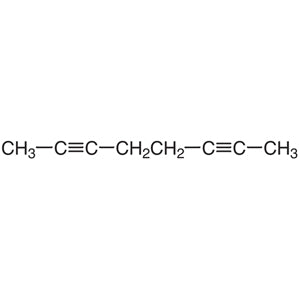
TCI O0194 2,6-Octadiyne is a linear eight-carbon hydrocarbon with two internal triple bonds, at positions 2 and 6. A two-methylene bridge separates the two triple bonds. Because it has no terminal alkyne, the compound behaves as a symmetrical internal diyne. In the laboratory it is a useful non-heterocyclic building block for making ring systems through cyclization and cycloaddition reactions. It is also used as a model substrate in transition-metal catalysis research.
Chemists choose this material for how its two alkyne groups are arranged. The spacing between the triple bonds lets a five-membered ring form when both alkynes combine with a third unsaturated component. This is used in metal-catalyzed [2+2+2] cycloadditions to build bicyclic systems such as indane derivatives or fused pyridines. The methyl groups at each end make the substitution pattern of the products easy to identify. That makes the compound a good benchmark substrate when developing and comparing new catalysts.
In Indonesian laboratories, 2,6-Octadiyne is relevant to research groups working in organometallic chemistry, catalysis and the synthesis of polycyclic compounds. University chemistry departments, research institutes and graduate research programs can use it to study cyclization methods, test new catalyst systems, and prepare bicyclic frameworks for further synthetic work. Its well-defined symmetrical structure also makes it suitable for teaching and methods-development projects where reaction outcomes need to be interpreted clearly and reproducibly.
- Metal-catalyzed [2+2+2] cycloaddition: the two internal alkynes combine with a third unsaturated partner to give bicyclic products such as indane derivatives or fused pyridines.
- Five-membered ring construction: the two-methylene bridge between the triple bonds provides the spacing needed to close a five-membered ring during cyclization reactions.
- Catalyst development and benchmarking: the symmetrical structure and terminal methyl groups give clearly substituted products, making it a reliable reference substrate for comparing catalyst performance.
- Transition-metal catalysis research: as a model internal diyne without terminal alkyne protons, it lets researchers study metal-mediated alkyne coupling without side reactions from terminal C–H bonds.
- Synthesis of polycyclic compounds: as a non-heterocyclic building block, it provides a carbon framework for building fused ring systems used in further organic and organometallic synthesis.
| Brand | TCI (product code O0194) |
|---|---|
| CAS number | 764-73-8 |
| Molecular formula | — |
| Purity | — |
| Category | Chemistry > Building Blocks > Non-Heterocyclic Building Blocks |
| Pack sizes | available in the pack sizes offered by TCI for this product code |
| Physical form | refer to the TCI product label and Safety Data Sheet |
| Storage | follow the storage conditions stated on the TCI label and SDS |
Store 2,6-Octadiyne in its original, tightly closed TCI container. Keep it in a cool, dry, well-ventilated area away from heat, sparks, open flames and direct sunlight. Keep it apart from strong oxidizing agents and other incompatible materials, and follow any specific temperature or inert-atmosphere requirements on the product label and Safety Data Sheet. Handle it in a fume hood while wearing suitable personal protective equipment, including safety glasses, chemical-resistant gloves and a lab coat. Avoid inhalation, skin contact and eye contact. Reseal the container promptly after use to limit exposure to air and moisture, and dispose of residues and contaminated materials according to institutional and local chemical waste regulations.
—
Produk Terkait
-
1,7-Octadiyne TCI O0147
Regular price From Rp 1.565.550,00Regular priceRp 1.094.100,00Sale price From Rp 1.565.550,00 -
1,3,5-Triethynylbenzene TCI T2760
Regular price From Rp 3.578.400,00Regular priceRp 2.502.150,00Sale price From Rp 3.578.400,00 -
1-Butyl-4-ethynylbenzene TCI B2301
Regular price From Rp 980.700,00Regular priceRp 685.650,00Sale price From Rp 980.700,00 -
3,3-Dimethyl-1-butyne TCI B1114
Regular price From Rp 3.446.100,00Regular priceRp 2.409.750,00Sale price From Rp 3.446.100,00 -
2-Butyne TCI B0951
Regular price Rp 1.405.950,00Regular priceRp 982.800,00Sale price Rp 1.405.950,00 -
7-Tetradecyne TCI T0762
Regular price From Rp 4.957.050,00Regular priceRp 3.466.050,00Sale price From Rp 4.957.050,00 -
1-Tetradecyne TCI T0761
Regular price From Rp 1.273.650,00Regular priceRp 890.400,00Sale price From Rp 1.273.650,00 -
Propyne(ca2%inHexane,ca03mol/L) TCI P3067
Regular price From Rp 1.087.800,00Regular priceRp 760.200,00Sale price From Rp 1.087.800,00