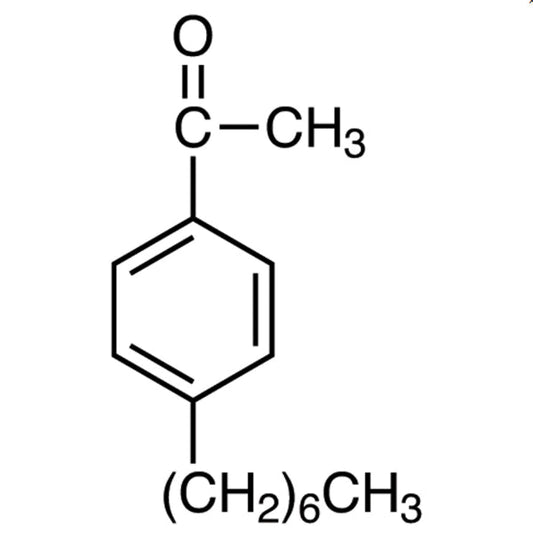
4'-n-Octylacetophenone from TCI (product code O0207) is an aromatic ketone. It is an acetophenone with a straight octyl chain at the para position of the benzene ring. It belongs to the Liquid Crystal (LC) Building Blocks group, which are intermediates used to build rod-shaped mesogenic molecules. In the laboratory it serves as a starting point for making compounds that join a rigid aromatic core to a flexible alkyl tail. This pairing is a typical structural feature in the design of liquid crystal materials and functional organic materials.
Researchers choose this material because its two parts complement each other. The n-octyl chain adds flexibility and hydrophobic character, which affect phase transition temperatures and solubility in organic solvents. The acetyl group is a versatile reactive handle. It can be oxidized to a substituted benzoic acid, reduced to an alcohol or an alkyl group, condensed to form chalcones, or converted through the haloform reaction. So one compound can yield many derivatives that all share the same tail length. This keeps structure–property comparisons across a compound series more consistent and easier to interpret.
In Indonesian laboratories, this material suits research groups in materials science, organic chemistry and physical chemistry at universities and research institutions. It is useful for projects that synthesize and characterize liquid crystal compounds or functional organic materials. Groups studying how alkyl chain length and molecular structure affect mesophase behavior can use it as a reliable common precursor. It also fits teaching and thesis work where students practice multistep synthesis from one well-defined aromatic ketone.
- Synthesis of rod-shaped mesogens: the rigid aromatic core and the flexible n-octyl tail give the basic structure that calamitic liquid crystal molecules need.
- Preparation of substituted benzoic acids: oxidizing the acetyl group, or using the haloform reaction, gives para-octyl benzoic acid derivatives for esters and other mesogenic linkages.
- Chalcone formation by condensation: the acetyl group reacts with aromatic aldehydes to form conjugated chalcones, which are studied as functional organic and mesogenic materials.
- Reduction to alcohols or alkyl derivatives: the ketone can be reduced to a secondary alcohol or a fully alkylated chain, which lets researchers change molecular shape while keeping the same tail.
- Structure–property relationship studies: many derivatives can be made that share the same octyl tail, so phase transition and solubility comparisons within a compound series stay consistent.
| Brand | TCI (product code O0207) |
|---|---|
| CAS number | 10541-56-7 |
| Molecular formula | — |
| Purity | — |
| Category | Materials Science > Material Building Blocks > Liquid Crystal (LC) Building Blocks |
| Pack sizes | available in the pack sizes offered by TCI for this product code |
| Physical form | — |
| Storage | follow the storage conditions on the TCI label and Safety Data Sheet |
- Chemical class: aromatic ketone (para-substituted acetophenone with an n-octyl chain)
Keep 4'-n-Octylacetophenone in its original, tightly closed TCI container. Store it in a cool, dry, well-ventilated place away from direct sunlight, heat sources and strong oxidizing agents, and follow any storage temperature given on the product label or Safety Data Sheet. If you transfer the material, use clean, dry, chemically compatible glass containers with good seals, and label them clearly. Handle it in a fume hood or a well-ventilated area. Wear safety glasses, chemical-resistant gloves and a lab coat, and avoid contact with skin and eyes and breathing in vapors. Read the Safety Data Sheet before use, and dispose of waste according to institutional and local regulations.
—
Produk Terkait
-
4'-Butylacetophenone TCI B1000
Regular price Rp 1.644.300,00Regular priceRp 1.149.750,00Sale price Rp 1.644.300,00 -
4'-Heptylacetophenone TCI H0678
Regular price Rp 1.961.400,00Regular priceRp 1.371.300,00Sale price Rp 1.961.400,00 -
4'-Propylacetophenone TCI P1036
Regular price From Rp 875.700,00Regular priceRp 612.150,00Sale price From Rp 875.700,00 -
4'-Methylacetophenone TCI M0135
Regular price From Rp 477.750,00Regular priceRp 333.900,00Sale price From Rp 477.750,00 -
4'-Hexylacetophenone TCI H0669
Regular price Rp 3.525.900,00Regular priceRp 2.465.400,00Sale price Rp 3.525.900,00 -
4'-Ethylacetophenone TCI E0318
Regular price From Rp 743.400,00Regular priceRp 519.750,00Sale price From Rp 743.400,00 -
2-Bromo-2-phenylacetophenone TCI B4471
Regular price From Rp 2.411.850,00Regular priceRp 1.702.050,00Sale price From Rp 2.411.850,00 -
2-Bromo-4'-phenylacetophenone TCI B0633
Regular price From Rp 1.060.500,00Regular priceRp 757.050,00Sale price From Rp 1.060.500,00