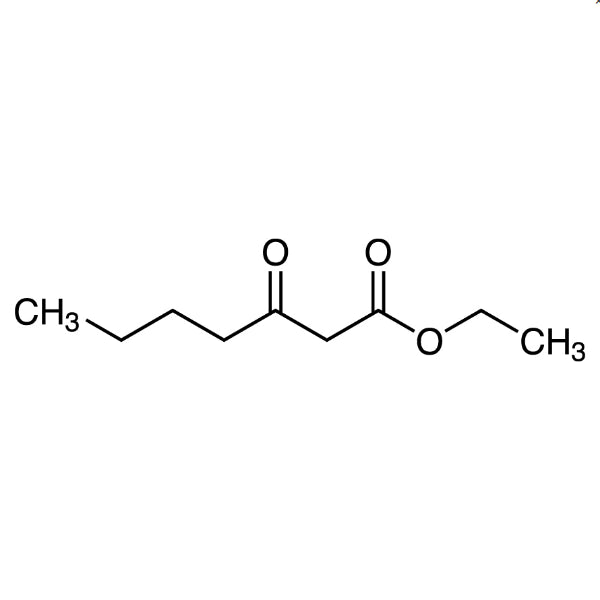
Ethyl 3-Oxoheptanoate from TCI (product code O0216) is a β-ketoester: the ethyl ester of 3-oxoheptanoic acid, with a butyl chain attached to the ketone group. Structurally, it is an analogue of ethyl acetoacetate with a longer side chain. In the laboratory, β-ketoesters are among the most versatile building blocks in organic synthesis, because they can form new carbon–carbon bonds and build heterocyclic rings. It is listed under Lipids because it closely resembles intermediates in fatty acid metabolism and biosynthesis.
Chemists choose this material because the carbon atom between its two carbonyl groups is acidic. That makes it easy to convert into an enolate, which can then be alkylated or acylated. After hydrolysis and decarboxylation, this route gives ketones with a chain designed by the chemist. The 1,3-dicarbonyl group also reacts with hydrazines, ureas, amidines, and amines to form pyrazolones, pyrimidines, and other heterocyclic frameworks that matter in medicinal chemistry. The butyl chain adds lipophilic character, so its derivatives differ from those made from ethyl acetoacetate, which gives researchers another way to adjust the properties of a target molecule.
In Indonesian laboratories, this material is relevant to organic synthesis research groups at universities and research institutes, to teams working on medicinal chemistry and heterocyclic compounds, and to laboratories studying lipid-related intermediates. It is useful wherever researchers need a β-ketoester with a longer chain than common acetoacetate reagents, such as in thesis and dissertation projects, method development, and preparing small compound libraries for screening. Coming from TCI, it offers the consistent quality that research laboratories depend on.
- Enolate alkylation and acylation: the acidic carbon between the two carbonyl groups forms an enolate easily, so new carbon–carbon bonds can be introduced under controlled conditions.
- Ketone synthesis by hydrolysis and decarboxylation: after the ester is modified, hydrolysis and decarboxylation give ketones with a designed chain that carry the butyl group from the starting material.
- Pyrazolone synthesis: the 1,3-dicarbonyl group condenses with hydrazines to build pyrazolone rings, which are useful scaffolds in medicinal chemistry and in developing heterocyclic compounds.
- Pyrimidine and related heterocycle construction: reactions with urea, amidines, or amines give pyrimidines and other nitrogen-containing frameworks, and the butyl chain adds lipophilicity to the products.
- Lipid and fatty acid metabolism studies: its structural resemblance to β-keto intermediates in fatty acid biosynthesis makes it a relevant model compound for lipid-related biochemical research.
| Brand | TCI (product code O0216) |
|---|---|
| CAS number | 7737-62-4 |
| Molecular formula | — |
| Purity | — |
| Category | Life Science > Biochemicals and Reagents > Lipids |
| Pack sizes | please confirm the available pack sizes with AMI Scientific |
| Physical form | refer to the TCI product label and certificate of analysis |
| Storage | follow the storage conditions on the TCI label and safety data sheet |
Store Ethyl 3-Oxoheptanoate in its original tightly closed TCI container, in a cool, dry, well-ventilated area away from heat, ignition sources, and direct sunlight. Keep it away from strong oxidizers, strong bases, and strong acids, and follow any specific temperature guidance on the product label. Handle it in a fume hood while wearing gloves, safety glasses, and a lab coat, and avoid breathing vapours and contact with skin or eyes. Close the container right after use to limit exposure to moisture. Read the safety data sheet before first use, and dispose of residues following your institution's chemical waste procedures.
—
Produk Terkait
-
TCI B5774 5,10-Bis(4,4,5,5-tetramethyl-1,3,2-dioxaborolan-2-yl)naphtho[1,2-c:5,6-c']bis([1,2,5]oxadiazole)
Regular price Rp 10.255.350,00Regular price -
Dihydroiodide TCI B6569
Regular price From Rp 1.936.200,00Regular price -
Trifluoromethanesulfonate TCI B7003
Regular price From Rp 1.936.200,00Regular price
![5,10-Bis(4,4,5,5-tetramethyl-1,3,2-dioxaborolan-2-yl)naphtho[1,2-c:5,6-c']bis([1,2,5]oxadiazole) - TCI B5774 - AMI Scientific](http://amiscientific.com/cdn/shop/files/TCI2510B5774.jpg?v=1769180228&width=533)