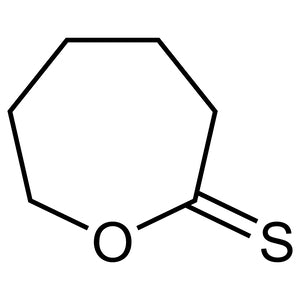
Oxepane-2-thione is a seven-membered thionolactone. It is an analogue of ε-caprolactone in which the carbonyl oxygen atom is replaced by a sulfur atom. TCI lists this compound as a polymer and macromolecule reagent, in the monomer group. In materials science laboratories, oxepane-2-thione is used as a monomer for ring-opening polymerization. This reaction gives polyester-based polymers that carry sulfur atoms in the main chain, which makes the compound a useful building block for sulfur-containing macromolecules.
Researchers choose this monomer because it brings sulfur atoms into a structure similar to polycaprolactone, a polymer known to be biodegradable. Sulfur in the backbone can change several polymer properties, such as refractive index, affinity toward metals, response to oxidative stimuli, and degradation behavior. During polymerization, the thionolactone can rearrange into thioester units, so the reaction mechanism and the structure of the final product are an active research topic. The monomer can also be copolymerized with other lactones, which lets researchers control how much sulfur ends up in the material.
In Indonesia, research on biodegradable polymers, biomedical materials, and functional polymers continues to grow at universities and research institutions. Oxepane-2-thione suits polymer chemistry laboratories that study ring-opening polymerization, sulfur-containing polyesters, and how backbone composition affects material properties. It is useful in academic projects, thesis work, and exploratory studies where researchers want to compare sulfur-modified polymers with conventional polycaprolactone. AMI Scientific supplies this TCI reagent to help these laboratories carry out their research.
- Ring-opening polymerization: this seven-membered thionolactone acts as a monomer that opens to form polyester-based chains with sulfur atoms built into the polymer backbone.
- Synthesis of sulfur-containing polycaprolactone analogues: because its structure mirrors ε-caprolactone, it lets researchers make polymers that resemble biodegradable polycaprolactone but contain sulfur.
- Copolymerization with other lactones: it can be combined with conventional lactone monomers, so researchers can tune the sulfur content and the resulting properties of the final copolymer material.
- Mechanistic polymerization studies: the thionolactone can rearrange into thioester units during polymerization, which makes it a good model compound for studying reaction mechanisms and product structure.
- Functional and stimuli-responsive materials research: sulfur in the backbone can change refractive index, metal affinity, oxidative response, and degradation behavior, which is relevant to functional polymer development.
| Brand | TCI (product code O0714) |
|---|---|
| CAS number | 72037-38-8 |
| Molecular formula | — |
| Purity | — |
| Category | Materials Science > Polymer/Macromolecule Reagents > Monomers |
| Pack sizes | not stated in the product data; please confirm available pack sizes with AMI Scientific |
| Physical form | not stated; refer to the TCI product label and Certificate of Analysis |
| Storage | follow the storage conditions on the TCI label and Safety Data Sheet |
Store Oxepane-2-thione in its original, tightly closed manufacturer's container, following the conditions on the TCI label and Safety Data Sheet. Keep it in a cool, dry, well-ventilated area away from heat, direct sunlight, moisture, and incompatible substances such as strong oxidizing agents. Because it is a reactive monomer for polymerization, protect it from contamination and from unnecessary exposure to air. Handle it in a fume hood while wearing suitable personal protective equipment, including safety glasses, chemical-resistant gloves, and a laboratory coat. Avoid inhaling vapors or dust and avoid contact with skin and eyes. Read the Safety Data Sheet before use, and dispose of waste according to local regulations and institutional laboratory safety procedures.
—
Produk Terkait
-
TCI B5774 5,10-Bis(4,4,5,5-tetramethyl-1,3,2-dioxaborolan-2-yl)naphtho[1,2-c:5,6-c']bis([1,2,5]oxadiazole)
Regular price Rp 10.255.350,00Regular price -
Dihydroiodide TCI B6569
Regular price From Rp 1.936.200,00Regular price -
Trifluoromethanesulfonate TCI B7003
Regular price From Rp 1.936.200,00Regular price
![5,10-Bis(4,4,5,5-tetramethyl-1,3,2-dioxaborolan-2-yl)naphtho[1,2-c:5,6-c']bis([1,2,5]oxadiazole) - TCI B5774 - AMI Scientific](http://amiscientific.com/cdn/shop/files/TCI2510B5774.jpg?v=1769180228&width=533)