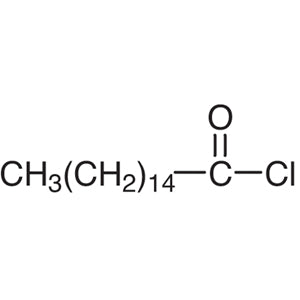
Palmitoyl Chloride from TCI is the acyl chloride of palmitic acid. It has a saturated C16 alkyl chain and a highly reactive carbonyl chloride group. TCI classifies it as a non-heterocyclic building block. It is one of the strongest acylating agents for transferring a palmitoyl group to alcohols, amines, thiols and other nucleophiles. In the laboratory, chemists use it to make esters, amides and ketones that carry a fatty chain. It is also used to prepare synthetic lipids and to modify the surfaces of materials or biomolecules.
Chemists choose palmitoyl chloride mainly because it is so reactive. Acylation is usually fast at low temperature or room temperature. A base such as triethylamine or pyridine neutralises the hydrogen chloride that forms. Because of this reactivity, it works well on substrates that react poorly with anhydrides or free acids. The product is a liquid sold by volume, so it can be measured easily with a syringe or pipette under an inert atmosphere. Precise dosing under controlled conditions matters in multi-step synthesis, which is one reason this reagent is so often used there.
In Indonesia, palmitoyl chloride is relevant to chemistry laboratories at universities, research institutes and industrial R&D departments that work with organic synthesis and lipid chemistry. Researchers studying fatty-acid derivatives, surfactant-like molecules, lipid conjugates or surface modification can use it as a dependable source of the palmitoyl group. It suits both academic projects and applied development work where a long saturated fatty chain has to be attached cleanly and efficiently to another molecule.
TCI brochures (PDF)
- Human-Serum-Albumin Binding Agents for Improvement of Pharmacokinetics 2019-02-22 · p. 2
- Lipids 2025-12-17 · p. 7
- Ester synthesis: palmitoyl chloride reacts quickly with alcohols in the presence of a base, giving palmitate esters efficiently, even from hydroxyl groups that react poorly with free acids.
- Amide formation: its highly reactive carbonyl chloride group acylates primary and secondary amines readily, so it is well suited to preparing fatty-chain amides under mild, controlled conditions.
- Thioester and ketone preparation: as a strong acylating agent, it transfers the palmitoyl group to thiols and other nucleophiles, giving access to sulphur-containing and ketone products with a C16 chain.
- Synthetic lipid preparation: its saturated C16 alkyl chain makes it a convenient building block for synthetic lipids and lipid-like molecules used in research on membranes and lipid chemistry.
- Surface and biomolecule modification: its high reactivity lets researchers attach hydrophobic palmitoyl chains to material surfaces or biomolecules, changing properties such as hydrophobicity and interfacial behaviour.
From the TCI brochure
- Palmitoylation reagent for introducing a fatty acid to optimize pharmacokinetics
| Brand | TCI (product code P0009) |
|---|---|
| CAS number | 112-67-4 |
| Molecular formula | — |
| Purity | — |
| Category | Chemistry > Building Blocks > Non-Heterocyclic Building Blocks |
| Pack sizes | supplied by volume; please contact AMI Scientific for the sizes currently available |
| Physical form | liquid |
| Storage | keep tightly closed, protected from moisture, preferably under an inert atmosphere |
Palmitoyl chloride is an acyl chloride. It reacts with water and moist air and releases hydrogen chloride. Store it in its original tightly sealed container in a cool, dry, well-ventilated place, away from water, alcohols, amines, bases and oxidising agents. Flush the headspace with nitrogen or argon after each use to help preserve quality. Handle it only in a fume hood. Wear chemical-resistant gloves, safety goggles and a lab coat. Use dry glassware and syringe techniques when measuring it out. Neutralise and dispose of residues according to local laboratory waste regulations, and always check the supplier's Safety Data Sheet before use.
References cited in the TCI brochure
- Sharon Myers. Acylation of Human Insulin With Palmitic Acid Extends the Time Action of Human Insulin in Diabetic Dogs Diabetes, 1997. doi:10.2337/diab.46.4.637
- Lotte B. Knudsen. Potent Derivatives of Glucagon-like Peptide-1 with Pharmacokinetic Properties Suitable for Once Daily Administration Journal of Medicinal Chemistry, 2000. doi:10.1021/jm9909645
- Sung‐Hyun Yang. Lipidation of Cysteine or Cysteine‐Containing Peptides Using the Thiol‐Ene Reaction (CLipPA) European Journal of Organic Chemistry, 2016. doi:10.1002/ejoc.201501375
Product Categories
- Biochemicals and ReagentsAlbumin Binding AgentsAlbumin Binding Modification Reagents
- Biochemicals and ReagentsBioconjugationAlbumin Binding Modification Reagents
- Biochemicals and ReagentsLipidsFatty Acyls
- Pharmaceutical Development and Drug Discovery ResearchAlbumin Binding AgentsAlbumin Binding Modification Reagents
- Pharmaceutical Development and Drug Discovery ResearchBioconjugationAlbumin Binding Modification Reagents
Produk Terkait
-
UndecanoylChloride TCI U0026
Regular price From Rp 1.590.750,00Regular priceRp 1.127.700,00Sale price From Rp 1.590.750,00 -
MyristoylChloride TCI T0086
Regular price From Rp 1.272.600,00Regular priceRp 905.100,00Sale price From Rp 1.272.600,00 -
StearoylChloride TCI S0404
Regular price From Rp 1.881.600,00Regular priceRp 1.331.400,00Sale price From Rp 1.881.600,00 -
LauroylChloride TCI D0972
Regular price From Rp 557.550,00Regular priceRp 405.300,00Sale price From Rp 557.550,00 -
DecanoylChloride TCI D0027
Regular price From Rp 822.150,00Regular priceRp 590.100,00Sale price From Rp 822.150,00 -
VinylPalmitate(stabilizedwithMEHQ) TCI P0848
Regular price From Rp 1.724.100,00Regular priceRp 1.205.400,00Sale price From Rp 1.724.100,00 -
VinylLaurate(stabilizedwithMEHQ) TCI L0090
Regular price From Rp 610.050,00Regular priceRp 442.050,00Sale price From Rp 610.050,00 -
AdipoylChloride TCI A0169
Regular price From Rp 1.272.600,00Regular priceRp 905.100,00Sale price From Rp 1.272.600,00