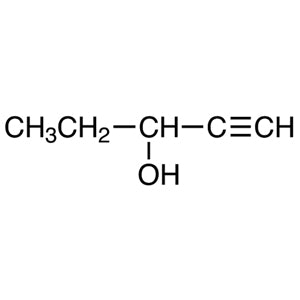
1-Pentyn-3-ol is a five-carbon propargylic alcohol whose molecule carries a terminal alkyne group right next to a secondary hydroxyl group. This TCI product belongs to the non-heterocyclic building block group. In synthetic organic chemistry laboratories it serves as a versatile starting material. Chemists can modify its two functional groups one at a time or together, which lets them build more complex molecular structures step by step from a simple, well-defined precursor.
Researchers choose this compound for its distinctive combination of functional groups. The terminal alkyne can take part in Sonogashira coupling, azide-alkyne click reactions and hydration, and it can also form metal acetylides. The secondary hydroxyl group can be oxidised to a ketone, esterified, protected or converted into a leaving group. Propargylic alcohols are also known to rearrange readily into unsaturated carbonyl compounds. This gives researchers extra synthetic routes from a single reagent and makes the material a flexible and practical choice for planning a synthesis.
In Indonesia, 1-Pentyn-3-ol is relevant to synthetic organic chemistry and medicinal chemistry research groups at universities and research institutions that design bioactive molecules or drug intermediates. Laboratories that study click chemistry and transition-metal catalysis can also use it as a substrate for developing methods and studying reactions. Teaching laboratories that run advanced organic synthesis courses may also find it useful for showing students how to transform functional groups selectively.
- Sonogashira cross-coupling: the terminal alkyne couples with aryl or vinyl halides under palladium catalysis, so it can join carbon frameworks while keeping a hydroxyl handle for later steps.
- Azide-alkyne click chemistry: the terminal alkyne reacts with organic azides to form triazole linkages, so it suits conjugation studies and building modular molecular libraries.
- Oxidation to ketones: the secondary hydroxyl group can be oxidised to the matching alkynyl ketone, which provides a reactive intermediate for further additions and cyclisation strategies.
- Protection and leaving-group chemistry: the hydroxyl group can be protected, esterified or turned into a leaving group, so researchers can control which site reacts during multistep synthesis.
- Rearrangement to unsaturated carbonyls: as a propargylic alcohol, it can rearrange into unsaturated carbonyl compounds, which opens extra synthetic routes for medicinal chemistry and methodology research.
| Brand | TCI (product code P0069) |
|---|---|
| CAS number | 4187-86-4 |
| Molecular formula | — |
| Purity | — |
| Category | Chemistry > Building Blocks > Non-Heterocyclic Building Blocks |
| Pack sizes | available in TCI standard pack sizes; please confirm current options with AMI Scientific |
| Physical form | please refer to the TCI product specification and Certificate of Analysis |
| Storage | follow the conditions stated on the TCI label and Safety Data Sheet |
Store 1-Pentyn-3-ol in its original tightly closed container, as specified on the TCI label and Safety Data Sheet. Keep it in a cool, dry, well-ventilated area away from heat, sparks, open flames and strong oxidising agents. Only trained personnel should handle it. Work inside a fume hood and wear suitable gloves, safety glasses and a laboratory coat. Avoid inhaling vapours and avoid contact with skin and eyes. Read the Safety Data Sheet before use, and dispose of residues and contaminated materials according to institutional and local chemical waste regulations.
—
Produk Terkait
-
TCI B5774 5,10-Bis(4,4,5,5-tetramethyl-1,3,2-dioxaborolan-2-yl)naphtho[1,2-c:5,6-c']bis([1,2,5]oxadiazole)
Regular price Rp 10.255.350,00Regular price -
Dihydroiodide TCI B6569
Regular price From Rp 1.936.200,00Regular price -
Trifluoromethanesulfonate TCI B7003
Regular price From Rp 1.936.200,00Regular price
![5,10-Bis(4,4,5,5-tetramethyl-1,3,2-dioxaborolan-2-yl)naphtho[1,2-c:5,6-c']bis([1,2,5]oxadiazole) - TCI B5774 - AMI Scientific](http://amiscientific.com/cdn/shop/files/TCI2510B5774.jpg?v=1769180228&width=533)