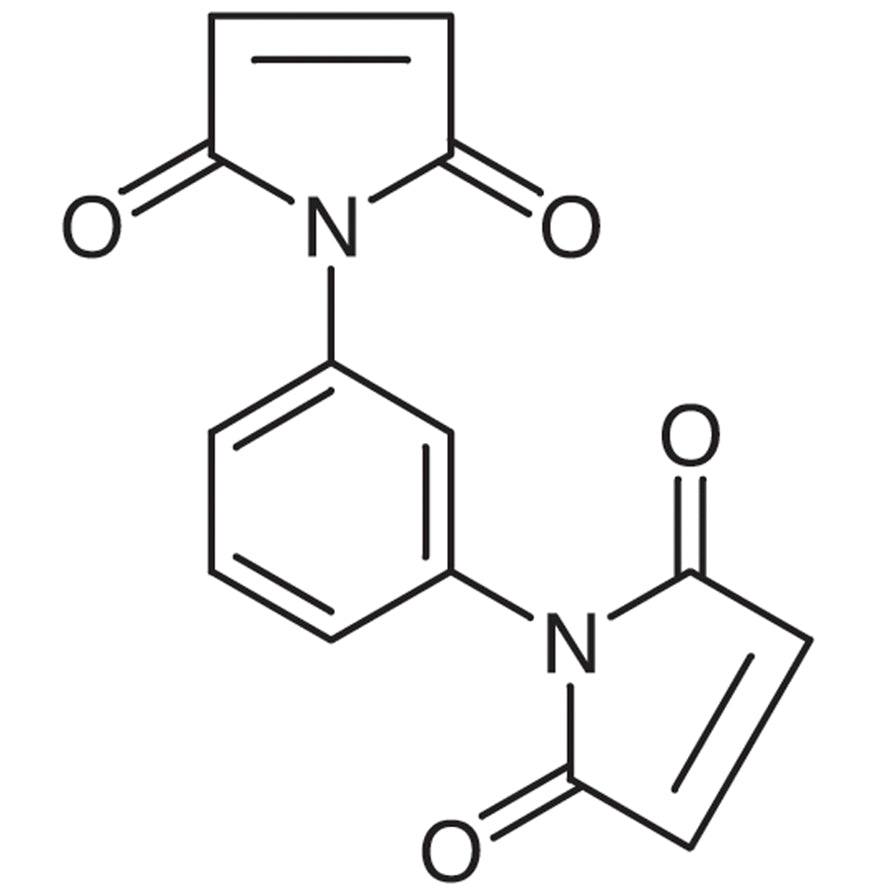
N,N'-1,3-Phenylenedimaleimide from TCI is a bismaleimide compound. Its molecule carries two maleimide groups attached to a benzene ring in the meta position. In materials science, it is classed as both a monomer and a crosslinking agent. In the laboratory, it is used to build thermoset polymer networks, to modify rubber, and to study addition reactions at the maleimide double bond. This makes it a highly relevant reagent for polymer and composite research groups.
Researchers choose this material because both maleimide groups are highly reactive toward thiols, dienes, and radicals. As a result, a single molecule can efficiently link two polymer chains through Michael addition, Diels–Alder reaction, or radical polymerization. The aromatic and imide rings in its structure generally give the resulting networks good heat resistance and rigidity. Its Diels–Alder reaction with furans is reversible, which has also made the compound a subject of interest in research on self-healing materials.
In Indonesia, natural rubber research is especially strategic because the country is one of the world's major rubber producers. Bismaleimides such as this one can be studied as vulcanization aids and as stabilizers for rubber compounds. Polymer laboratories at universities, research institutes, and industrial R&D centres can use this TCI reagent to explore new crosslinking systems, high-performance thermoset resins, and composite matrices for local applications.
- Thermoset network synthesis: the two reactive maleimide groups allow the compound to join polymer chains into rigid, heat-resistant crosslinked networks for resin and composite studies.
- Natural rubber modification: as a bismaleimide crosslinker, it can be studied as a vulcanization aid and stabilizer in rubber compound formulations, which matters for Indonesia's rubber sector.
- Thiol–maleimide Michael addition studies: the maleimide double bonds react readily with thiols, so the compound is a suitable model reagent for investigating efficient addition-based crosslinking chemistry.
- Reversible Diels–Alder chemistry: its reversible reaction with furan-functionalized materials makes it a valuable building block in research on self-healing and re-processable polymer systems.
- Radical polymerization and copolymerization: the maleimide groups take part in radical reactions, so researchers can use the compound to add crosslinks and thermal stability to growing polymer chains.
| Brand | TCI (product code P0976) |
|---|---|
| CAS number | 3006-93-7 |
| Molecular formula | — |
| Purity | — |
| Category | Materials Science > Polymer/Macromolecule Reagents > Monomers |
| Pack sizes | please contact AMI Scientific for currently available pack sizes |
| Physical form | refer to the manufacturer's Certificate of Analysis and Safety Data Sheet |
| Storage | keep tightly closed in a cool, dry place as directed in the manufacturer's SDS |
Store N,N'-1,3-Phenylenedimaleimide in its original, tightly sealed container. Keep it in a cool, dry, well-ventilated area away from heat, direct sunlight, and moisture. Because the maleimide groups are reactive, keep the material away from strong bases, thiols, amines, and oxidizing agents unless they are part of a planned reaction. Handle it in a fume hood and wear suitable gloves, safety glasses, and a lab coat. Avoid breathing in dust and avoid contact with skin and eyes. Always check the manufacturer's Safety Data Sheet for specific hazard, storage, and disposal instructions before use.
—
Produk Terkait
-
TCI B5774 5,10-Bis(4,4,5,5-tetramethyl-1,3,2-dioxaborolan-2-yl)naphtho[1,2-c:5,6-c']bis([1,2,5]oxadiazole)
Regular price Rp 10.255.350,00Regular price -
Dihydroiodide TCI B6569
Regular price From Rp 1.936.200,00Regular price -
Trifluoromethanesulfonate TCI B7003
Regular price From Rp 1.936.200,00Regular price
![5,10-Bis(4,4,5,5-tetramethyl-1,3,2-dioxaborolan-2-yl)naphtho[1,2-c:5,6-c']bis([1,2,5]oxadiazole) - TCI B5774 - AMI Scientific](http://amiscientific.com/cdn/shop/files/TCI2510B5774.jpg?v=1769180228&width=533)