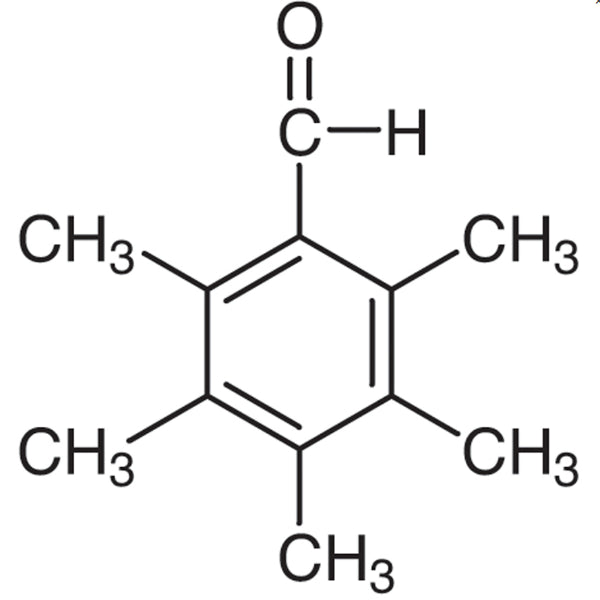
Pentamethylbenzaldehyde from TCI is an aromatic aldehyde whose benzene ring carries five methyl groups. Every ring position except the one holding the formyl group is substituted. It belongs to the non-heterocyclic building blocks used in organic synthesis. Researchers use it to add a very bulky, electron-rich aryl group to target molecules. It is also a common model substrate for studying how steric hindrance changes the reactivity of a carbonyl group, which makes it useful for both preparative and mechanistic work.
The compound's key feature is the pair of methyl groups in the ortho positions on either side of the aldehyde group. These two groups create strong steric hindrance and can change how the formyl group sits relative to the plane of the ring. Because of this, nucleophilic addition to this aldehyde runs at a different rate and with different selectivity than it does with ordinary benzaldehyde. The five methyl groups also make the ring electron-rich. Together, these traits make it attractive for designing ligands, catalysts, or functional molecules that need a sterically shielded space around their reactive center.
In Indonesia, this material suits physical organic chemistry, coordination chemistry, and materials synthesis laboratories at universities and research institutions. Graduate students and researchers can use it in projects that compare hindered and unhindered aldehydes, in work that builds bulky ligand frameworks, and in synthetic routes that need a fully substituted aryl group. Because it is supplied under the TCI brand, laboratories can work with a consistent, well-documented reagent across repeated experiments and research projects.
- Introducing bulky aryl groups: the pentamethylphenyl group adds a very bulky, electron-rich aromatic unit to target molecules, which helps when building crowded molecular structures.
- Steric hindrance studies: the two ortho methyl groups beside the formyl group make this aldehyde a clear model substrate for studying how steric crowding changes carbonyl reactivity.
- Nucleophilic addition research: the hindered aldehyde reacts at a different rate and with different selectivity than plain benzaldehyde, so it suits comparative studies of addition reactions.
- Ligand and catalyst design: the electron-rich, sterically shielding aryl group suits ligands and catalysts that need a protected space around their reactive or metal-binding center.
- Functional molecule and materials synthesis: as a non-heterocyclic building block, it gives materials researchers a fully substituted aromatic aldehyde for building functional molecules that need steric protection.
| Brand | TCI (product code P1351) |
|---|---|
| CAS number | 17432-38-1 |
| Molecular formula | — |
| Purity | — |
| Category | Chemistry > Building Blocks > Non-Heterocyclic Building Blocks |
| Pack sizes | check the pack options offered for this product |
| Physical form | see the TCI certificate of analysis or safety data sheet |
| Storage | follow the storage conditions on the TCI label and safety data sheet |
Keep Pentamethylbenzaldehyde in its original, tightly closed TCI container. Store it in a cool, dry, well-ventilated place away from direct sunlight, heat, and strong oxidizing agents. Aldehydes can slowly oxidize in air, so reseal the container promptly after each use and limit how often it is left open. Handle the compound in a fume hood and wear standard protective equipment, including a lab coat, safety glasses, and chemical-resistant gloves. Avoid breathing in dust or vapor and avoid contact with skin and eyes. Before use, read the TCI safety data sheet for specific hazard information, first-aid measures, and disposal instructions. Label any portions you transfer clearly, and dispose of waste according to institutional and local regulations.
—
Produk Terkait
-
TCI B5774 5,10-Bis(4,4,5,5-tetramethyl-1,3,2-dioxaborolan-2-yl)naphtho[1,2-c:5,6-c']bis([1,2,5]oxadiazole)
Regular price Rp 10.255.350,00Regular price -
Dihydroiodide TCI B6569
Regular price From Rp 1.936.200,00Regular price -
Trifluoromethanesulfonate TCI B7003
Regular price From Rp 1.936.200,00Regular price
![5,10-Bis(4,4,5,5-tetramethyl-1,3,2-dioxaborolan-2-yl)naphtho[1,2-c:5,6-c']bis([1,2,5]oxadiazole) - TCI B5774 - AMI Scientific](http://amiscientific.com/cdn/shop/files/TCI2510B5774.jpg?v=1769180228&width=533)