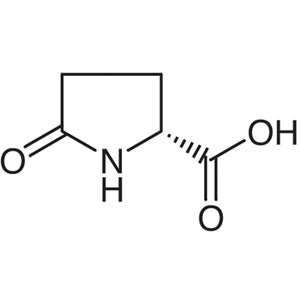
D-Pyroglutamic Acid from TCI (product code P1354) is the D-enantiomer, with R configuration, of pyroglutamic acid. It is a five-membered cyclic lactam formed when glutamic acid cyclizes. The compound belongs to the chiral resolution reagents category within asymmetric synthesis. In the laboratory, its main role is to separate racemic mixtures, especially amines, by forming diastereomeric salts. It also serves as a chiral building block from the "chiral pool" for synthesizing compounds that need a specific stereochemical configuration.
Chemists choose this compound because it combines three useful structural features: a single, clearly defined chiral centre, a carboxylic acid group that forms salts, and a rigid lactam ring. When it reacts with a racemic amine, the two amine enantiomers form diastereomeric salts with different solubilities. These salts can then be separated by fractional crystallization. The D-form complements the more common L-pyroglutamic acid, so researchers can pick whichever reagent enantiomer gives the most effective resolution for their substrate. As a building block, its pyrrolidinone ring can be modified into a range of proline, pyrrolidine and alkaloid derivatives.
In Indonesia, this material is useful for pharmaceutical chemistry laboratories, asymmetric synthesis research groups, and university organic chemistry departments. Teams working on chiral drug intermediates can use it to obtain single enantiomers from racemic amine mixtures without specialized chromatographic equipment. Academic researchers studying stereoselective methods can use it as a defined chiral starting material for multistep synthesis. Teaching laboratories can also use it to show students in practice how diastereomeric salt formation and fractional crystallization separate enantiomers.
- Resolution of racemic amines: its carboxylic acid group forms diastereomeric salts with amine enantiomers, and the different solubilities of these salts allow separation by fractional crystallization.
- Chiral pool synthesis: its single, well-defined chiral centre with R configuration makes it a reliable starting material for target molecules that need a specific stereochemistry.
- Preparation of proline and pyrrolidine derivatives: the rigid pyrrolidinone ring can be modified step by step into many substituted five-membered nitrogen heterocycles for research.
- Alkaloid and natural product research: as a chiral building block, it gives access to the stereodefined nitrogen-containing frameworks found in many alkaloid structures studied in organic chemistry.
- Screening resolving agents: used alongside L-pyroglutamic acid, it lets researchers compare both reagent enantiomers and choose whichever gives the more efficient separation for a particular substrate.
| Brand | TCI (product code P1354) |
|---|---|
| CAS number | 4042-36-8 |
| Molecular formula | — |
| Purity | — |
| Category | Chemistry > Asymmetric Synthesis > Chiral Resolution Reagents |
| Pack sizes | available in the pack sizes TCI offers; please check the product listing for current options |
| Physical form | solid organic acid (cyclic lactam of glutamic acid) |
| Storage | keep tightly closed in a cool, dry place; follow the label and Safety Data Sheet |
Store D-Pyroglutamic Acid in its original, tightly sealed container in a cool, dry and well-ventilated area, away from direct sunlight and moisture. Moisture can affect a chiral reagent's quality over time. Keep it away from strong bases and oxidizing agents, and label any secondary containers clearly with the name and CAS number. When handling the material, wear standard laboratory protective equipment, including safety glasses, gloves and a lab coat. Avoid creating or breathing in dust, and weigh the material in a well-ventilated area or a fume hood. Always read the supplier's Safety Data Sheet before use, and dispose of residues according to local laboratory and environmental regulations.
—
Produk Terkait
-
TCI B5774 5,10-Bis(4,4,5,5-tetramethyl-1,3,2-dioxaborolan-2-yl)naphtho[1,2-c:5,6-c']bis([1,2,5]oxadiazole)
Regular price Rp 10.255.350,00Regular price -
Dihydroiodide TCI B6569
Regular price From Rp 1.936.200,00Regular price -
Trifluoromethanesulfonate TCI B7003
Regular price From Rp 1.936.200,00Regular price
![5,10-Bis(4,4,5,5-tetramethyl-1,3,2-dioxaborolan-2-yl)naphtho[1,2-c:5,6-c']bis([1,2,5]oxadiazole) - TCI B5774 - AMI Scientific](http://amiscientific.com/cdn/shop/files/TCI2510B5774.jpg?v=1769180228&width=533)