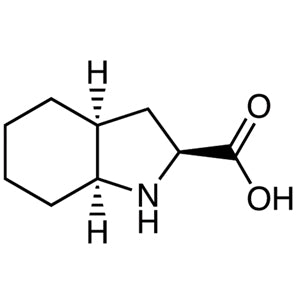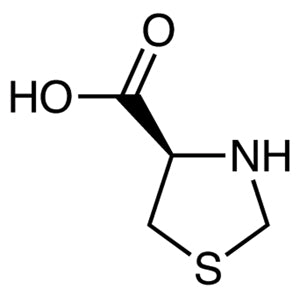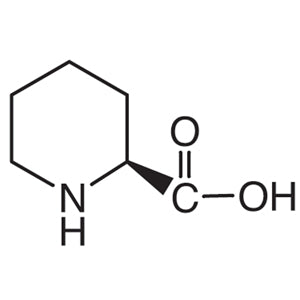
L-Pipecolic Acid from TCI (product code P1404) is a cyclic, non-proteinogenic amino acid built on a six-membered piperidine ring. It is a homologue of L-proline whose ring is one carbon atom larger. In nature, pipecolic acid forms as a metabolite of lysine and plays a part in plant defence systems. In the chemistry laboratory, TCI classifies it as an organocatalyst. It is also an important chiral building block for synthesising peptidomimetics and a range of piperidine-based pharmaceutical compounds.
Chemists choose this material because, like proline, it carries a secondary amine and a carboxylic acid together within a rigid chiral framework. This bifunctional structure lets it catalyse aldol, Mannich, and Michael reactions through enamine or iminium intermediates. Its six-membered ring gives it a different geometry and conformational flexibility from proline, so it can deliver different selectivity. For this reason, researchers often compare the two when optimising a catalyst. As an enantiomerically pure amino acid, the compound is also a reliable source of stereochemistry for asymmetric synthesis.
In Indonesia, L-Pipecolic Acid is relevant to organic chemistry researchers developing asymmetric synthesis methods, and to university and research institute laboratories that study organocatalysis. Medicinal chemistry groups working on piperidine-containing drug candidates or peptidomimetic scaffolds can also use it as a chiral starting material. Postgraduate students running catalyst screening projects often use it next to L-proline to see how ring size affects yield and stereoselectivity. Sourcing a TCI-branded reagent helps keep results consistent from one study to the next.
TCI brochures (PDF)
- Plant Hormones 2025-01-30 · p. 1
- Asymmetric Organocatalysts 2025-06-12 · p. 7
- Asymmetric Synthesis 2026-03-18 · p. 7
- Agrochemical Ingredients for Research and Experimental Use 2026-01-08 · p. 8
- Plant Research Reagents 2026-02-24 · p. 14
- Amino Acids and Peptide Synthesis Reagents 2025-08-14 · p. 10
Related TCI products
- TCI T4195 67123-97-1 H-DL-Tic-OH
- TCI T1515 74163-81-8 (S)-(-)-1,2,3,4-Tetrahydroisoquinoline-3-carboxylic Acid
- TCI A1043 2133-34-8 L-Azetidine-2-carboxylic Acid [Antagonist of L-Proline]
- TCI O0370 80875-98-5 (2S,3aS,7aS)-Octahydro-1H-indole-2-carboxylic Acid
- TCI I0395 79815-20-6 (S)-(-)-Indoline-2-carboxylic Acid
- TCI F0818 2507-61-1 trans-4-Fluoro-L-proline
- Asymmetric aldol reactions: its secondary amine and carboxylic acid work together through enamine intermediates, making it a useful proline-type organocatalyst for building chiral β-hydroxy carbonyl compounds.
- Mannich and Michael reactions: its bifunctional chiral framework can activate substrates through enamine or iminium pathways, which helps researchers form carbon–carbon bonds with stereocontrol.
- Catalyst optimisation studies: its six-membered ring has a different geometry from proline, so researchers screen it next to L-proline to see how ring size changes selectivity and reactivity.
- Peptidomimetic synthesis: as an enantiomerically pure cyclic amino acid, it adds a conformationally constrained piperidine unit to modified peptides, a common strategy in bioactive molecule design.
- Synthesis of piperidine-based pharmaceutical compounds: it acts as a chiral building block that brings defined stereochemistry into piperidine scaffolds used in medicinal chemistry and drug discovery research.
| Brand | TCI (product code P1404) |
|---|---|
| CAS number | 3105-95-1 |
| Molecular formula | — |
| Purity | — |
| Category | Chemistry > Catalysis and Inorganic Chemistry > Organocatalysts [Catalysis] |
| Pack sizes | available in the pack sizes listed on the product page |
| Physical form | — |
| Storage | follow the conditions on the TCI label and Safety Data Sheet |
- Compound type: cyclic non-proteinogenic amino acid (L-enantiomer, homologue of L-proline)
Keep L-Pipecolic Acid in its original, tightly closed TCI container in a cool, dry, well-ventilated place, away from direct sunlight, heat sources, and incompatible materials such as strong oxidising agents. Reseal the container straight after use so the material does not pick up moisture or contamination, which could affect its catalytic performance and enantiomeric integrity. Always follow the storage conditions on the product label and Safety Data Sheet. Handle the compound in a fume hood or well-ventilated area while wearing suitable personal protective equipment, including safety glasses, gloves, and a lab coat. Avoid breathing in dust and avoid contact with skin and eyes. Dispose of waste according to local regulations and your institution's chemical waste procedures.
—
Product Categories
Produk Terkait
-
H-DL-Tic-OH TCI T4195
Regular price Rp 2.411.850,00Regular priceRp 1.702.050,00Sale price Rp 2.411.850,00 -
(S)-(-)-1,2,3,4-Tetrahydroisoquinoline-3-carboxylicAcid TCI T1515
Regular price From Rp 795.900,00Regular priceRp 572.250,00Sale price From Rp 795.900,00 -
L-Azetidine-2-carboxylicAcid[AntagonistofL-Proline] TCI A1043
Regular price From Rp 1.378.650,00Regular priceRp 979.650,00Sale price From Rp 1.378.650,00 -
(2S,3aS,7aS)-Octahydro-1H-indole-2-carboxylicAcid TCI O0370
Regular price From Rp 1.618.050,00Regular priceRp 1.146.600,00Sale price From Rp 1.618.050,00 -
(S)-(-)-Indoline-2-carboxylicAcid TCI I0395
Regular price From Rp 610.050,00Regular priceRp 442.050,00Sale price From Rp 610.050,00 -
trans-4-Fluoro-L-proline TCI F0818
Regular price Rp 2.782.500,00Regular priceRp 1.961.400,00Sale price Rp 2.782.500,00 -
L-Thioproline TCI T0219
Regular price From Rp 1.643.250,00Regular priceRp 1.164.450,00Sale price From Rp 1.643.250,00 -
trans-4-Hydroxy-L-proline TCI H0296
Regular price From Rp 637.350,00Regular priceRp 460.950,00Sale price From Rp 637.350,00


![TCI A1043 2133-34-8 L-Azetidine-2-carboxylic Acid [Antagonist of L-Proline]](http://amiscientific.com/cdn/shop/files/TCI2510A1043_4bbf518d-01bb-4190-ba80-a68d1e770d01.jpg?v=1792656541&width=533)
![2133-34-8 L-Azetidine-2-carboxylic Acid [Antagonist of L-Proline] - AMI Scientific](http://amiscientific.com/cdn/shop/files/TCI2510A1043.jpg?v=1767080570&width=533)