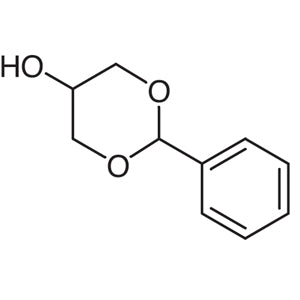
2-Phenyl-1,3-dioxan-5-ol from TCI (product code P1422, CAS 1708-40-3) is a glycerol derivative. Its two primary hydroxyl groups are protected as a benzylidene acetal, which forms a six-membered dioxane ring, so only the secondary hydroxyl group at the central position is free. In organic synthesis laboratories, it is a practical building block for selectively modifying the 2-position of glycerol. Without protection, this is hard to do because glycerol has three hydroxyl groups with similar reactivity.
Chemists choose this material because it gives clear regiochemical control. The free secondary hydroxyl group can be acylated, alkylated or oxidised to a ketone without affecting either primary position. Once the modification is finished, the benzylidene acetal can be removed under acidic conditions or by hydrogenolysis, which frees both hydroxyl groups again. This protecting-group strategy is well established in carbohydrate and lipid chemistry. As a result, many procedures are available in the literature, and researchers can apply it with relative ease.
In Indonesia, this compound is relevant to research groups working in organic chemistry, natural product chemistry and oleochemistry. Indonesia is a major producer of palm oil, and glycerol is a by-product of that industry, so methods for turning glycerol into more valuable derivatives are of real interest to local universities and research institutes. University synthesis laboratories, postgraduate research projects and industrial R&D teams can use this protected glycerol to prepare well-defined intermediates for further study.
- Selective modification at glycerol's 2-position: with both primary hydroxyl groups protected, chemists can work on the central secondary hydroxyl group without the competing reactions that unprotected glycerol would cause.
- Acylation and esterification studies: the single free secondary hydroxyl group can be acylated in a controlled way, which makes it useful for preparing defined glycerol esters for lipid chemistry research.
- Alkylation to form ether derivatives: the free hydroxyl group can be alkylated while the benzylidene acetal stays in place, giving a clear route to 2-O-substituted glycerol intermediates.
- Oxidation to the corresponding ketone: the secondary hydroxyl group can be oxidised to a ketone without disturbing the protected primary positions, providing a useful intermediate for further synthetic steps.
- Teaching and research on protecting-group strategy: benzylidene acetal protection and deprotection by acid or hydrogenolysis are well documented, so the compound suits instruction and method development in carbohydrate and lipid chemistry.
| Brand | TCI (product code P1422) |
|---|---|
| CAS number | 1708-40-3 |
| Molecular formula | — |
| Purity | — |
| Category | Chemistry > Building Blocks > Non-Heterocyclic Building Blocks |
| Pack sizes | as listed on the product page for this TCI item |
| Physical form | refer to the manufacturer's product documentation |
| Storage | follow the conditions on the TCI label and Safety Data Sheet |
Keep this compound in its original, tightly closed manufacturer container. Store it in a cool, dry, well-ventilated area away from direct sunlight, heat sources, moisture and incompatible substances such as strong acids and strong oxidising agents. Acidic conditions can cleave the benzylidene acetal, so avoid acid contamination. Before use, read the Safety Data Sheet from TCI. Handle the material in a fume hood or well-ventilated area, and wear standard personal protective equipment, including laboratory gloves, safety glasses and a lab coat. Avoid inhaling dust or vapour and avoid contact with skin and eyes. After each use, reseal the container promptly. Label any secondary containers clearly, and dispose of waste according to institutional and local chemical waste regulations.
—
Produk Terkait
-
TCI B5774 5,10-Bis(4,4,5,5-tetramethyl-1,3,2-dioxaborolan-2-yl)naphtho[1,2-c:5,6-c']bis([1,2,5]oxadiazole)
Regular price Rp 10.255.350,00Regular price -
Dihydroiodide TCI B6569
Regular price From Rp 1.936.200,00Regular price -
Trifluoromethanesulfonate TCI B7003
Regular price From Rp 1.936.200,00Regular price
![5,10-Bis(4,4,5,5-tetramethyl-1,3,2-dioxaborolan-2-yl)naphtho[1,2-c:5,6-c']bis([1,2,5]oxadiazole) - TCI B5774 - AMI Scientific](http://amiscientific.com/cdn/shop/files/TCI2510B5774.jpg?v=1769180228&width=533)