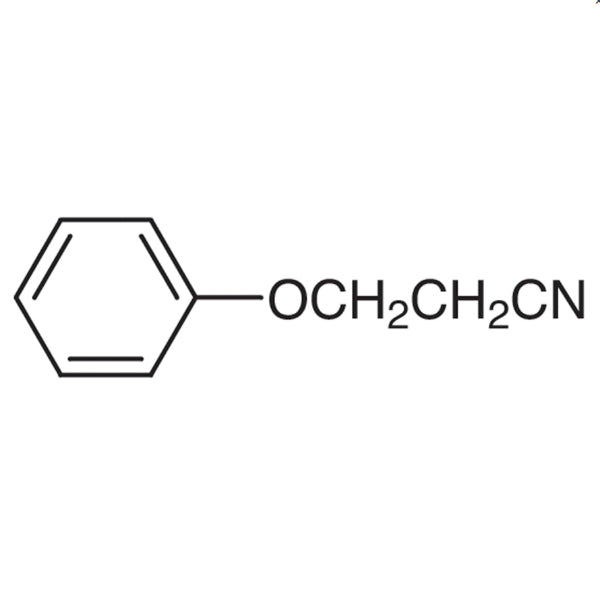
3-Phenoxypropionitrile from TCI (product code P1426) is an aliphatic nitrile with a phenoxy group, meaning a phenyl ring bonded through an oxygen atom, at the end of a three-carbon chain. In synthesis laboratories it serves as a non-heterocyclic building block that combines two useful functional groups: a stable aryl ether and a nitrile group that can be converted into many other functionalities. This combination makes it a practical starting material for building the aryl ether frameworks often found in pharmaceutical compounds, agrochemicals, and specialty chemicals.
The nitrile group is one of the most versatile functional groups in organic synthesis. It can be hydrolysed to a carboxylic acid or an amide, reduced to a primary amine, or reacted with organometallic reagents to give ketones. Hydrolysis gives 3-phenoxypropionic acid, a classic precursor for intramolecular cyclisation to the chromanone framework. The aryl ether bond holds up under many reaction conditions, so the phenoxy group stays intact while the nitrile group is being transformed. Chemists can therefore change one end of the molecule and leave the aromatic part as it is, which makes multistep synthetic routes simpler to plan.
In Indonesia, this compound suits organic chemistry laboratories at universities, research institutes, and industrial pharmaceutical development units. Graduate students and researchers can use it in synthetic methodology projects, in preparing intermediates for target molecules, and in practical teaching on how functional groups are transformed. Because it is supplied under the TCI brand, laboratories receive a material with clear product identification. This makes it easier to document, reproduce, and report results in theses, journal publications, and internal research records.
- Carboxylic acid synthesis: hydrolysing the nitrile group gives 3-phenoxypropionic acid, a useful intermediate for further derivatisation and coupling reactions in organic synthesis.
- Chromanone framework construction: the 3-phenoxypropionic acid obtained by hydrolysis is a classic precursor for intramolecular cyclisation to chromanone ring systems.
- Primary amine preparation: reducing the nitrile group gives a primary amine that keeps the phenoxy group, which is useful for building amine-containing aryl ether intermediates.
- Ketone synthesis with organometallic reagents: organometallic reagents react with the nitrile group to give ketones, which extends the carbon skeleton while the aryl ether stays intact.
- Teaching and methodology research: the molecule has two clearly different functional groups, so it is a convenient model substrate for showing selective transformations in advanced organic chemistry courses.
| Brand | TCI (product code P1426) |
|---|---|
| CAS number | 3055-86-5 |
| Molecular formula | — |
| Purity | — |
| Category | Chemistry > Building Blocks > Non-Heterocyclic Building Blocks |
| Pack sizes | please contact AMI Scientific to confirm the pack sizes currently available |
| Physical form | please check the TCI product documentation and certificate of analysis |
| Storage | follow the conditions on the TCI label and Safety Data Sheet (SDS) |
Store 3-Phenoxypropionitrile in its original, tightly closed TCI container. Keep it in a cool, dry, well-ventilated area away from heat sources, direct sunlight, and incompatible materials such as strong oxidising agents, strong acids, and strong bases. Always follow the specific storage conditions on the product label and in the Safety Data Sheet. Handle the compound in a fume hood while wearing suitable personal protective equipment, including chemical-resistant gloves, safety glasses, and a laboratory coat. Avoid inhaling vapours and avoid contact with skin and eyes. Nitrile compounds should be handled with care, so make sure all waste is collected and disposed of according to institutional rules and local regulations for chemical waste. Label any secondary containers clearly with the compound name, CAS number, and date opened.
—
Produk Terkait
-
TCI B5774 5,10-Bis(4,4,5,5-tetramethyl-1,3,2-dioxaborolan-2-yl)naphtho[1,2-c:5,6-c']bis([1,2,5]oxadiazole)
Regular price Rp 10.255.350,00Regular price -
Dihydroiodide TCI B6569
Regular price From Rp 1.936.200,00Regular price -
Trifluoromethanesulfonate TCI B7003
Regular price From Rp 1.936.200,00Regular price
![5,10-Bis(4,4,5,5-tetramethyl-1,3,2-dioxaborolan-2-yl)naphtho[1,2-c:5,6-c']bis([1,2,5]oxadiazole) - TCI B5774 - AMI Scientific](http://amiscientific.com/cdn/shop/files/TCI2510B5774.jpg?v=1769180228&width=533)