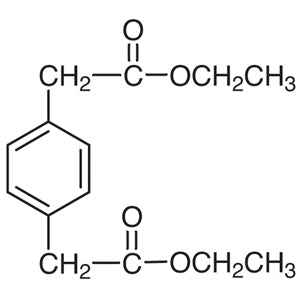
Diethyl 1,4-Phenylenediacetate from TCI (product code P1434) is the diethyl diester of 1,4-phenylenediacetic acid. The molecule is a para-substituted benzene ring with an ethyl acetate group on each side. In organic synthesis laboratories, this compound is a practical symmetrical building block, because both ester groups can be transformed at the same time to give bifunctional molecules. Like most esters, it is generally more soluble in organic solvents than the free acid, so it works under a wider range of reaction conditions.
Chemists choose this material because it can react at two kinds of site. First, the ester groups can be hydrolysed, reduced to the corresponding diol, or converted into amides and hydrazides. Second, the methylene carbons between the aromatic ring and the carbonyl groups are fairly acidic. They can be deprotonated and alkylated, or used in condensation reactions. Together, these two kinds of reactive site give chemists plenty of room to design more complex symmetrical molecular frameworks, which makes the compound a flexible starting point for multistep synthesis.
In Indonesia, this compound is useful to organic chemistry and materials laboratories at universities, research centres and industrial R&D units that need a bifunctional aromatic intermediate. Postgraduate research groups can use it to build symmetrical target molecules for synthetic method studies. Materials researchers can use it as a precursor for difunctional monomers and linkers. Because it is a catalogue item from TCI, a long-established reagent brand, laboratories can document their starting materials consistently across repeated experiments.
- Synthesis of symmetrical bifunctional molecules: both ethyl ester groups can be transformed at the same time, so one reaction step turns the para-substituted core into a difunctional product.
- Preparation of the corresponding diacid, diol, diamide or dihydrazide: standard hydrolysis, reduction or aminolysis of the ester groups gives several useful derivatives from one starting material.
- Alkylation at the benzylic methylene positions: the fairly acidic methylene carbons next to the carbonyl groups can be deprotonated and alkylated to build substituted symmetrical frameworks for further study.
- Condensation reactions in synthetic method development: the activated methylene groups can take part in condensation chemistry, which helps researchers explore new carbon–carbon bond-forming routes on an aromatic scaffold.
- Precursor work in materials chemistry: the rigid para-phenylene core with two reactive arms suits the preparation of difunctional monomers, linkers and intermediates for polymer and materials research.
| Brand | TCI (product code P1434) |
|---|---|
| CAS number | 36076-26-3 |
| Molecular formula | — |
| Purity | — |
| Category | Chemistry > Building Blocks > Non-Heterocyclic Building Blocks |
| Pack sizes | available in TCI catalogue pack sizes; please confirm the available options on the product page |
| Physical form | — |
| Storage | follow the conditions on the TCI label and Safety Data Sheet (SDS) |
- Chemical identity: diethyl ester of 1,4-phenylenediacetic acid
Keep Diethyl 1,4-Phenylenediacetate in its original, tightly closed manufacturer container in a cool, dry, well-ventilated area, away from heat sources, direct sunlight and strong oxidising agents. Because it is an ester, keep it away from moisture and from strong acids or bases, which can cause gradual hydrolysis. Always check the TCI label and SDS for the recommended storage temperature. Handle it in a fume hood or well-ventilated area while wearing safety glasses, chemical-resistant gloves and a laboratory coat. Avoid skin and eye contact and breathing in any vapour or dust. Use clean, dry tools when dispensing it, and dispose of residues according to institutional chemical waste procedures.
—
Produk Terkait
-
TCI B5774 5,10-Bis(4,4,5,5-tetramethyl-1,3,2-dioxaborolan-2-yl)naphtho[1,2-c:5,6-c']bis([1,2,5]oxadiazole)
Regular price Rp 10.255.350,00Regular price -
Dihydroiodide TCI B6569
Regular price From Rp 1.936.200,00Regular price -
Trifluoromethanesulfonate TCI B7003
Regular price From Rp 1.936.200,00Regular price
![5,10-Bis(4,4,5,5-tetramethyl-1,3,2-dioxaborolan-2-yl)naphtho[1,2-c:5,6-c']bis([1,2,5]oxadiazole) - TCI B5774 - AMI Scientific](http://amiscientific.com/cdn/shop/files/TCI2510B5774.jpg?v=1769180228&width=533)