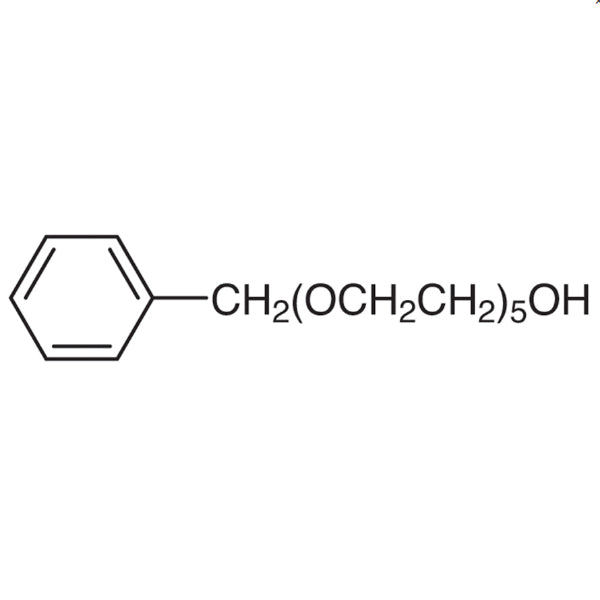
Pentaethylene Glycol Monobenzyl Ether from TCI (product code P1435) is an ethylene glycol oligomer made of exactly five ethylene oxide units. One end of the chain is capped with a benzyl group as an ether. The other end carries a free hydroxyl group. In the laboratory, this compound is a very useful monodisperse PEG building block for making linkers, spacers, and conjugates. Its chain length is precisely defined. Polymeric PEG, by contrast, always has a molecular weight distribution, so this material gives chemists much more structural control.
Chemists choose this compound because its two ends can be worked on one after the other in a controlled way. The free hydroxyl group can be activated to a tosylate, mesylate, halide, or azide, or oxidized to a carboxylic acid. Once that end has been modified, the benzyl group can be removed, usually by catalytic hydrogenolysis, to expose a second hydroxyl group. The ethylene glycol chain also makes any molecule it is attached to more hydrophilic, more flexible, and more soluble. These properties matter a great deal when designing bioactive compounds.
In Indonesia, this material is relevant to medicinal chemistry, biotechnology, and materials chemistry laboratories. These include groups developing linkers for biomolecule conjugation and bifunctional molecules such as PROTACs. University research groups, pharmaceutical development teams, and institutional laboratories working on organic synthesis can also use it as a reliable, well-defined intermediate. Its exact chain length makes structure–activity studies and analytical characterization easier, and it helps keep results consistent from one batch of synthesized compounds to the next.
- Linker synthesis for bioconjugation: the defined five-unit chain gives a spacer of exact length, so conjugates of biomolecules are structurally uniform and easier to characterize.
- Building bifunctional molecules such as PROTACs: the two ends can be modified in sequence, so chemists can attach two different ligands step by step with good control.
- Preparing activated PEG intermediates: the free hydroxyl group can be converted into a tosylate, mesylate, halide, or azide for later coupling or click-type reactions.
- Making carboxylic acid–terminated PEG spacers: the hydroxyl end can be oxidized to an acid, which can then be coupled to amines to form amide-linked conjugates.
- Improving solubility in bioactive compound design: adding the ethylene glycol chain makes target molecules more hydrophilic and flexible, which helps solubility in aqueous and biological media.
| Brand | TCI (product code P1435) |
|---|---|
| CAS number | 57671-28-0 |
| Molecular formula | — |
| Purity | — |
| Category | Chemistry > Building Blocks > Non-Heterocyclic Building Blocks |
| Pack sizes | as listed on this product page |
| Physical form | see the product label and the Certificate of Analysis |
| Storage | keep tightly closed in a cool, dry place and follow the label recommendations |
Keep the container tightly closed in a cool, dry, well-ventilated area, away from direct sunlight, heat sources, and strong oxidizing agents. Leave the material in its original manufacturer container, or move it to a clean, well-labeled glass container with a secure cap. Ethylene glycol ethers can pick up moisture, so reseal the container promptly after each use. Handle the material in a fume hood or another well-ventilated area. Wear standard personal protective equipment, including safety glasses, chemical-resistant gloves, and a laboratory coat. Avoid contact with skin and eyes, and do not breathe in vapors. Before use, read the Safety Data Sheet supplied with the product, and dispose of any waste according to local regulations and your institution's procedures.
—
Produk Terkait
-
TCI B5774 5,10-Bis(4,4,5,5-tetramethyl-1,3,2-dioxaborolan-2-yl)naphtho[1,2-c:5,6-c']bis([1,2,5]oxadiazole)
Regular price Rp 10.255.350,00Regular price -
Dihydroiodide TCI B6569
Regular price From Rp 1.936.200,00Regular price -
Trifluoromethanesulfonate TCI B7003
Regular price From Rp 1.936.200,00Regular price
![5,10-Bis(4,4,5,5-tetramethyl-1,3,2-dioxaborolan-2-yl)naphtho[1,2-c:5,6-c']bis([1,2,5]oxadiazole) - TCI B5774 - AMI Scientific](http://amiscientific.com/cdn/shop/files/TCI2510B5774.jpg?v=1769180228&width=533)