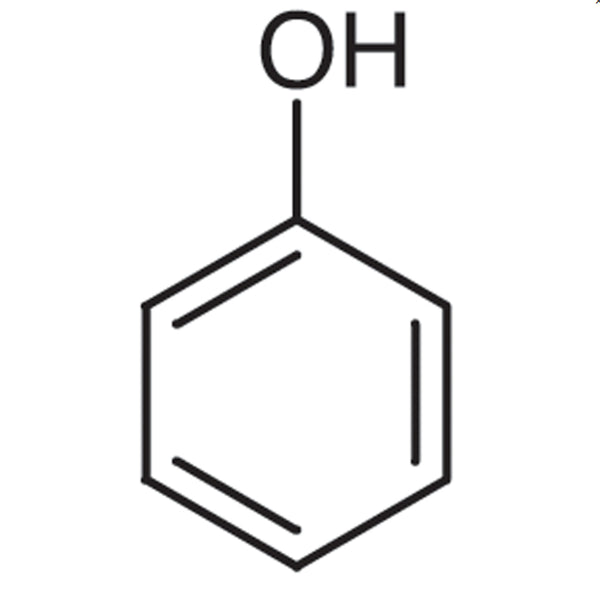
Phenol from TCI is the simplest aromatic compound that carries a hydroxyl group bonded directly to a benzene ring. It is one of the most widely used basic chemicals, serving as a synthesis reagent, a starting material for a broad range of aromatic derivatives, and a reference compound in analytical work. In the chemistry laboratory, phenol is an essential material for studying the reactivity of activated aromatic rings and for preparing ethers, esters, and other substituted compounds used in further research.
Researchers choose phenol because its hydroxyl group is weakly acidic and strongly activates the aromatic ring toward electrophilic substitution at the ortho and para positions. As a result, phenol is readily halogenated, nitrated, or acylated under suitable conditions. The hydroxyl group can also be deprotonated to form the nucleophilic phenoxide ion, which suits Williamson ether synthesis and esterification. Because it reacts both at the oxygen atom and on the aromatic ring, phenol is a very flexible starting material for organic synthesis and for teaching.
In Indonesian laboratories, phenol is used by chemistry teaching laboratories, organic synthesis research groups, analytical chemistry laboratories, and polymer development teams. University lecturers and laboratory staff use it to demonstrate fundamental aromatic substitution reactions in practical classes. Research groups use it as a dependable building block for preparing new aromatic derivatives. Analytical and quality control laboratories keep it on hand as a well-characterised reference compound for method development and routine comparison work.
- Electrophilic aromatic substitution studies: the hydroxyl group strongly activates the ring at the ortho and para positions, which makes phenol a clear model for halogenation, nitration, and acylation experiments.
- Williamson ether synthesis: phenol is easily deprotonated to the nucleophilic phenoxide ion, which reacts with suitable alkylating agents to give aryl ethers for further synthetic work.
- Esterification and preparation of aryl esters: the reactive hydroxyl group lets researchers prepare phenyl esters, which are useful intermediates and model compounds in organic synthesis research.
- Chemistry education and practical classes: as the simplest phenolic compound, it lets students observe weak acidity and ring activation directly in one well-understood molecule.
- Analytical reference and polymer development work: phenol serves as a reference compound in analytical methods and as a basic aromatic starting material for laboratories exploring phenol-based polymer chemistry.
| Brand | TCI (product code P1610) |
|---|---|
| CAS number | 108-95-2 |
| Molecular formula | — |
| Purity | — |
| Category | Chemistry > Building Blocks > Non-Heterocyclic Building Blocks |
| Pack sizes | several pack sizes available; please contact AMI Scientific for current options |
| Physical form | solid (refer to the TCI certificate of analysis for lot-specific details) |
| Storage | keep in a tightly closed container, protected from light and moisture |
Store phenol in its original, tightly sealed container in a cool, dry, well-ventilated area, away from light, oxidising agents, and sources of moisture. Phenol can discolour when exposed to air and light, so close the container promptly after each use. Phenol is toxic and corrosive, and it can be absorbed through the skin. Handle it only in a fume hood while wearing chemical-resistant gloves, safety goggles, and a laboratory coat. Do not inhale dust or vapour, and avoid all skin contact. Keep spill materials and an eyewash station nearby. Always read the supplier's Safety Data Sheet before use and dispose of waste according to local regulations.
—
Produk Terkait
-
TCI B5774 5,10-Bis(4,4,5,5-tetramethyl-1,3,2-dioxaborolan-2-yl)naphtho[1,2-c:5,6-c']bis([1,2,5]oxadiazole)
Regular price Rp 10.255.350,00Regular price -
Dihydroiodide TCI B6569
Regular price From Rp 1.936.200,00Regular price -
Trifluoromethanesulfonate TCI B7003
Regular price From Rp 1.936.200,00Regular price
![5,10-Bis(4,4,5,5-tetramethyl-1,3,2-dioxaborolan-2-yl)naphtho[1,2-c:5,6-c']bis([1,2,5]oxadiazole) - TCI B5774 - AMI Scientific](http://amiscientific.com/cdn/shop/files/TCI2510B5774.jpg?v=1769180228&width=533)