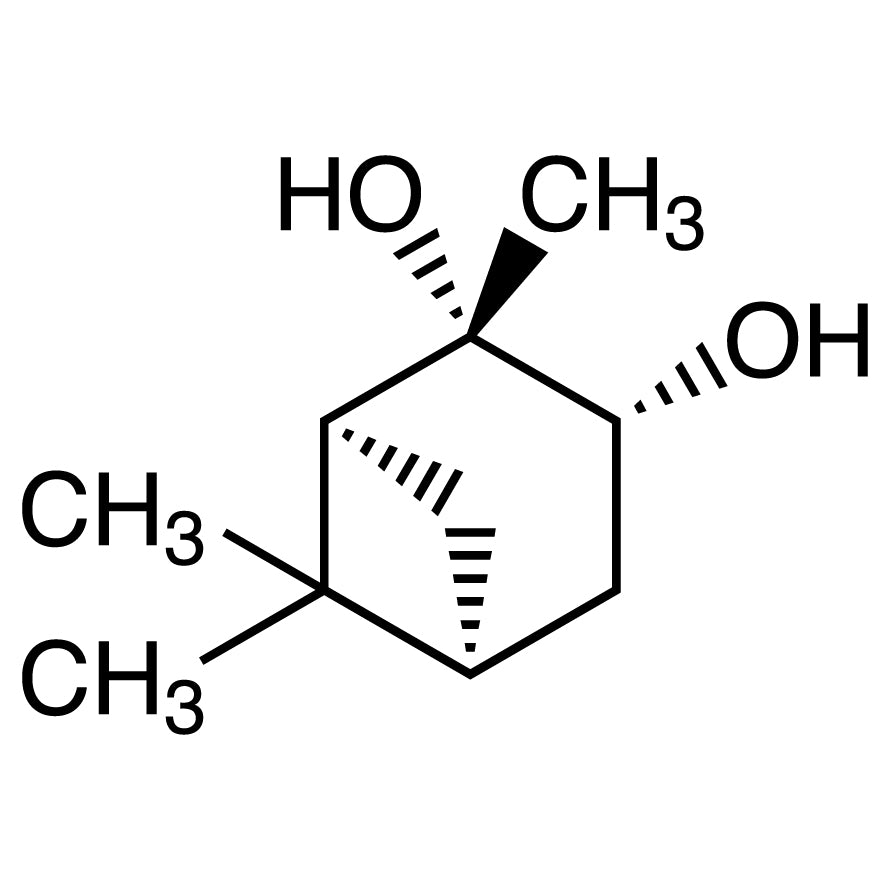
(1S,2S,3R,5S)-(+)-2,3-Pinanediol from TCI (product code P1934) is a chiral diol built on a pinane skeleton. It is usually made from α-pinene, a common natural terpene. The molecule has two hydroxyl groups on neighbouring carbons (a vicinal diol) on a rigid bicyclic framework, and its four stereogenic centres are fully defined. In synthetic chemistry, pinanediol is a well-known chiral auxiliary. Its main use is to form chiral boronic acid esters, which are key intermediates in many asymmetric syntheses carried out in research laboratories.
Researchers choose pinanediol because its rigid bicyclic framework is very effective at controlling the stereochemical course of a reaction. Pinanediol boronic esters are stable and can be purified. They are the basis of Matteson-type asymmetric homologation, a method that builds chiral centres one after another with reliable stereocontrol. The same approach is used to make α-aminoboronic acids, a class of compounds that matters in medicinal chemistry. The absolute configuration is stated in the compound's name, so chemists can plan and trace the stereochemistry of their products with confidence.
In Indonesian laboratories, this material suits research groups in organic synthesis and medicinal chemistry that develop asymmetric methods, work with organoboron chemistry or synthesise chiral target molecules. University chemistry departments, pharmaceutical research units and government research institutes can use it as a reliable chiral building block in multistep synthesis. It also suits teaching and advanced student research projects that show how a chiral auxiliary works and why a rigid terpene-derived scaffold gives predictable stereochemical outcomes.
TCI brochures (PDF)
- Terpenes 2025-09-22 · p. 6
- Chiral Building Blocks 2025-04-14 · p. 17
Related TCI products
- Chiral boronic ester formation: the vicinal diol condenses with boronic acids to give stable, purifiable chiral pinanediol boronic esters, which serve as dependable intermediates in asymmetric synthesis.
- Matteson-type asymmetric homologation: pinanediol boronic esters are the classic basis of this method, so chemists can add new chiral centres one after another with strong stereochemical control.
- Synthesis of α-aminoboronic acids: the pinanediol auxiliary is used in routes to α-aminoboronic acid derivatives, which are relevant to medicinal chemistry and studies of enzyme-targeted compounds.
- Chiral auxiliary studies in asymmetric methodology: the rigid bicyclic pinane framework and four defined stereocentres make it a good model auxiliary for developing and comparing new stereoselective reactions.
- Organoboron chemistry research: it gives a well-characterised chiral diol partner for protecting, stabilising and handling boronic acids during multistep work on organoboron reagents and intermediates.
| Brand | TCI (product code P1934) |
|---|---|
| CAS number | 18680-27-8 |
| Molecular formula | — |
| Purity | — |
| Category | Chemistry > Asymmetric Synthesis > Chiral Building Blocks |
| Pack sizes | as listed by TCI for product P1934 |
| Physical form | see the TCI product specification and certificate of analysis |
| Storage | follow the conditions on the TCI label and Safety Data Sheet |
Store (1S,2S,3R,5S)-(+)-2,3-Pinanediol in its original tightly closed container, in a cool, dry, well-ventilated place away from direct sunlight, heat sources and incompatible substances such as strong oxidising agents. Always follow the storage temperature and conditions on the TCI label and Safety Data Sheet. Reseal the container promptly after each use to limit exposure to moisture and air. Handle the material in a fume hood or another well-ventilated area. Wear appropriate personal protective equipment, including a lab coat, chemical-resistant gloves and safety glasses. Avoid inhaling dust or vapour and avoid contact with skin and eyes. Label containers clearly, keep accurate inventory records, and dispose of waste according to local regulations and institutional laboratory safety procedures.
—
Produk Terkait
-
(1R,2R,3S,5R)-(-)-2,3-Pinanediol TCI P2245
Regular price From Rp 1.192.800,00Regular priceRp 849.450,00Sale price From Rp 1.192.800,00 -
(-)-Verbenone TCI V0072
Regular price Rp 1.405.950,00Regular priceRp 998.550,00Sale price Rp 1.405.950,00 -
(-)-3-Bromocamphor-8-sulfonicAcidAmmoniumSalt TCI B4412
Regular price Rp 1.220.100,00Regular priceRp 868.350,00Sale price Rp 1.220.100,00 -
(+)-3-Bromocamphor-8-sulfonicAcidAmmoniumSalt TCI B1125
Regular price From Rp 1.113.000,00Regular priceRp 793.800,00Sale price From Rp 1.113.000,00 -
(-)-Borneol TCI B1012
Regular price From Rp 928.200,00Regular priceRp 664.650,00Sale price From Rp 928.200,00 -
(+)-3-Bromocamphor TCI B0567
Regular price Rp 742.350,00Regular priceRp 534.450,00Sale price Rp 742.350,00 -
(1R)-(+)-alpha-Pinene TCI P1099
Regular price From Rp 584.850,00Regular priceRp 408.450,00Sale price From Rp 584.850,00 -
(-)-beta-Pinene TCI P0441
Regular price From Rp 505.050,00Regular priceRp 352.800,00Sale price From Rp 505.050,00