

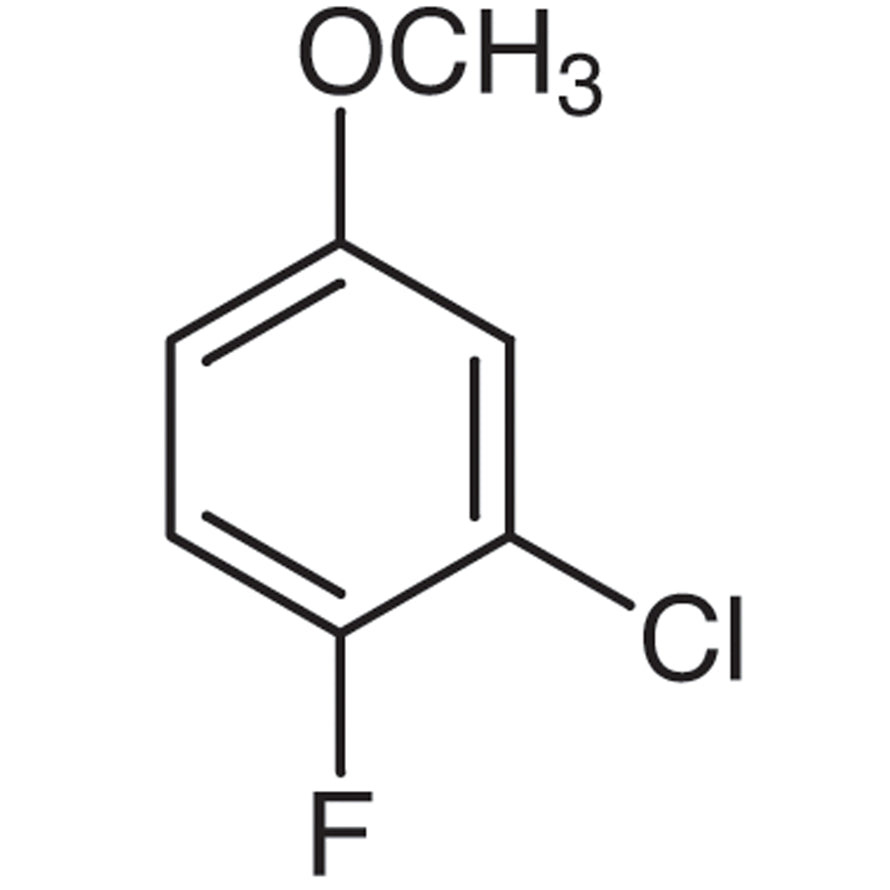
3-Chloro-4-fluoroanisole is a chemical compound widely used as a building block in the synthesis of complex organic molecules. It serves as a versatile intermediate in laboratory settings, enabling the creation of compounds with specific functional groups and structural features. This compound is particularly valuable in organic chemistry due to its unique combination of halogen substituents, which influence its reactivity and compatibility with various synthetic pathways. Its presence in research labs across Indonesia highlights its importance in advancing chemical innovation and discovery.
The compound’s reactivity stems from its dual halogen substitution—chlorine and fluorine—on the anisole ring. These substituents contribute to its stability and reactivity, making it suitable for a range of chemical transformations such as substitution, reduction, and electrophilic reactions. The presence of both halogens also allows for the fine-tuning of molecular properties, enabling the development of compounds with tailored characteristics. This makes it a preferred choice for researchers aiming to design new pharmaceuticals, industrial chemicals, or materials with specific functionalities.
In Indonesian laboratories, 3-Chloro-4-fluoroanisole is commonly used in organic synthesis projects, especially in pharmaceutical and material science research. Its role in creating complex structures and its compatibility with various reaction conditions make it a staple in academic and industrial research settings. Researchers rely on this compound to explore new chemical pathways and develop innovative solutions in diverse scientific fields.
- Organic synthesis is a key application where 3-Chloro-4-fluoroanisole is used to create complex molecular structures with specific functional groups.
- Pharmaceutical research benefits from this compound due to its halogen substituents, which can be modified to produce drug candidates with desired biological activity.
- Material science applications leverage its reactivity to develop new polymers and functional materials with tailored properties.
- Analytical chemistry uses it as a standard for testing reaction mechanisms and evaluating synthetic pathways.
- Environmental studies may incorporate it to investigate the behavior of halogenated compounds in various chemical environments.
| Brand | TCI |
|---|---|
| CAS number | 202925-07-3 |
| Molecular formula | — |
| Purity | — |
| Category | Chemistry > Building Blocks > Fluorinated Building Blocks |
| Pack sizes | — |
| Physical form | — |
| Storage | Store in a cool, dry place away from light and incompatible materials |
This compound should be stored in a cool, dry environment, away from direct sunlight and sources of heat. It is recommended to keep it in a sealed container to prevent moisture absorption and contamination. Due to its halogenated nature, it should be stored separately from reactive or incompatible substances to avoid potential chemical interactions. In laboratory settings, proper ventilation and the use of appropriate personal protective equipment are essential when handling this material. Always follow standard safety protocols to ensure safe handling and minimize any risks associated with its chemical properties.
—
Produk Terkait
-
5-Bromo-2-chloro-4-fluoroanisole TCI B5354
Regular price From Rp 664.650,00Regular price -
3-Chloro-5-fluoroanisole TCI C2218
Regular price From Rp 955.500,00Regular price -
2-Chloro-5-fluoroanisole TCI C2216
Regular price Rp 2.466.450,00Regular price -
2-Chloro-4-fluoroanisole TCI C1667
Regular price Rp 2.199.750,00Regular price -
2-Bromo-5-fluoroanisole TCI B3875
Regular price Rp 2.016.000,00Regular price -
4-Bromo-3-fluoroanisole TCI B3743
Regular price From Rp 1.670.550,00Regular price -
4-Bromo-3,5-difluoroanisole TCI B3392
Regular price Rp 2.625.000,00Regular price -
4-Bromo-2,6-difluoroanisole TCI B3391
Regular price Rp 4.320.750,00Regular price


