

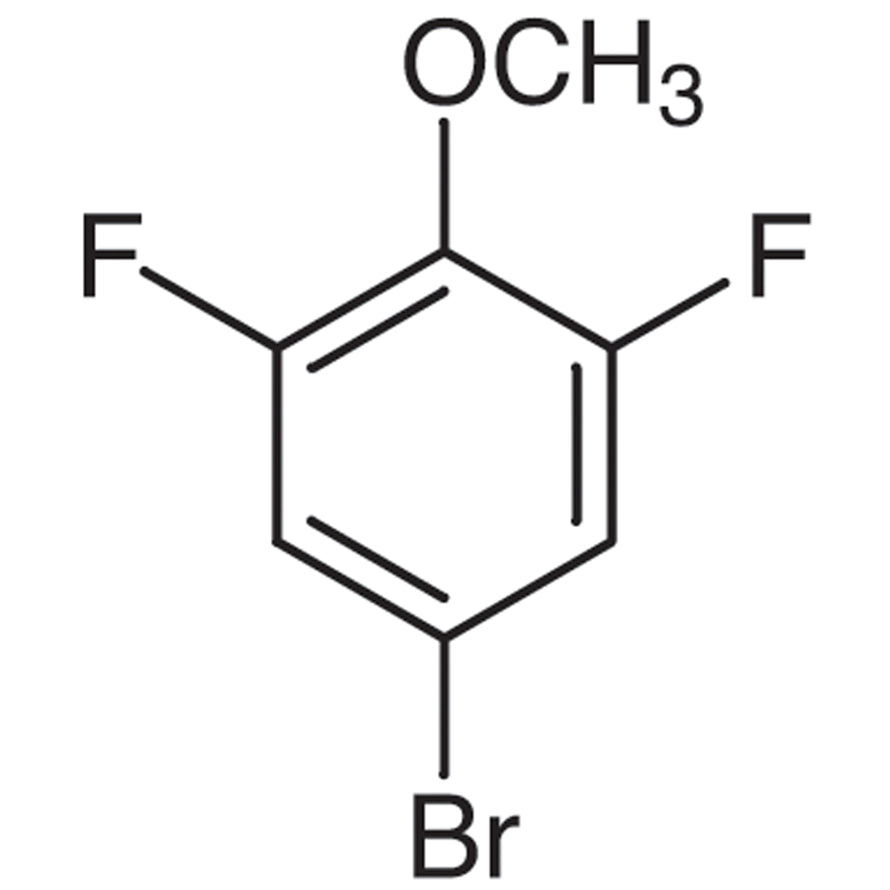
4-Bromo-2,6-difluoroanisole is a chemical compound widely used as a building block in the synthesis of complex organic molecules. Its aromatic structure enables substitution reactions and other chemical transformations, making it a valuable tool in organic chemistry research. This compound is commonly utilized in laboratories for constructing more intricate molecular frameworks through targeted chemical reactions. Its versatility and reactivity make it a preferred choice among researchers looking to develop new compounds with specific functional properties.
The compound’s unique combination of fluorine and bromine substituents imparts distinct electronic properties, influencing its reactivity and molecular stability. These characteristics allow for precise control during synthetic processes, enabling the creation of compounds with tailored functionalities. The stability of the molecule under various reaction conditions further enhances its appeal for use in both academic and industrial research settings. Its chemical inertness in certain environments also contributes to its reliability in laboratory applications.
In Indonesian laboratories, 4-Bromo-2,6-difluoroanisole is frequently employed in organic chemistry research, particularly in pharmaceutical and materials science fields. It plays a key role in the development of new drugs and advanced materials, where precise molecular design is essential. Its availability and chemical properties make it an integral part of the research toolkit for chemists in Indonesia, supporting innovation and scientific advancement.
TCI brochures (PDF)
- Fluorination Reagents, Fluorinated Building Blocks 2026-03-18 · p. 29
- Organic synthesis applications benefit from the compound’s aromatic structure and reactivity, enabling the creation of complex molecules with specific functional groups.
- Pharmaceutical research utilizes the compound to develop new drug candidates, leveraging its unique electronic properties for targeted molecular design.
- Materials science applications take advantage of the compound’s stability and reactivity to create advanced polymers and functional materials.
- Analytical chemistry uses the compound as a reference standard for spectroscopic and chromatographic analyses due to its well-defined chemical properties.
- Environmental studies incorporate the compound to investigate the behavior of halogenated aromatic compounds in various chemical environments.
| Brand | TCI |
|---|---|
| CAS number | 104197-14-0 |
| Molecular formula | — |
| Purity | — |
| Category | Chemistry > Building Blocks > Fluorinated Building Blocks |
| Pack sizes | Available in various quantities as per standard supplier offerings |
| Physical form | Solid, crystalline appearance |
| Storage | Store in a cool, dry place away from light and moisture |
The compound should be stored in a cool, dry environment, away from direct sunlight and moisture to maintain its chemical integrity. It is recommended to use airtight containers made of glass or high-density polyethylene to prevent contamination and degradation. Due to its halogenated nature, it is important to handle the compound with appropriate personal protective equipment, including gloves and safety goggles, to ensure laboratory safety. The compound should be kept in a well-ventilated area to minimize exposure to vapors. Regular monitoring of storage conditions is advised to ensure optimal preservation and safety in the laboratory setting.
—
Produk Terkait
-
4-Bromo-3,5-difluoroanisole TCI B3392
Regular price Rp 2.625.000,00Regular priceRp 1.835.400,00Sale price Rp 2.625.000,00 -
4-Bromo-2,5-difluoroanisole TCI B3097
Regular price Rp 1.298.850,00Regular priceRp 908.250,00Sale price Rp 1.298.850,00 -
2,6-Difluoroanisole TCI D3360
Regular price From Rp 848.400,00Regular priceRp 593.250,00Sale price From Rp 848.400,00 -
3,4-Difluoroanisole TCI D2856
Regular price From Rp 637.350,00Regular priceRp 445.200,00Sale price From Rp 637.350,00 -
3,5-Difluoroanisole TCI D2463
Regular price Rp 2.889.600,00Regular priceRp 2.020.200,00Sale price Rp 2.889.600,00 -
2,4-Difluoroanisole TCI D1849
Regular price From Rp 1.353.450,00Regular priceRp 946.050,00Sale price From Rp 1.353.450,00 -
5-Bromo-2-chloro-4-fluoroanisole TCI B5354
Regular price From Rp 664.650,00Regular priceRp 464.100,00Sale price From Rp 664.650,00 -
2-Bromo-5-fluoroanisole TCI B3875
Regular price Rp 2.016.000,00Regular priceRp 1.409.100,00Sale price Rp 2.016.000,00


