

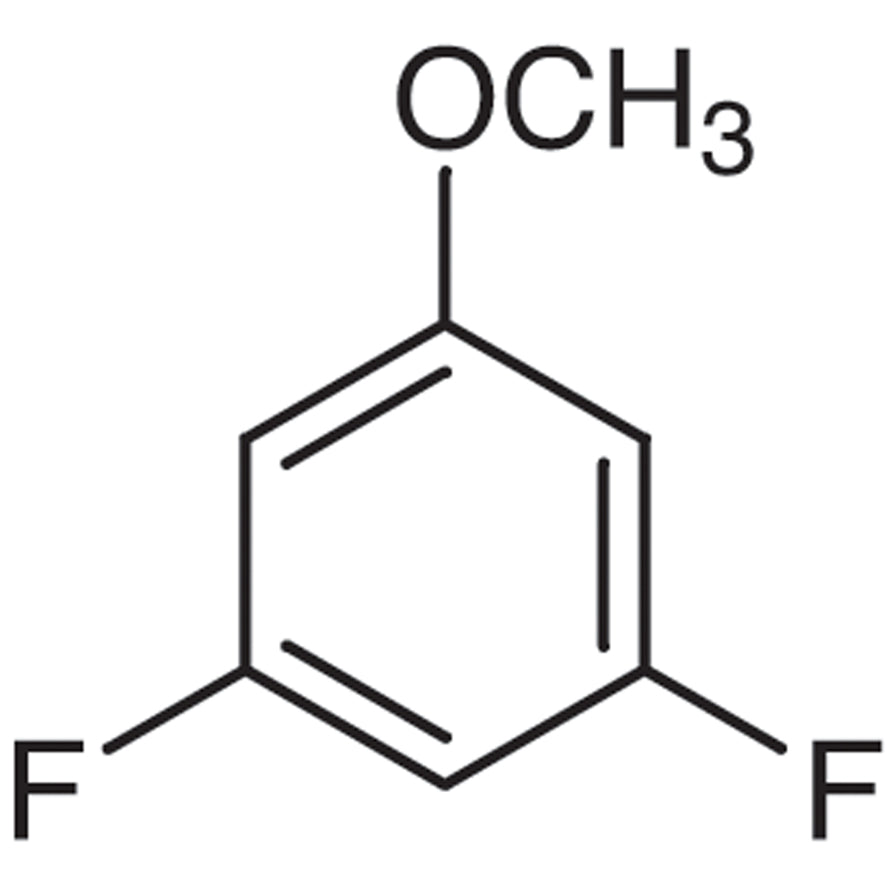
3,5-Difluoroanisole from TCI is an anisole derivative with two fluorine atoms at the meta positions relative to the methoxy group. It is a fluorinated building block that is in steady demand in modern organic synthesis. In the laboratory it is used to introduce a difluoro-methoxy aromatic ring into target molecules, especially in medicinal chemistry, agrochemical, and functional materials research. Fluorine can noticeably change a molecule's physicochemical properties, so starting materials like this one are a key part of many synthesis projects.
The main appeal of 3,5-Difluoroanisole is its symmetrical substitution pattern. The two electron-withdrawing fluorine atoms work against the electron-donating methoxy group, which gives the ring a distinctive reactivity in aromatic substitution and metalation reactions. The methoxy group can also be cleaved to give a phenol for further functionalization. In drug design, fluorine atoms are often used to tune lipophilicity, metabolic stability, and interactions with target proteins. The molecule's symmetry also makes NMR spectra easier to interpret, including fluorine NMR.
In Indonesia, this compound is relevant to synthesis laboratories at universities, research institutions, and research and development units that work on organic and medicinal chemistry. Research groups developing new bioactive compounds, agrochemical candidates, or functional materials can use it as a reliable fluorinated starting material for multistep routes. It also suits teaching and thesis projects that study how fluorine substitution affects reactivity and spectroscopic behavior, because its symmetrical structure gives clean, readable analytical data for students and researchers.
TCI brochures (PDF)
- Fluorination Reagents, Fluorinated Building Blocks 2026-03-18 · p. 30
- Medicinal chemistry synthesis: the compound introduces a difluoro-methoxy aromatic ring into drug candidates, where fluorine helps researchers tune lipophilicity, metabolic stability, and binding to target proteins.
- Agrochemical research: as a fluorinated building block, it gives research teams a dependable route to fluorine-containing aromatic structures when building and optimizing new crop protection candidate molecules.
- Functional materials development: the symmetrical difluoro substitution pattern lets materials chemists place fluorinated aromatic units precisely when designing molecules with altered physicochemical properties for advanced applications.
- Aromatic substitution and metalation studies: fluorine withdraws electrons while the methoxy group donates them, so the ring reacts in a distinctive way that suits studies of regioselectivity in substitution and metalation.
- Phenol-based functionalization and NMR studies: the methoxy group can be cleaved to a phenol for further derivatization, and the molecule's symmetry makes NMR spectra, including fluorine NMR, easier to interpret.
| Brand | TCI (product code D2463) |
|---|---|
| CAS number | 93343-10-3 |
| Molecular formula | — |
| Purity | — |
| Category | Chemistry > Building Blocks > Fluorinated Building Blocks |
| Pack sizes | TCI catalog pack sizes; please confirm when ordering |
| Physical form | refer to the TCI product label and Safety Data Sheet |
| Storage | keep the container tightly closed, following the conditions on the TCI label and SDS |
Store 3,5-Difluoroanisole in its original, tightly closed TCI container in a cool, dry, well-ventilated area, away from heat sources, ignition sources, and incompatible materials such as strong oxidizing agents. Always follow the storage conditions printed on the label and in the Safety Data Sheet. If you need to transfer the material, use clean, dry, chemically compatible glass containers with secure closures and clear labels. Handle the compound in a fume hood while wearing safety glasses, chemical-resistant gloves, and a lab coat. Avoid breathing vapors and avoid contact with skin and eyes. Read the SDS before first use, keep spill materials nearby, and dispose of waste according to institutional and local regulations.
—
Produk Terkait
-
4-Bromo-3,5-difluoroanisole TCI B3392
Regular price Rp 2.697.450,00Regular priceRp 1.835.400,00Sale price Rp 2.697.450,00 -
4-Bromo-2,6-difluoroanisole TCI B3391
Regular price Rp 4.440.450,00Regular priceRp 3.020.850,00Sale price Rp 4.440.450,00 -
4-Bromo-2,5-difluoroanisole TCI B3097
Regular price Rp 1.335.600,00Regular priceRp 908.250,00Sale price Rp 1.335.600,00 -
2,6-Difluoroanisole TCI D3360
Regular price From Rp 872.550,00Regular priceRp 593.250,00Sale price From Rp 872.550,00 -
3,4-Difluoroanisole TCI D2856
Regular price From Rp 655.200,00Regular priceRp 445.200,00Sale price From Rp 655.200,00 -
2,4-Difluoroanisole TCI D1849
Regular price From Rp 1.391.250,00Regular priceRp 946.050,00Sale price From Rp 1.391.250,00 -
5-Bromo-2-chloro-4-fluoroanisole TCI B5354
Regular price From Rp 682.500,00Regular priceRp 464.100,00Sale price From Rp 682.500,00 -
2-Bromo-5-fluoroanisole TCI B3875
Regular price Rp 2.070.600,00Regular priceRp 1.409.100,00Sale price Rp 2.070.600,00


