

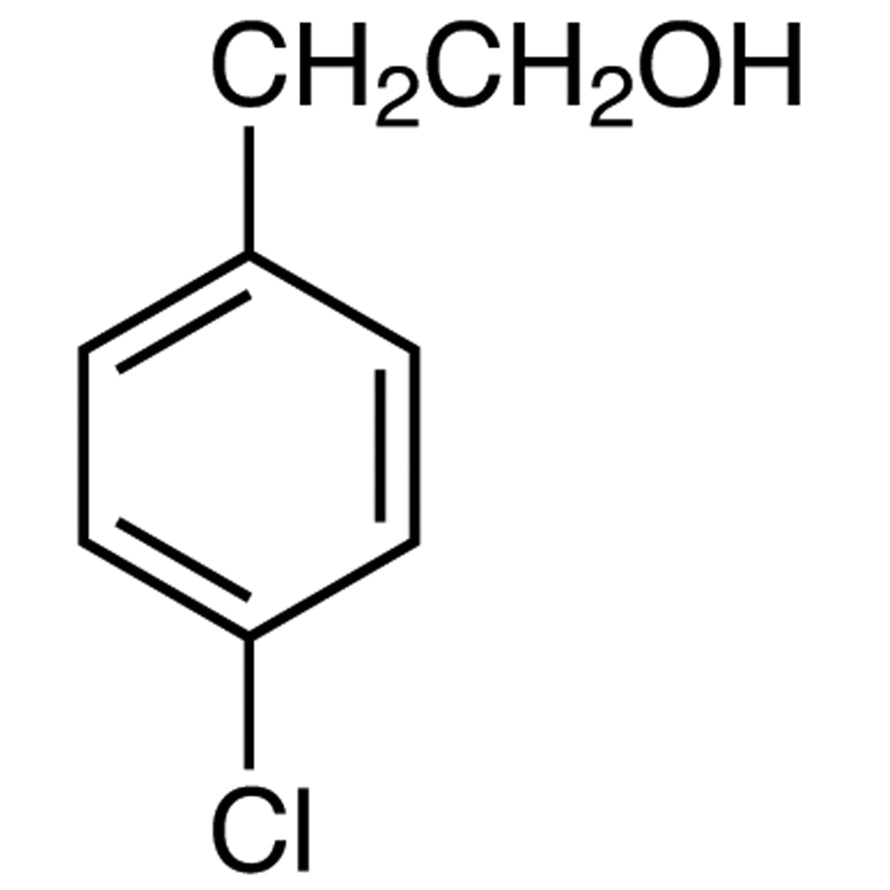
2-(4-Chlorophenyl)ethanol, identified by CAS number 1875-88-3, is an organic intermediate belonging to the class of aromatic alcohols, specifically a phenylethanol derivative carrying a chlorine atom at the para position of the benzene ring. In laboratory practice, this compound serves as a synthetic building block, meaning a starting material that is transformed through various chemical reactions into more complex and valuable molecules. It is frequently employed in the synthesis of pharmaceutical compounds, agrochemicals, and other biologically active substances because of its reactive hydroxyl group and its stable aromatic ring. In an organic chemistry laboratory, the compound provides a ready-made 4-chlorophenyl framework that researchers can build upon.
The main advantage of 2-(4-Chlorophenyl)ethanol as a laboratory chemical lies in its maintained purity and consistent quality, which are guaranteed by the manufacturer, so that reaction outcomes remain reproducible from batch to batch. The reactive hydroxyl group enables straightforward derivatization through esterification, etherification, and oxidation reactions, while the stable aromatic ring tolerates a wide range of substitution conditions. This combination of reactivity and stability makes the compound a dependable, versatile intermediate that fits smoothly into standard synthetic workflows. Its well-defined structure and reliable supply support controlled, predictable results, allowing researchers to focus on optimizing reaction parameters rather than troubleshooting raw material variability.
In Indonesian research and development laboratories, this building block is commonly stocked as a routine raw material for organic synthesis projects, from early screening stages to final product optimization. Academic chemistry groups, pharmaceutical R&D units, and agrochemical testing facilities across the country use it when designing efficient and targeted synthetic routes that require a 4-chlorophenyl backbone. Because it is supplied through a local distributor, researchers can obtain the compound conveniently and maintain continuity in their experiments without long lead times, supporting steady progress in drug discovery, fine chemical development, and related studies.
- Pharmaceutical intermediate synthesis: the reactive hydroxyl group and stable 4-chlorophenyl ring make it a reliable starting material for constructing drug-like molecules in medicinal chemistry campaigns.
- Agrochemical research: the compound serves as a versatile precursor for building biologically active molecules, supporting the development of crop protection agents and related formulations in agricultural laboratories.
- Esterification and etherification reactions: the hydroxyl group reacts cleanly to form esters and ethers, making the compound a convenient building block for installing the 4-chlorophenyl group.
- Oxidation studies: the primary alcohol function can be oxidized to the corresponding aldehyde or acid derivatives, giving researchers a controlled route to higher-value intermediates for further elaboration.
- Substitution and coupling experiments: the para-chlorine substituent provides a handle for further functionalization of the aromatic ring, enabling substitution and cross-coupling strategies in advanced organic synthesis.
| Brand | TCI |
|---|---|
| CAS number | 1875-88-3 |
| Molecular formula | — |
| Purity | — |
| Category | Chemistry > Building Blocks > Non-Heterocyclic Building Blocks |
| Pack sizes | standard TCI laboratory pack sizes; physical form as indicated on the TCI product data sheet |
| Physical form | — |
| Storage | keep container tightly sealed in a cool, dry place, protected from direct light |
- Product name: 2-(4-Chlorophenyl)ethanol (TCI catalog code C2233)
Store the product in its original, tightly sealed container in a cool, dry and well-ventilated place, away from direct sunlight and sources of heat or ignition. Keep the container closed when not in use and avoid exposure to moisture, since repeated opening may affect the quality of the reagent over time. Handle the compound in a fume hood or a properly ventilated area, wearing appropriate personal protective equipment such as laboratory gloves, safety goggles and a lab coat. Avoid skin and eye contact, do not inhale vapors or dust, and wash hands thoroughly after handling. Follow standard laboratory chemical hygiene practices and refer to the TCI safety data sheet for detailed hazard information and waste disposal guidance.
—
Produk Terkait
-
9-(3-Bromophenyl)-9H-fluoren-9-ol TCI B5615
Regular price From Rp 1.326.150,00Regular price -
2-Bromo-9-phenyl-9H-fluoren-9-ol TCI B5678
Regular price Rp 1.724.100,00Regular price -
2-Bromo-1-phenylethan-1-ol TCI B6616
Regular price Rp 2.518.950,00Regular price -
(S)-1-(2-Bromophenyl)ethan-1-ol TCI B6795
Regular price From Rp 1.431.150,00Regular price -
(S)-1-(4-Bromophenyl)ethan-1-ol TCI B6839
Regular price From Rp 1.405.950,00Regular price -
(R)-1-(4-Bromophenyl)ethan-1-ol TCI B6878
Regular price From Rp 2.332.050,00Regular price -
4-Chloro-alpha-methylbenzylAlcohol TCI C0198
Regular price Rp 1.431.150,00Regular price -
(E)-CinnamylAlcohol TCI C0362
Regular price From Rp 505.050,00Regular price


