

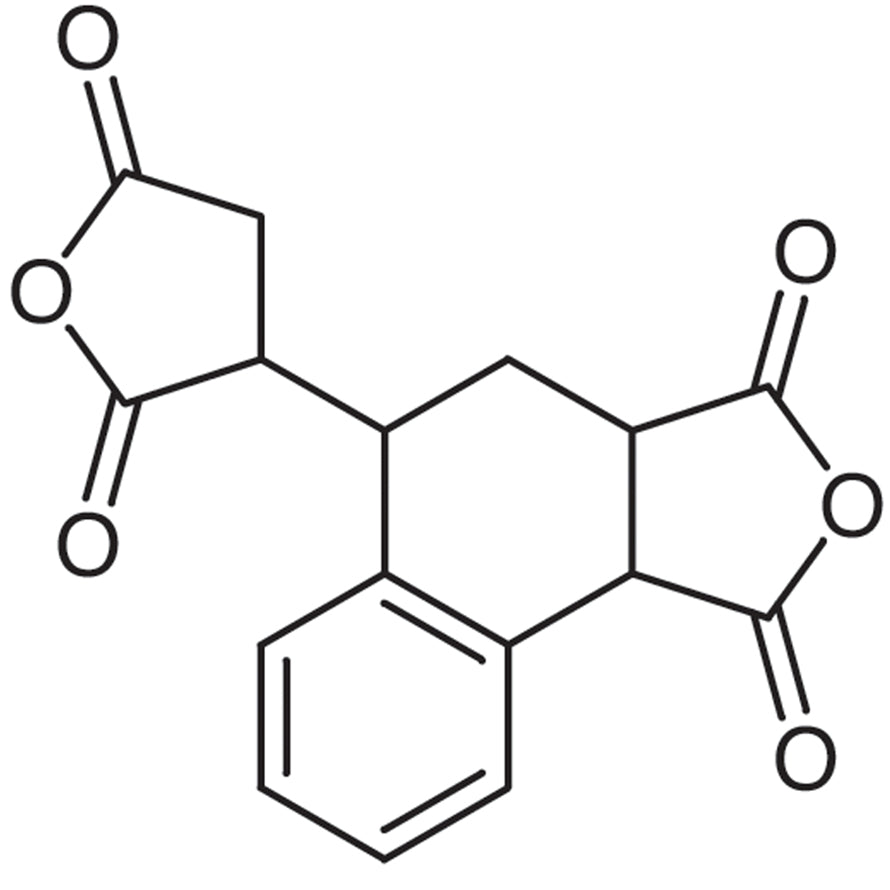
TCI D2192, 4-(2,5-Dioxotetrahydrofuran-3-yl)-1,2,3,4-tetrahydronaphthalene-1,2-dicarboxylic Anhydride (CAS 13912-65-7), is an alicyclic tetracarboxylic dianhydride built on a tetrahydronaphthalene framework carrying two anhydride units on the same molecule. It is classified as a monomer within polymer and macromolecule reagents, because its primary function is to react with diamines to form polyimides, or to serve as a curing agent for epoxy resins. In the laboratory it acts as a defined building block rather than a bulk chemical, giving synthetic and materials groups a reproducible starting point for step-growth polymerisation experiments.
The two available anhydride groups allow controlled growth of the polymer chain, so materials researchers can design the mechanical and thermal properties of the final product by selecting an appropriate partner monomer. The characteristic that makes this monomer a preferred choice is its partly saturated alicyclic structure. Unlike fully aromatic dianhydrides, which yield brownish-yellow polyimides through charge-transfer complex formation, this hydrogenated framework interrupts conjugation, so the resulting polymers tend to be clearer and more readily soluble in common organic solvents. Those properties are highly valued in optical and thin-film applications while also simplifying solution processing, and the rigid ring structure is retained.
In Indonesian laboratories this dianhydride is typically used in university and institutional polymer research groups, materials science departments, and industrial R&D units developing coatings, films, and resin formulations. It suits work where colourless or solution-processable polyimides are required, and where epoxy systems need an anhydride hardener. Because it is supplied as a defined research-grade monomer, it fits small-scale synthesis, formulation trials, and method development rather than production-volume manufacturing.
TCI brochures (PDF)
- Raw Materials for Polyimide Synthesis 2026-05-11 · p. 2
- Monomers 2025-05-28 · p. 37
Related TCI products
- TCI D1901 73003-90-4 5-(2,5-Dioxotetrahydrofuryl)-3-methyl-3-cyclohexene-1,2-dicarboxylic Anhydride
- TCI I0856 38103-06-9 4,4'-(4,4'-Isopropylidenediphenoxy)diphthalic Anhydride
- TCI B4629 36978-41-3 3,4'-Biphthalic Anhydride
- TCI B4262 2420-87-3 4,4'-Biphthalic Anhydride (purified by sublimation)
- TCI B1326 2420-87-3 4,4'-Biphthalic Anhydride
- TCI P2421 17828-53-4 4,4'-(1,4-Phenylenedioxy)bisphthalic Anhydride
- Polyimide synthesis — reacts with a chosen diamine through poly(amic acid) formation and imidisation, giving researchers direct control over the backbone of the resulting polymer.
- Colourless and optically clear film development — the interrupted conjugation of the hydrogenated framework avoids the brownish-yellow colour typical of fully aromatic dianhydride systems.
- Epoxy resin curing studies — functions as an anhydride hardener, allowing formulation groups to compare crosslinking behaviour and network properties across different resin systems.
- Solution-processable polymer preparation — improved solubility in common organic solvents supports spin coating, casting, and other solution-based thin-film fabrication routes in the laboratory.
- Structure–property investigations — the two anhydride groups and rigid alicyclic core let materials scientists tune mechanical and thermal performance by varying the comonomer pairing.
| Brand | TCI |
|---|---|
| CAS number | 13912-65-7 |
| Molecular formula | — |
| Purity | — |
| Category | Materials Science > Polymer/Macromolecule Reagents > Monomers |
| Pack sizes | available in standard TCI research-scale packaging; please confirm the currently offered sizes when ordering |
| Physical form | — |
| Storage | keep tightly closed in a dry place, protected from moisture |
- Chemical name: 4-(2,5-Dioxotetrahydrofuran-3-yl)-1,2,3,4-tetrahydronaphthalene-1,2-dicarboxylic Anhydride
Store the container tightly closed in a cool, dry, well-ventilated area, away from moisture, since anhydride groups are susceptible to hydrolysis on contact with water or humid air. Keep the material in its original tightly sealed container, or transfer it to a clean, dry, chemically compatible container with a secure closure; a desiccator or dry storage cabinet is advisable for opened packs. Weigh and handle the solid in a fume hood, minimising dust generation, and wear safety glasses, gloves, and a laboratory coat. Avoid contact with skin, eyes, and clothing, keep the product away from incompatible materials such as strong bases and oxidising agents, and always consult the manufacturer's safety data sheet before use and disposal.
—
Produk Terkait
-
5-(2,5-Dioxotetrahydrofuryl)-3-methyl-3-cyclohexene-1,2-dicarboxylicAnhydride TCI D1901
Regular price From Rp 1.458.450,00Regular priceRp 1.019.550,00Sale price From Rp 1.458.450,00 -
4,4'-(4,4'-Isopropylidenediphenoxy)diphthalicAnhydride TCI I0856
Regular price From Rp 1.431.150,00Regular priceRp 1.016.400,00Sale price From Rp 1.431.150,00 -
3,4'-BiphthalicAnhydride TCI B4629
Regular price From Rp 2.411.850,00Regular priceRp 1.686.300,00Sale price From Rp 2.411.850,00 -
4,4'-BiphthalicAnhydride(purifiedbysublimation) TCI B4262
Regular price Rp 4.347.000,00Regular priceRp 3.039.750,00Sale price Rp 4.347.000,00 -
4,4'-BiphthalicAnhydride TCI B1326
Regular price From Rp 1.298.850,00Regular priceRp 908.250,00Sale price From Rp 1.298.850,00 -
4,4'-(1,4-Phenylenedioxy)bisphthalicAnhydride TCI P2421
Regular price From Rp 2.994.600,00Regular priceRp 2.109.450,00Sale price From Rp 2.994.600,00 -
4,4'-OxydiphthalicAnhydride(purifiedbysublimation) TCI O0423
Regular price Rp 4.399.500,00Regular priceRp 3.092.250,00Sale price Rp 4.399.500,00 -
3,4'-OxydiphthalicAnhydride TCI O0384
Regular price From Rp 1.008.000,00Regular priceRp 720.300,00Sale price From Rp 1.008.000,00


