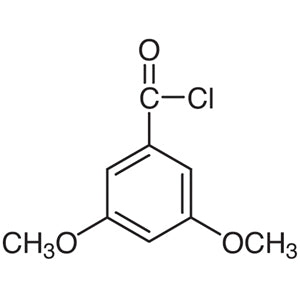
TCI D2609 3,5-Dimethoxybenzoyl Chloride is an aromatic acid chloride carrying two methoxy groups at positions 3 and 5 of the benzene ring. As an acylating reagent, this compound plays an important role in the organic synthesis laboratory, allowing the 3,5-dimethoxybenzoyl fragment to be introduced into target molecules quickly and efficiently. The acid chloride group is one of the most reactive carboxylic acid derivatives, so its reactions with amines, alcohols, or thiols proceed readily and deliver amides, esters, and thioesters without requiring additional, complicated coupling reagents.
The property that makes this reagent a frequent choice is the high reactivity of the acyl chloride group combined with the symmetrical methoxy substitution pattern on the ring. The symmetry of the 3 and 5 positions simplifies the interpretation of spectroscopic data and removes regiochemical concerns, while the methoxy groups are electron donating and therefore influence ring reactivity in subsequent transformations such as Friedel–Crafts acylation or aromatic substitution. The 3,5-dimethoxyaryl motif is also widely encountered in a range of natural products and polyphenol derivatives, which makes this reagent a practical shortcut toward those frameworks.
In Indonesian laboratories, this reagent is typically used in academic and industrial organic synthesis work: university and research-institute groups building substituted aromatic scaffolds, medicinal and natural-product chemistry projects that need the 3,5-dimethoxyaryl motif, and analytical or method-development work requiring a reliable acylating agent. It is handled on the bench or in a fume hood as part of routine amide, ester, and thioester preparation, where its predictable reactivity shortens multi-step synthetic routes.
- Amide synthesis — direct reaction with primary or secondary amines forms the amide bond readily, since the highly reactive acid chloride avoids the need for complicated additional coupling reagents.
- Ester preparation — reaction with alcohols proceeds easily to give 3,5-dimethoxybenzoate esters, making this reagent a straightforward route to benzoate derivatives in synthetic sequences.
- Thioester formation — reaction with thiols delivers thioesters under mild conditions, exploiting the same high reactivity of the acyl chloride group toward nucleophilic sulfur.
- Friedel–Crafts acylation — the electron-donating methoxy groups influence ring reactivity in this transformation, so the reagent suits studies and syntheses involving aromatic acylation chemistry.
- Natural-product and polyphenol scaffold work — because the 3,5-dimethoxyaryl motif appears in many natural products and polyphenol derivatives, this reagent provides a practical shortcut to those frameworks.
| Brand | TCI (Tokyo Chemical Industry) |
|---|---|
| CAS number | 17213-57-9 |
| Molecular formula | — |
| Purity | — |
| Category | Chemistry > Building Blocks > Non-Heterocyclic Building Blocks |
| Pack sizes | available in standard TCI research-scale packaging; please confirm the currently offered pack size when ordering |
| Physical form | — |
| Storage | keep tightly closed in a cool, dry place, protected from moisture |
- Catalogue number: D2609
- Chemical class: aromatic acid chloride (carboxylic acid derivative) with methoxy substitution at positions 3 and 5
Store the container tightly closed in a cool, dry, well-ventilated place, away from moisture, and keep it separated from amines, alcohols, and other nucleophiles as well as from strong bases. Acid chlorides react with water and atmospheric humidity, so the original tightly sealed bottle should be reclosed promptly after each use; transfers are best made in dry glassware, and working under an inert atmosphere helps preserve reagent quality. Handle the material in a fume hood using standard laboratory personal protective equipment — safety glasses, chemically resistant gloves, and a lab coat — and avoid inhaling vapours or contact with skin and eyes. Follow the manufacturer's Safety Data Sheet and your institution's chemical waste procedures for disposal of residues and rinsings.
—
Produk Terkait
-
tert-Butyl12-Hydroxy-4,7,10-trioxadodecanoate TCI B5587
Regular price From Rp 2.279.550,00Regular price -
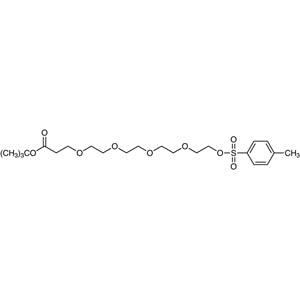
tert-Butyl1-(Tosyloxy)-3,6,9,12-tetraoxapentadecan-15-oate TCI B5902
Regular price From Rp 5.539.800,00Regular price -
1,6-Bis(4-carboxyphenoxy)hexane TCI B6150
Regular price From Rp 2.625.000,00Regular price -
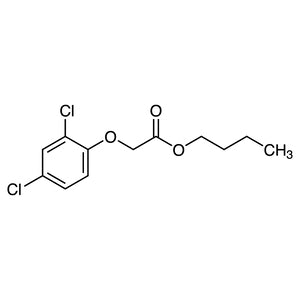
Butyl2-(2,4-Dichlorophenoxy)acetate TCI B6492
Regular price Rp 2.969.400,00Regular price -
tert-Butyl4-[4-(1-Hydroxyethyl)-2-methoxy-5-nitrophenoxy]butanoate TCI B6668
Regular price Rp 8.082.900,00Regular price -
tert-Butyl4-(4-Acetyl-2-methoxy-5-nitrophenoxy)butanoate TCI B6669
Regular price Rp 4.957.050,00Regular price -
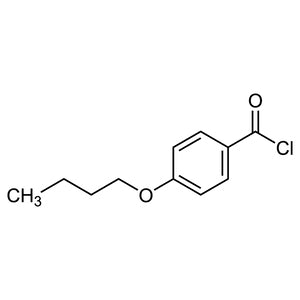
4-ButoxybenzoylChloride TCI B6724
Regular price Rp 3.312.750,00Regular price


![tert-Butyl 4-[4-(1-Hydroxyethyl)-2-methoxy-5-nitrophenoxy]butanoate (CAS 1410809-16-3) - TCI B6668 - AMI Scientific](http://amiscientific.com/cdn/shop/files/TCI2510B6668.jpg?v=1767094102&width=533)